Friday, 31 March 2023

Celebrities don’t want to pay Elon for a blue check

April 1 is the dumbest day on the internet, and this year, it’s not just because brands will try to prank you by selling “hot iced coffee.” Starting on Saturday, Twitter will begin removing blue checks from “legacy verified” users if they don’t sign up for a Twitter Blue subscription. This is part of new owner Elon Musk’s grand plan to make Twitter profitable, but this particular scheme has a glaring issue: if anyone with $8 per month can get a blue check, the symbol won’t be cool anymore (and also disinformation will proliferate, but Musk doesn’t seem super worried about that).

Twitter initially launched its verification system in 2009 to protect celebrities from impersonation. Someone made an account pretending to be former St. Louis Cardinals manager Tony La Russa, but instead of just asking for the account to be taken down, La Russa sued Twitter. And so, the three-year-old company introduced its iconic blue check badge.

Now, we’ve come full circle. Celebrities are a day away from losing their verification badges, and you might think they would lament the loss of this symbol that was literally created to protect them. Unfortunately for Musk, paying for Twitter Blue is cheugy, so some celebrities have spoken out to say that they won’t be paying for a blue check.

At the beginning of the month, the musician Ice Spice weighed in: “1M on here is heavy blue check wya :’)”

What she means is that people will know she is who she says she is, since a scam account couldn’t compete with her 1.2 million followers. She has a point, but we know that people don’t always click on your profile when they’re not sure you’re real — they might just believe that insulin is free now (it is not).

In that chaotic first few days of Twitter’s new verification program — a time when anyone could instantly get a blue check, change their handle, and impersonate others — basketball superstar LeBron James was one of the first celebrities to be impersonated. On an account verified with Twitter Blue, someone pretending to be James posted that he was requesting a trade from the Los Angeles Lakers back to the Cleveland Cavaliers. This was not true, but the news spread anyway.

James still doesn’t want to pay for a blue check, he said on Twitter.

James is the highest-paid NBA player of all time, earning over $40 million per year. That makes it all the more hilarious that he won’t pay.

For some celebrities, it’s not about the $8. It’s about the principle of it. Actor William Shatner tweeted at Musk, “Now you’re telling me that I have to pay for something you gave me for free?”

But also, everyone knows how uncool they will look if they pay to be verified. Michael Thomas, a wide receiver for the NFL’s New Orleans Saints, summed it up best: “Don’t nobody want that raggedy blue check no way anymore 😂

This year’s Super Bowl MVP Patrick Mahomes II, also an extremely well-paid athlete, joked that he can’t pay the $8 because he has kids to take care of.

Philadelphia Eagles cornerback Darius Slay made an excellent point (and also, he is on the best team in the NFL, don’t fact-check me, this is true). If someone wants to impersonate him, then maybe raging Philly fans will accidentally tweet their complaints to the wrong person.

Other stars took the time to tell their followers that even if they lose their check, they are who they say they are… but they still don’t want to pay for verification. Monica Lewinsky posted a set of screenshots showing what happens when you search her name on Twitter. There are already many impersonators, some of whom have a paid blue check.

She added, “in what universe is this fair to people who can suffer consequences for being impersonated? a lie travels half way around the world before truth even gets out the door.”

“Seinfeld” actor Jason Alexander said that if he loses his check, he will leave the platform altogether, since he is worried about impersonation.

Even New Order bassist Peter Hook weighed in. The 67-year-old Brit earnestly reminded his followers that he will never sell anything to fans via DM.

Impersonation is clearly the biggest concern among celebrities (… and journalists), but there are other benefits to Twitter Blue beyond the blue check. According to Musk, only verified users’ tweets will be shown in the “For You” feed. Still, we can’t imagine LeBron is too worried about getting eyes on his tweets. The dude has 52 million followers.

Celebrities don’t want to pay Elon for a blue check by Amanda Silberling originally published on TechCrunch


from TechCrunch

Stability AI CEO has the ambition to IPO in next few years

Emad Mostaque, the CEO and founder of open source platform Stability AI, hinted at plans to go public in the next few years, during the Cerebral Valley AI Conference in San Francisco on Thursday. He also shut down the idea that Stability AI, an OpenAI rival and leader in the generative artificial intelligence space, will ever get acquired.

“I think you can’t just IPO,” Mostaque said during an interview with journalist Eric Newcomer. “You need to have amazing revenue, amazing margins, distribution, and so we’ve been executing…we’re 17 months old.” He also said that the business model of Stability AI’s open source platform will be seen more properly in the next year,” but added that he doesn’t “want to give away my arbitrage opportunities.”

The generative intelligence company landed a spotlight after building Stable Diffusion, an image-generating system, along with Dance Diffusion and the development of open source music. Thus, it’s unsurprising that Mostaque feels strongly about creating open source standards in the world of generated art.

Mostaque was one of the notable 1,100+ signatories who published an open letter this week asking for more regulation in the AI space, but more specifically, for “‘all AI labs to immediately pause for at least 6 months.” His name appeared alongside Elon Musk, Steve Wozniak and Tristan Harris.

“OpenAI should become transparent and probably governed; what is the governance of Open AI? Nobody knows. What is transparent? Completely opaque,” Mostaque said during the panel, defending the petition, which some critics see as destructive or an attempt by some buidlers to slow down competition.

The bullishness around exits, and pause on innovation, comes as Bloomberg reports swirl that Stability AI is seeking funding that would value the business at $4 billion, up from a reported $1 billion post-money valuation that it landed in October when it raised capital from Coatue and Lightspeed Venture partners. Mostaque didn’t comment on fundraising rumors. Earlier this month, Stability AI bought imaging tool Init ML. 

Despite all the activity in the space, Mostaque doesn’t think AI is a bubble, saying that “this is bigger than 5G and self-driving customers.”

“When founders come to me, I say build good products and solve problems…most of the stuff is still surface level,” he said.

If you have a juicy tip or lead about happenings in the venture world, you can reach Natasha Mascarenhas on Twitter @nmasc_ or on Signal at +1 925 271 0912. Anonymity requests will be respected.  

Stability AI CEO has the ambition to IPO in next few years by Natasha Mascarenhas originally published on TechCrunch


from TechCrunch

DNA Exclusive: Is Violence In West Bengal On Ram Navami State-Sponsored?

Violence broke out on Thursday evening between two groups when a Ram Navami procession was taken out at Kazipra in Howrah. 

from Zee News :India National

Maha Govt Announces `Veerbhoomi Parikrama` Between May 21-28 To Honour Savarkar

The ruling Shiv Sena-BJP, which has also attacked former chief minister Uddhav Thackeray for his silence on Gandhi's remarks, had last week said it would organise 'Savarkar Gaurav' yatras across the state.

from Zee News :India National

Thursday, 30 March 2023

Asking the right dumb questions

You’ll have to forgive the truncated newsletter this week. Turns out I brought more back from Chicago than a couple of robot stress balls (the one piece of swag I will gladly accept). I was telling someone ahead of the ProMat trip that I’ve returned to 2019 travel levels this year. One bit I’d forgotten was the frequency and severity of convention colds — “con crud,” as my comics friends used to call it.

I’ve been mostly housebound for the last few days, dealing with this special brand of Chicago-style deep-dish viral infection. The past three years have no doubt hobbled my immune system, but after catching COVID-19 three times, it’s frankly refreshing to have a classic, good old-fashioned head cold. Sometimes you want the band you see live to play the hits, you know? I’m rediscovering the transformative properties of honey in a cup of tea.

The good news for me is that (and, hopefully, you) is I’ve got a trio of interviews from ProMat that I’ve been wanting to share in Actuator. As I said last week, the trip was really insightful. At one of the after-show events, someone asked me how one gets into tech journalism. It’s something I’ve been asked from time to time, and I always have the same answer. There are two paths in. One is as a technologist; the other is as a journalist.

It’s obvious on the face of it. But the point is that people tend to enter the field in one of two distinct ways. Either they love writing or they’re really into tech. I was the former. I moved to New York City to write about music. It’s something I still do, but it’s never fully paid the bills. The good news for me is I sincerely believe it’s easier to learn about technology than it is to learn how to be a good writer.

I suspect the world of robotics startups is similarly bifurcated. You enter as either a robotics expert or someone with a deep knowledge of the field that’s being automated. I often think about the time iRobot CEO Colin Angle told me that, in order to become a successful roboticist, he first had to become a vacuum salesman. He and his fellow co-founders got into the world through the robotics side. And then there’s Locus robotics, which began as a logistics company that started building robots out of necessity.

Both approaches are valid, and I’m not entirely sure one is better than the other, assuming you’re willing to surround yourself with assertive people who possess deep knowledge in areas where you fall short. I don’t know if I entirely buy the old adage that there’s no such thing as a dumb question, but I do believe that dumb questions are necessary, and you need to get comfortable asking them. You also need to find a group of people you’re comfortable asking. Smart people know the right dumb questions to ask.

Covering robotics has been a similar journey for me. I learned as much about supply chain/logistics as the robots that serve them at last week’s event. That’s been an extremely edifying aspect of writing about the space. In robotics, no one really gets to be a pure roboticist anymore.

Q&A with Rick Faulk
Locus Robotics

Image Credits: Locus Robotics

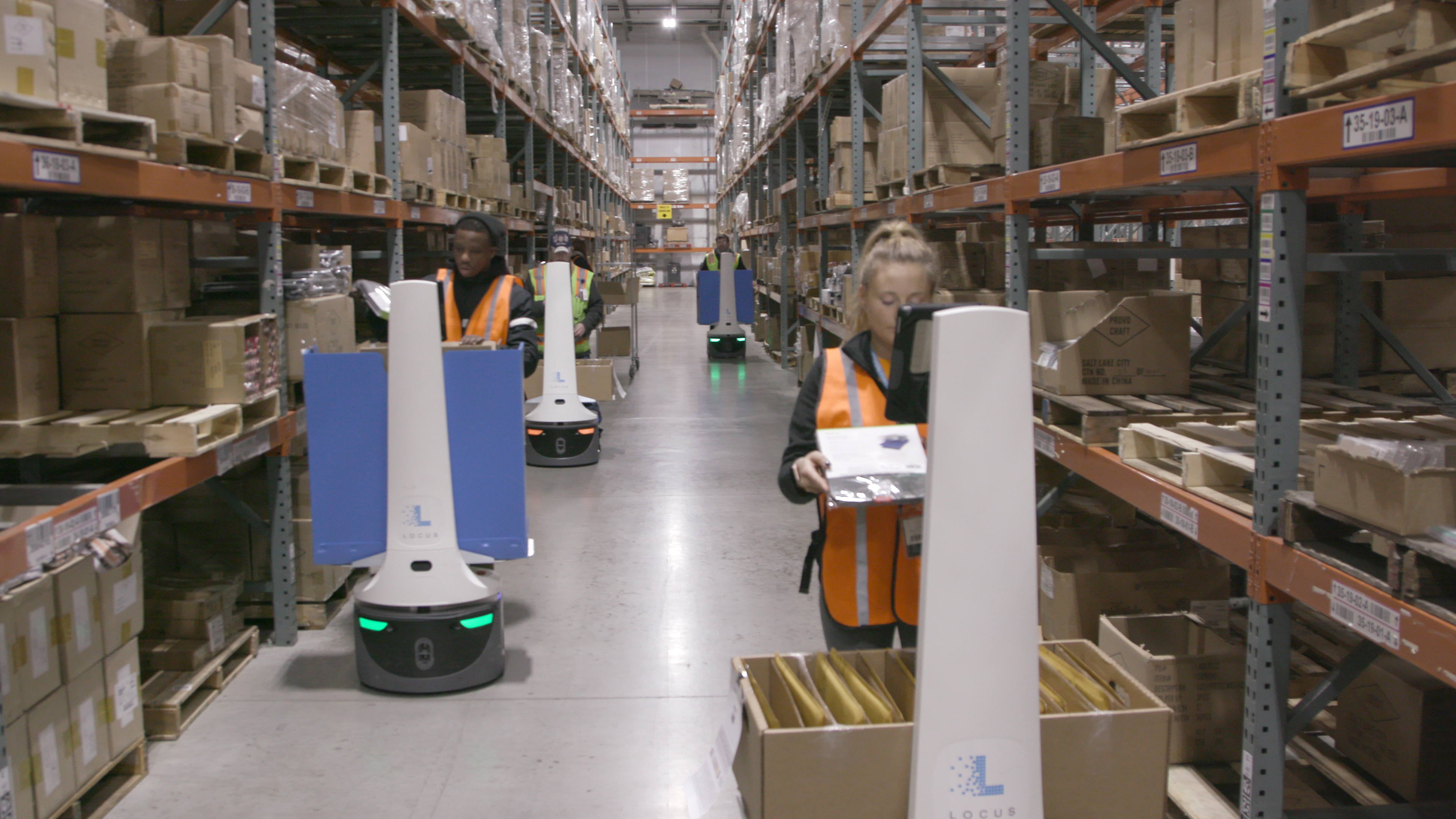
I’m gonna kick things off this week with highlights from a trio of ProMat interviews. First up is Locus Robotics CEO, Rick Faulk. The full interview is here.

TC: You potentially have the foundation to automate the entire process.

RF: We absolutely do that today. It’s not a dream.

Lights out?

It’s not lights out. Lights out might happen 10 years from now, but the ROI is not there to do it today. It may be there down the road. We’ve got advanced product groups working on some things that are looking at how to get more labor out of the equation. Our strategy is to minimize labor over time. We’re doing integrations with Berkshire Grey and others to minimize labor. To get to a dark building is going to be years away.

Have you explored front-of-house — retail or restaurants?

We have a lot of calls about restaurants. Our strategy is to focus. There are 135,000 warehouses out there that have to be automated. Less than 5% are automated today. I was in Japan recently, and my meal was filled by a robot. I look around and say, “Hey, we could do that.” But it’s a different market.

What is the safety protocol? If a robot and I are walking toward each other on the floor, will it stop first?

It will stop or they’ll navigate around. It’s unbelievably smart. If you saw what happened on the back end — it’s dynamically planning paths in real time. Each robot is talking to other robots. This robot will tell this robot over here, “You can’t get through here, so go around.” If there’s an accident, we’ll go around it.

They’re all creating a large, cloud-based map together in real time.

That’s exactly what it is.

When was the company founded?

[In] 2014. We actually spun out of a company called Quiet Logistics. It was a 3PL. We were fully automated with Kiva. Amazon bought Kiva in 2012, and said, “We’re going to take the product off the market.” We looked for another robot and couldn’t find one, so we decided to build one.

The form factors are similar.

Their form factor is basically the bottom. It goes under a shelf and brings the shelf back to the station to do a pick. The great thing about our solution is we can go into a brownfield building. They’re great and they work, but it will also take four times the number of robots to do the same work our robots do.

Amazon keeps coming up in my conversations in the space as a motivator for warehouses to adopt technologies to remain competitive. But there’s an even deeper connection here.

Amazon is actually our best marketing organization. They’re setting the bar for SLAs (service-level agreements). Every single one of these 3PLs walking around here [has] to do same- or next-day delivery, because that’s what’s being demanded by their clients.

Do the systems’ style require in-person deployment?

The interesting thing during COVID is we actually deployed a site over FaceTime.

Someone walked around the warehouse with a phone?

Yeah. It’s not our preferred method. They probably actually did a better job than we did. It was terrific.

As far as efficiency, that could make a lot of sense, moving forward.

Yeah. It does still require humans to go in, do the installation and training — that sort of thing. I think it will be a while before we get away from that. But it’s not hard to do. We take folks off the street, train them and in a month they know how to deploy.

Where are they manufactured?

We manufacture them in Boston, believe it or not. We have contract manufacturers manufacturing some components, like the base and the mast. And then we integrate them together in Boston. We do the final assembly and then do all the shipments.

As you expand sales globally, are there plans to open additional manufacturing sites?

We will eventually. Right now we’re doing some assemblies in Amsterdam. We’re doing all refurbishments for Europe in Amsterdam. […] There’s a big sustainability story, too. Sustainability is really important to big clients like DHL. Ours is an inherently green model. We have over 12,000 robots in the field. You can count the number of robots we’ve scrapped on two hands. Everything gets recycled to the field. A robot will come back after three or four years and we’ll rewrap it. We may have to swap out a camera, a light or something. And then it goes back into service under a RaaS model.

What happened in the cases where they had to be scrapped?

They got hit by forklifts and they were unrepairable. I mean crushed.

Any additional fundraising on the horizon?

We’ve raised about $430 million, went through our Series F. Next leg in our financing will be an IPO. Probably. We have the numbers to do it now. The market conditions are not right to do it, for all the reasons you know.

Do you have a rough timeline?

It will be next year, but the markets have got to recover. We don’t control that.

Q&A with Jerome Dubois
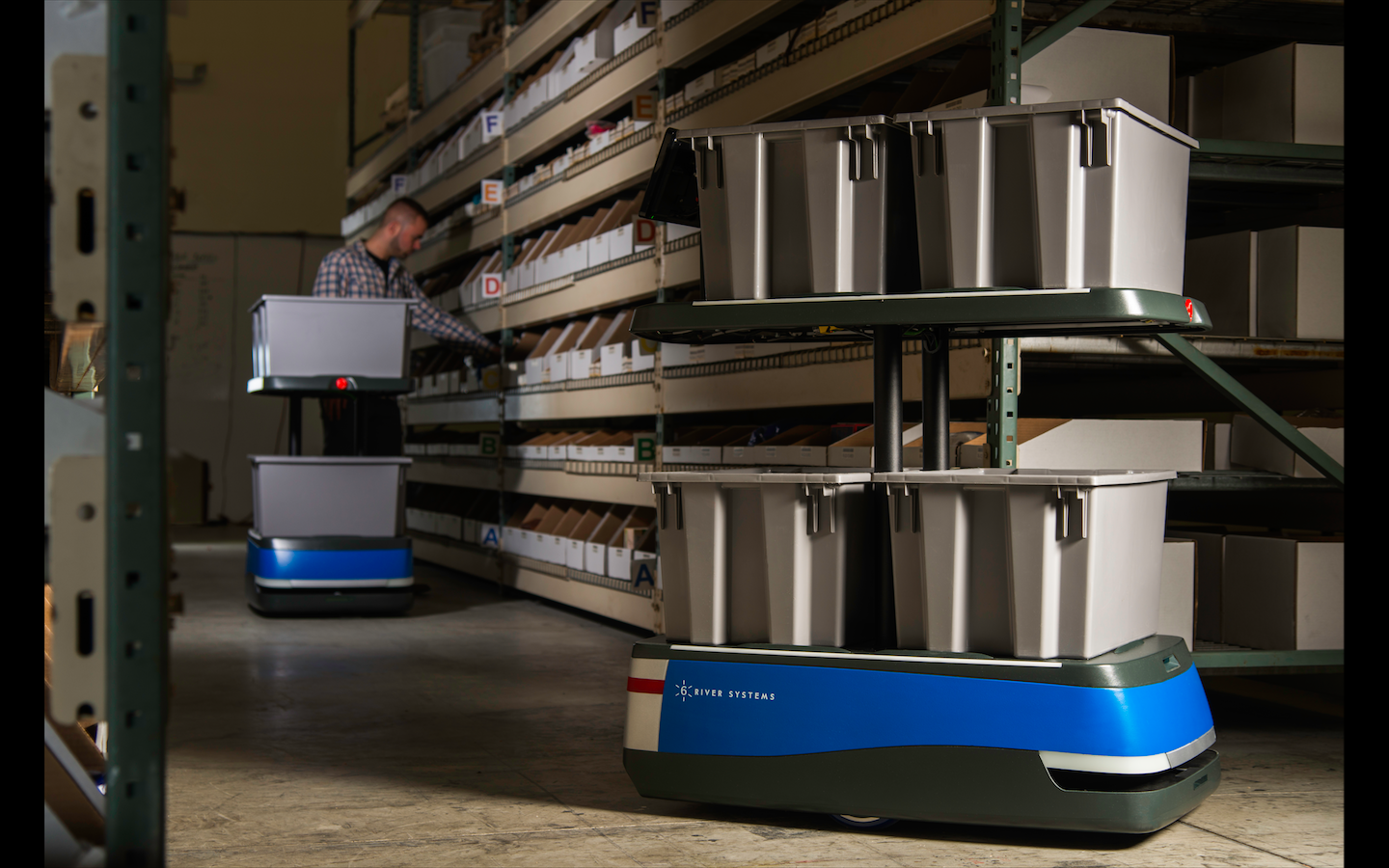
Image Credits: 6 River Systems

Next up, fittingly, is Jerome Dubois, the co-founder of Locus’ chief competitor, 6 River Systems (now a part of Shopify). Full interview here.

TC: Why was [the Shopify acquisition] the right move? Had you considered IPO’ing or moving in a different direction?

JD: In 2019, when we were raising money, we were doing well. But Shopify presents itself and says, “Hey, we’re interested in investing in the space. We want to build out a logistics network. We need technology like yours to make it happen. We’ve got the right team; you know about the space. Let’s see if this works out.”

What we’ve been able to do is leverage a tremendous amount of investment from Shopify to grow the company. We were about 120 employees at 30 sites. We’re at 420 employees now and over 110 sites globally.

Amazon buys Kiva and cuts off third-party access to their robots. That must have been a discussion you had with Shopify.

Up front. “If that’s what the plan is, we’re not interested.” We had a strong positive trajectory; we had strong investors. Everyone was really bullish on it. That’s not what it’s been. It’s been the opposite. We’ve been run independently from Shopify. We continue to invest and grow the business.

From a business perspective, I understand Amazon’s decision to cut off access and give itself a leg up. What’s in it for Shopify if anyone can still deploy your robots?

Shopify’s mantra is very different from Amazon. I’m responsible for Shopify’s logistics. Shopify is the brand behind the brand, so they have a relationship with merchants and the customers. They want to own a relationship with the merchant. It’s about building the right tools and making it easier for the merchant to succeed. Supply chain is a huge issue for lots of merchants. To sell the first thing, they have to fulfill the first thing, so Shopify is making it easier for them to print off a shipping label.

Now, if you’ve got to do 100 shipping letters a day, you’re not going to do that by yourself. You want us to fulfill it for you, and Shopify built out a fulfillment network using a lot of third parties, and our technology is the backbone of the warehouse.

Watching you — Locus or Fetch — you’re more or less maintaining a form factor. Obviously, Amazon is diversifying. For many of these customers, I imagine the ideal robot is something that’s not only mobile and autonomous, but also actually does the picking itself. Is this something you’re exploring?

Most of the AMR (autonomous mobile robot) scene has gotten to a point where the hardware is commoditized. The robots are generally pretty reliable. Some are maybe higher quality than others, but what matters the most is the workflows that are being enacted by these robots. The big thing that’s differentiating Locus and us is, we actually come in with predefined workflows that do a specific kind of work. It’s not just a generic robot that comes in and does stuff. So you can integrate it into your workflow very quickly, because it knows you want to do a batch pick and sortation. It knows that you want to do discreet order picking. Those are all workflows that have been predefined and prefilled in the solution.

With respect to the solving of the grabbing and picking, I’ve been on the record for a long time saying it’s a really hard problem. I’m not sure picking in e-comm or out of the bin is the right place for that solution. If you think about the infrastructure that’s required to solve going into an aisle and grabbing a pink shirt versus a blue shirt in a dark aisle using robots, it doesn’t work very well, currently. That’s why goods-to-person makes more sense in that environment. If you try to use arms, a Kiva-like solution or a shuttle-type solution, where the inventory is being brought to a station and the lighting is there, then I think arms are going to be effective there.

Are these the kinds of problems you invest R&D in?

Not the picking side. In the world of total addressable market — the industry as a whole, between Locus, us, Fetch and others — is at maybe 5% penetration. I think there’s plenty of opportunity for us to go and implement a lot of our technology in other places. I also think the logical expansion is around the case and pallet operations.

Interoperability is an interesting conversation. No one makes robots for every use case. If you want to get near full autonomous, you’re going to have a lot of different robots.

We are not going to be a fit for 100% of the picks in the building. For the 20% that we’re not doing, you still leverage all the goodness of our management consoles, our training and that kind of stuff, and you can extend out with [the mobile fulfillment application]. And it’s not just picking. It’s receiving, it’s put away and whatever else. It’s the first step for us, in terms of proving wall-to-wall capabilities.

What does interoperability look like beyond that?

We do system interoperability today. We interface with automation systems all the time out in the field. That’s an important part of interoperability. We’re passing important messages on how big a box we need to build and in what sequence it needs to be built.

When you’re independent, you’re focused on getting to portability. Does that pressure change when you’re acquired by a Shopify?

I think the difference with Shopify is, it allows us to think more long-term in terms of doing the right thing without having the pressure of investors. That was one of the benefits. We are delivering lots of longer-term software bets.

Q&A with Peter Chen
Covariant

Image Credits: Covariant

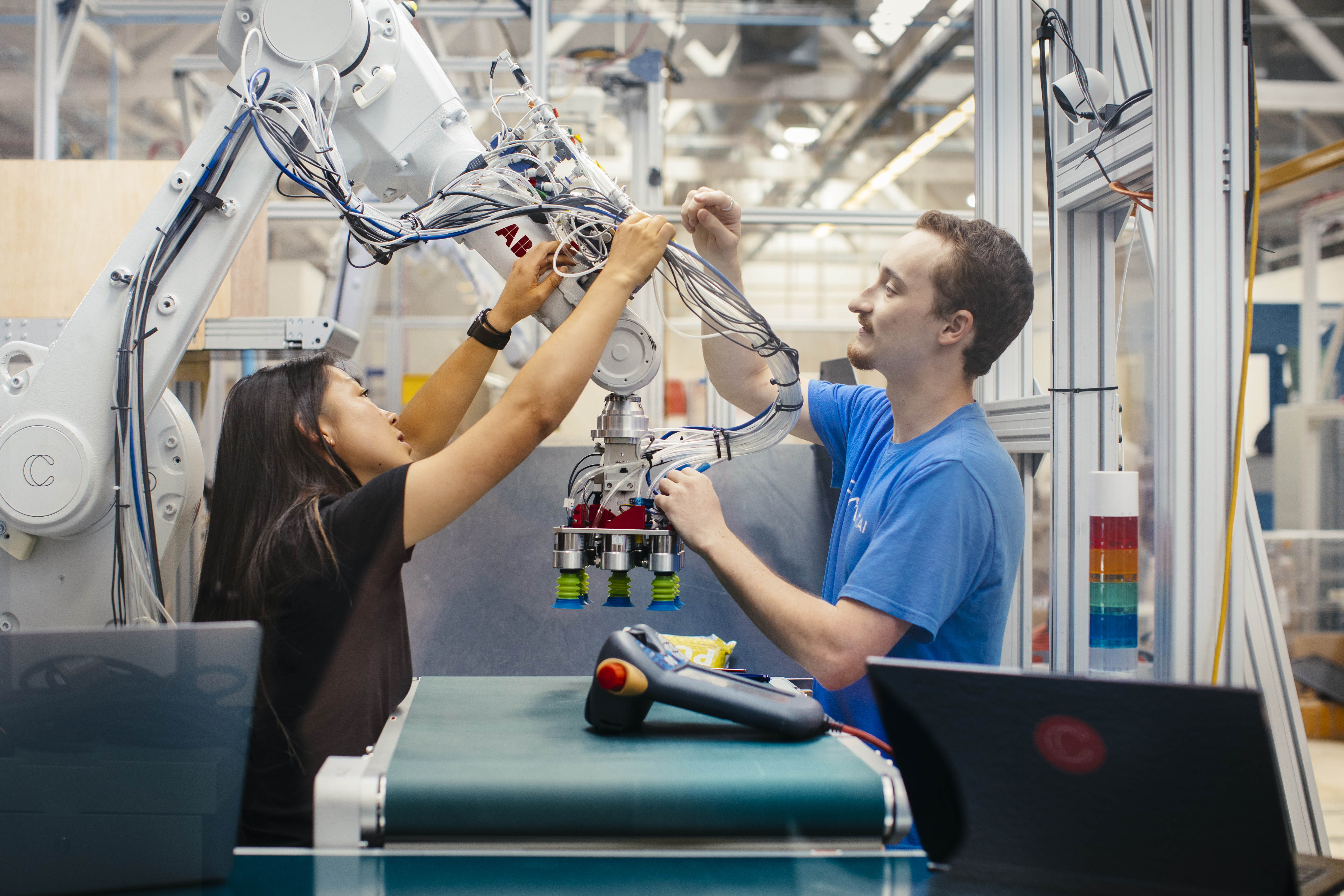
Lastly, since I’ve chatted with co-founder Pieter Abbeel a number of times over the years, it felt right to have a formal conversation with Covariant CEO Peter Chen. Full interview here.

TC: A lot of researchers are taking a lot of different approaches to learning. What’s different about yours?

PC: A lot of the founding team was from OpenAI — like three of the four co-founders. If you look at what OpenAI has done in the last three to four years to the language space, it’s basically taking a foundation model approach to language. Before the recent ChatGPT, there were a lot of natural language processing AIs out there. Search, translate, sentiment detection, spam detection — there were loads of natural language AIs out there. The approach before GPT is, for each use case, you train a specific AI to it, using a smaller subset of data. Look at the results now, and GPT basically abolishes the field of translation, and it’s not even trained to translation. The foundation model approach is basically, instead of using small amounts of data that’s specific to one situation or train a model that’s specific to one circumstance, let’s train a large foundation-generalized model on a lot more data, so the AI is more generalized.

You’re focused on picking and placing, but are you also laying the foundation for future applications?

Definitely. The grasping capability or pick and place capability is definitely the first general capability that we’re giving the robots. But if you look behind the scenes, there’s a lot of 3D understanding or object understanding. There are a lot of cognitive primitives that are generalizable to future robotic applications. That being said, grasping or picking is such a vast space we can work on this for a while.

You go after picking and placing first because there’s a clear need for it.

There’s clear need, and there’s also a clear lack of technology for it. The interesting thing is, if you came by this show 10 years ago, you would have been able to find picking robots. They just wouldn’t work. The industry has struggled with this for a very long time. People said this couldn’t work without AI, so people tried niche AI and off-the-shelf AI, and they didn’t work.

Your systems are feeding into a central database and every pick is informing machines how to pick in the future.

Yeah. The funny thing is that almost every item we touch passes through a warehouse at some point. It’s almost a central clearing place of everything in the physical world. When you start by building AI for warehouses, it’s a great foundation for AI that goes out of warehouses. Say you take an apple out of the field and bring it to an agricultural plant — it’s seen an apple before. It’s seen strawberries before.

That’s a one-to-one. I pick an apple in a fulfillment center, so I can pick an apple in a field. More abstractly, how can these learnings be applied to other facets of life?

If we want to take a step back from Covariant specifically, and think about where the technology trend is going, we’re seeing an interesting convergence of AI, software and mechatronics. Traditionally, these three fields are somewhat separate from each other. Mechatronics is what you’ll find when you come to this show. It’s about repeatable movement. If you talk to the salespeople, they tell you about reliability, how this machine can do the same thing over and over again.

The really amazing evolution we have seen from Silicon Valley in the last 15 to 20 years is in software. People have cracked the code on how to build really complex and highly intelligent looking software. All of these apps we’re using [are] really people harnessing the capabilities of software. Now we are at the front seat of AI, with all of the amazing advances. When you ask me what’s beyond warehouses, where I see this really going is the convergence of these three trends to build highly autonomous physical machines in the world. You need the convergence of all of the technologies.

You mentioned ChatGPT coming in and blindsiding people making translation software. That’s something that happens in technology. Are you afraid of a GPT coming in and effectively blindsiding the work that Covariant is doing?

That’s a good question for a lot of people, but I think we had an unfair advantage in that we started with pretty much the same belief that OpenAI had with building foundational models. General AI is a better approach than building niche AI. That’s what we have been doing for the last five years. I would say that we are in a very good position, and we are very glad OpenAI demonstrated that this philosophy works really well. We’re very excited to do that in the world of robotics.

News of the week
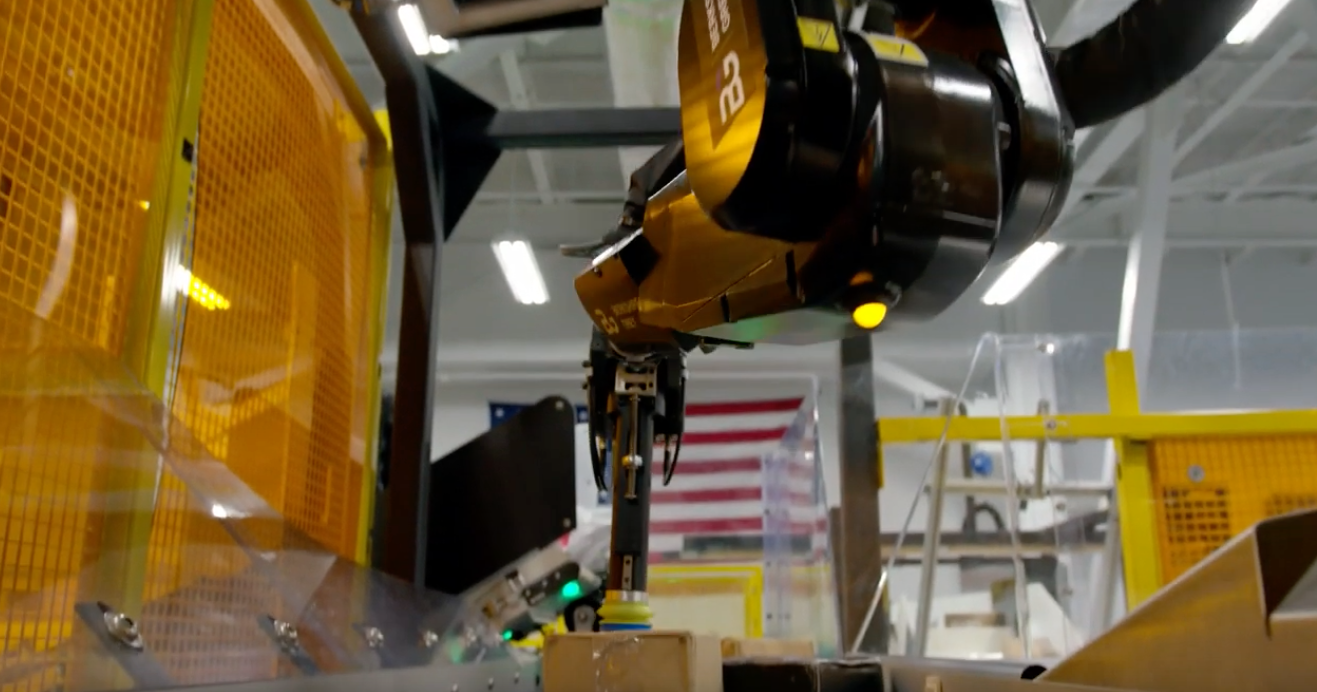
Image Credits: Berkshire Grey

The big news of the week quietly slipped out the day after ProMat drew to a close. Berkshire Grey, which had a strong presence at the event, announced on Friday a merger agreement that finds SoftBank Group acquiring all outstanding capital stock it didn’t already own. The all-cash deal is valued at around $375 million.

The post-SPAC life hasn’t been easy for the company, in spite of a generally booming market for logistics automation. Locus CEO Rick Faulk told me above that the company plans to IPO next year, after the market settles down. The category is still a young one, and there remains an open question around how many big players will be able to support themselves. For example, 6 River Systems and Fetch have both been acquired, by Shopify and Zebra, respectively.

“After a thoughtful review of value creation opportunities available to Berkshire Grey, we are pleased to have reached this agreement with SoftBank, which we believe offers significant value to our stockholders,” CEO Tom Wagner said in a release. “SoftBank is a great partner and this merger will strengthen our ability to serve customers with our disruptive AI robotics technology as they seek to become more efficient in their operations and maintain a competitive edge.”

Unlike the Kiva deal that set much of this category in motion a decade ago, SoftBank maintains that it’s bullish about offering BG’s product to existing and new customers. Says managing partner, Vikas J. Parekh:

As a long-time partner and investor in Berkshire Grey, we have a shared vision for robotics and automation. Berkshire Grey is a pioneer in transformative, AI-enabled robotic technologies that address use cases in retail, eCommerce, grocery, 3PL, and package handling companies. We look forward to partnering with Berkshire Grey to accelerate their growth and deliver ongoing excellence for customers.

Container ships at dock

Image Credits: John Lamb / Getty Images

A healthy Series A this week from Venti Technologies. The Singapore/U.S. firm, whose name translates to “large Starbucks cup,” raised $28.8 million, led by LG Technology Ventures. The startup is building autonomous systems for warehouses, ports and the like.

“If you have a big logistics facility where you run vehicles, the largest cost is human capital: drivers,” co-founder and CEO Heidi Wyle tells TechCrunch. “Our customers are telling us that they expect to save over 50% of their operations costs with self-driving vehicles. Think they will have huge savings.”

Neubility

Image Credits: Neubility / Neubility

This week in fun pivots, Neubility is making the shift from adorable last-mile delivery robots to security bots. This isn’t the company’s first pivot, either. Kate notes that it’s now done so five times since its founding. Fifth time’s the charm, right?

Neubility currently has 50 robots out in the world, a number it plans to raise significantly, with as many as 400 by year’s end. That will be helped along by the $2.6 million recently tacked onto its existing $26 million Series A.

Model-Prime emerged out of stealth this week with a $2.3 million seed round, bringing its total raise to $3.3 million. The funding was led by Eniac Ventures and featured Endeavors and Quiet Capital. The small Pittsburgh-based firm was founded by veterans of the self-driving world, Arun Venkatadri and Jeanine Gritzer, who were seeking a way to create reusable data logs for robotics companies.

The startup says its tech, “handles important tasks like pulling the metadata, automated tagging, and making logs searchable. The vision is to make the robotics industry more like web apps, or mobile apps, where it now seems silly to build your own data solution when you could just use Datadog or Snowflake instead.”

Image Credits: Saildrone

Saildrone, meanwhile, is showcasing Voyager, a 33-foot uncrewed water vehicle. The system sports cameras, radar and an acoustic system designed to map a body of water down to 900 feet. The company has been testing the boat out in the world since last February and is set to begin full-scale production at a rate of a boat a week.
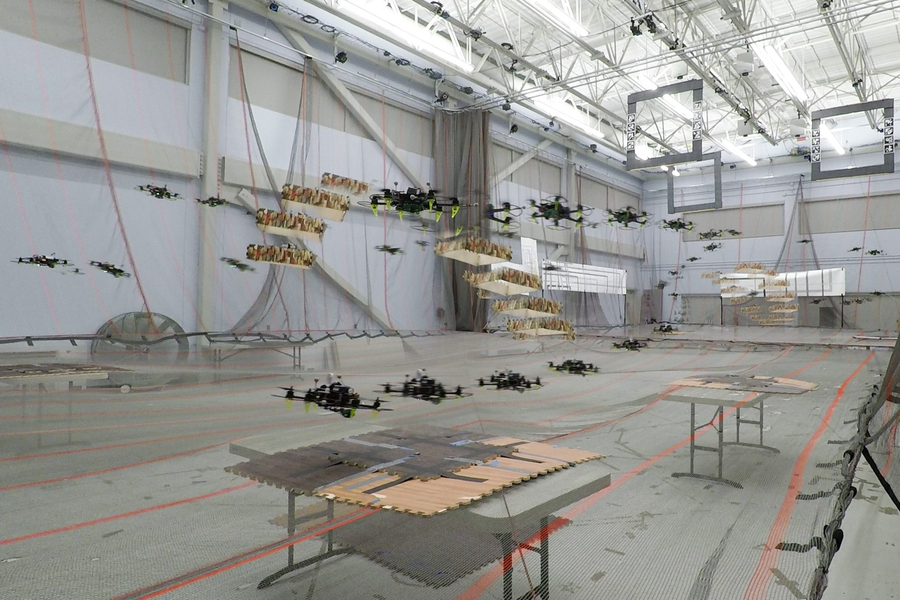
Image Credits: MIT

Finally, some research out of MIT. Robust MADER is a new version of MADER, which the team introduced in 2020 to help drones avoid in-air collisions.

“MADER worked great in simulations, but it hadn’t been tested in hardware. So, we built a bunch of drones and started flying them,” says grad student Kota Kondo. “The drones need to talk to each other to share trajectories, but once you start flying, you realize pretty quickly that there are always communication delays that introduce some failures.”

The new version adds in a delay before setting out on a new trajectory. That added time will allow it to receive and process information from fellow drones and adjust as needed. Kondo adds, “If you want to fly safer, you have to be careful, so it is reasonable that if you don’t want to collide with an obstacle, it will take you more time to get to your destination. If you collide with something, no matter how fast you go, it doesn’t really matter because you won’t reach your destination.”

Fair enough.

Image Credits: Bryce Durbin/TechCrunch


Here you go, way too fast. Don’t slow down, you’re gonna crash. Na-na-na-na-na-na-na-na-na. (Subscribe to Actuator!)


Asking the right dumb questions by Brian Heater originally published on TechCrunch


from TechCrunch

DNA Exclusive: Analysis Of Tragedy At Indore Temple, Which Took 13 Lives

In today's DNA, Zee News' Rohit Ranjan analysed the tragic accident that took place at Indore temple which took 13 lives. 

from Zee News :India National

Wednesday, 29 March 2023

Online used-car marketplace Shift cuts workforce 30% following CarLotz merger

Online used vehicle retailer Shift Technologies cut its workforce by 30% in the first quarter as the company sought to reduce costs and eliminate duplicate positions following its merger with CarLotz, CEO Jeff Clementz said during an earnings call.

The layoffs came as the company saw its revenue plummet in the fourth quarter and its operating losses expand.

Shift closed its merger with CarLotz in December and immediately eliminated duplicate costs and roles, Clementz said during Tuesday’s earnings call. In early February, the company decided to exit CarLotz’s presence on the East Coast and shut down the Downer Grove, Illinois location in order to focus on core West Coast markets. One remaining CarLotz location in Pomona, California remains open. Shift also has three locations in Los Angeles, San Francisco Bay Area and Portland.

“While difficult, we reduced headcount by approximately 30% in the first quarter,” Clementz said on the call. “In addition to corporate roles, the majority of reductions were due to our move to decentralized sales organization, which occurred in February.” He added that the “CarLotz integration and strategic moves to rightsize our SG&A are largely behind us.”

Shift Technologies, which went public in 2020 via a merger with special purpose acquisition company, reported it generated $65.6 million in revenue in the fourth quarter, a 67% drop from the same year-ago period. Shift reported an operating loss of $60.7 million in the fourth quarter, a 14% increase from the same period in 2021.

Shift did report net income of $13 million in the fourth quarter compared to a net loss of $75.8 million in the same quarter in 2021. However, much of that was due to the one-time gain of $76.7 million from its acquisition of CarLotz. Shift had a net loss of $172 million in 2022, up from the $162.2 million loss it reported the year prior. Notably, the company’s gross profit per unit fell 42% between 2021 and 2022 to $1,208 per vehicle. 

The earnings report caused Shift shares to fall. Share fell nearly 28% on Wednesday to $1.21. However, the share price is still hovering above $1, which has allowed the company to regain the Nasdaq exchange listing requirement.

Online used-car marketplace Shift cuts workforce 30% following CarLotz merger by Kirsten Korosec originally published on TechCrunch


from TechCrunch

In A First, Over 4,300 Indian Women To Perform Haj Without A Male Companion This Year

Each year, Saudi Arabia hosts around 25 lakh to 30 lakh pilgrims from across the globe to visit Mecca and India sends the third largest contingent of pilgrims in the world.

from Zee News :India National

Tuesday, 28 March 2023

All the tech and features in the all-electric Kia EV9 SUV

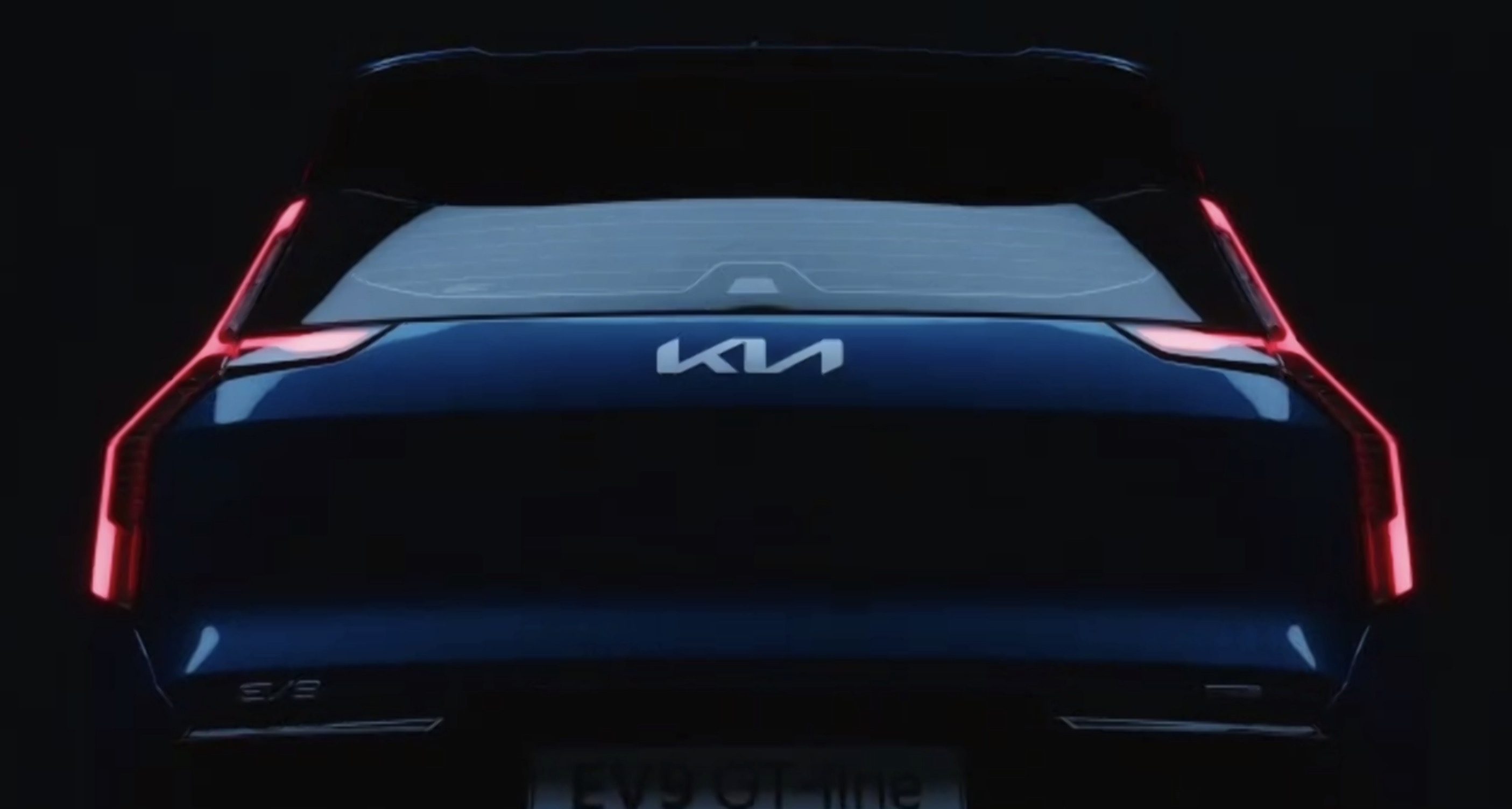
Kia revealed Tuesday the next EV in its portfolio, a three-row flagship SUV called the EV9 that is packed with tech and a key product in the company’s mission to reach annual sales of 1.2 million battery electric vehicles by 2030.

The South Korean automaker didn’t disclose pricing, but it did provide numerous details on the SUV, which will go on sale in selected global markets in the second half of 2023. And more specs may come our way next week when the Kia EV9 makes its North American debut at the New York Auto Show.

While Kia hasn’t listed every market that the EV9 SUV will be sold, it is certainly one made for North America. Kia has already gained U.S. customers with its full-sized Telluride SUV. Now it’s betting that it can land even more customers with a large all-electric SUV that is likely more affordable than other similarly sized EVs on the market today such as the Mercedes EQS SUV and the Rivian R1S.

The stakes are certainly high for the company; Kia CEO Ho Sung Song went as far as to call the Kia EV9 a flagship of its brand.

“In many ways we consider the Kia EV9 to be the new flagship for our brand,” Kia CEO Ho Sung Song said in a livestream that aired Tuesday. “While the Kia EV6 played an important role in repositioning the Kia brand following the launch in 2021, the Kia EV9 moves us further forward.”

Here are the features and tech that stood out in the all-electric Kia EV9 SUV.

The basics

Kia EV9 SUV

Image Credits: Kia/screenshot

The EV9 is a three-row SUV based on the company’s Electric Global Modular Platform (E-GMP) that has a 122-inch wheelbase and an overall length of 197 inches, putting it about in line with other full-size SUVs on the market today including the popular internal combustion engine-powered Kia Telluride. The E-GMP platform is shared with Hyundai and is the underlying foundation of the Hyundai Ioniq 5 compact crossover.

The EV9 will be offered in a standard trim as well as a GT-line model design that includes a digital pattern lighting grille and other exterior features that distinguish it from its base model counterpart. Buyers will be able to pick from different electric powertrain configurations, including a rear wheel drive standard model with a 76.1 kilowatt-hour battery and RWD and all-wheel drive variants with a 99.8-kWh battery.

The RWD long range vehicle has an estimated range of 541 kilometers (or 336 miles) under the WLTP metric. (WLTP is typically more generous than the EPA estimates). It also comes equipped with a 150 kW electric motor that allows it to accelerate from 0 to 100 km per hour (62 miles per hour) in 9.4 seconds, according to the company. The standard RWD version of the EV9 also comes with a more powerful 160 kW electric motor that can accelerate from 0-to-100 km/h in 8.2 seconds.

The EV9 is also equipped with an 800-volt electrical architecture that allows ultra fast charging of about 239 km (or 136 miles) added to the battery in 15 minutes..

Digital services

Kia EV9 SUV EV

Image Credits: Kia/screenshot

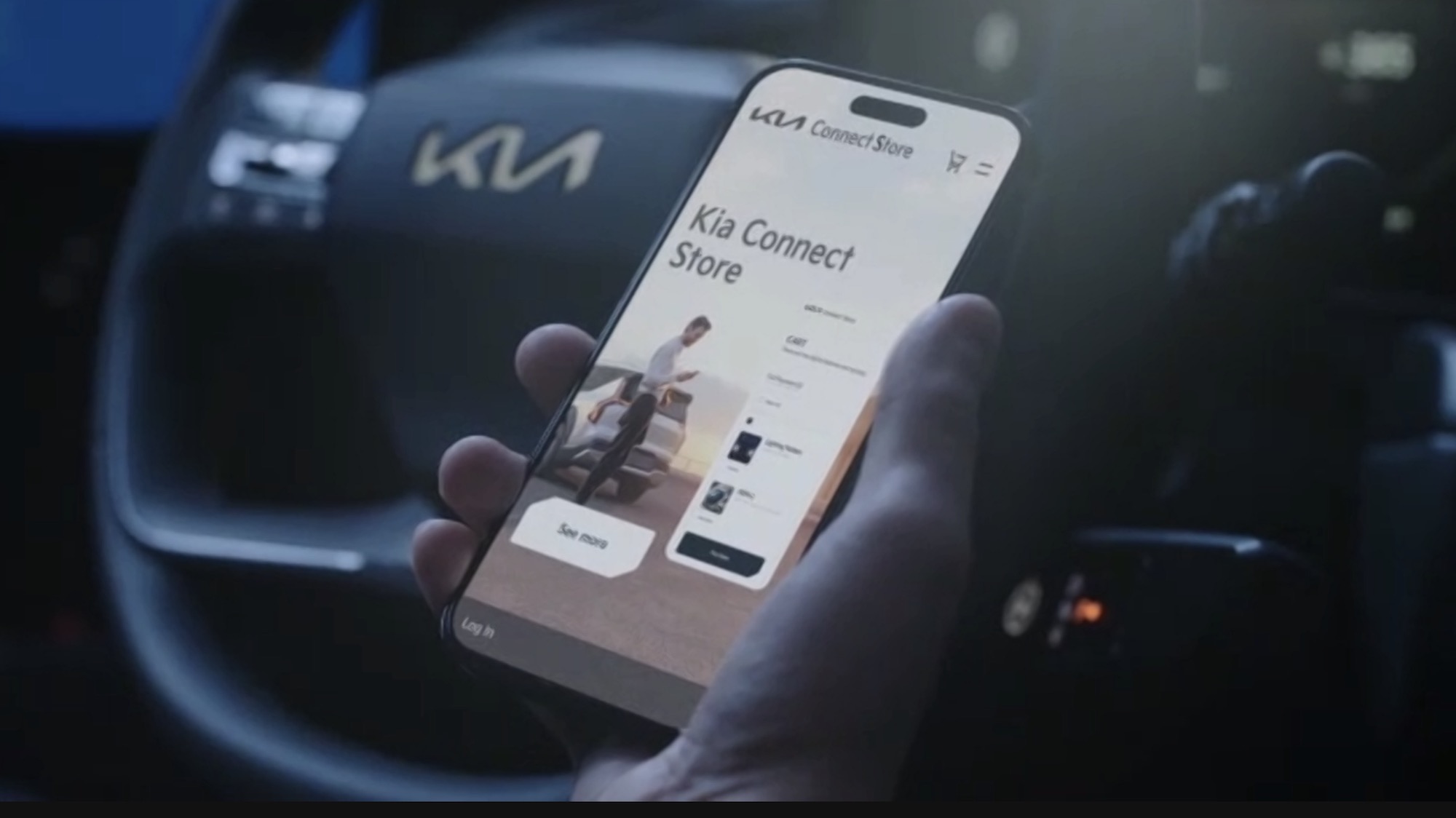
Kia will launch a store its calling the Kia Connect Store, where customers can buy digital features and services on demand. For instance, a Kia EV9 owner might decide after their purchase that they do want that remote smart parking assist feature. Now, they’ll be able to open the Kia app and select that item to upgrade the vehicle via an over-the-air software update.

Owners will also be able to upgrade the performance and lighting features.

Lighting

Kia EV9 SUV front lighting grille

Image Credits: Kia/screenshot

Speaking of lighting, Kia is using the EV9 to launch what it calls a “digital tiger face.”

No, there are not any tigers on, or in, this vehicle. Instead, its a playful name for a new lighting scheme on the front grille. Adjacent to the two vertical headlamps, are two clusters of small cube lamps that creates an animated lighting pattern. Owners will be able to change the design of the digital tiger face.

Interior

Kia EV9 GTL interior

Image Credits: Kia

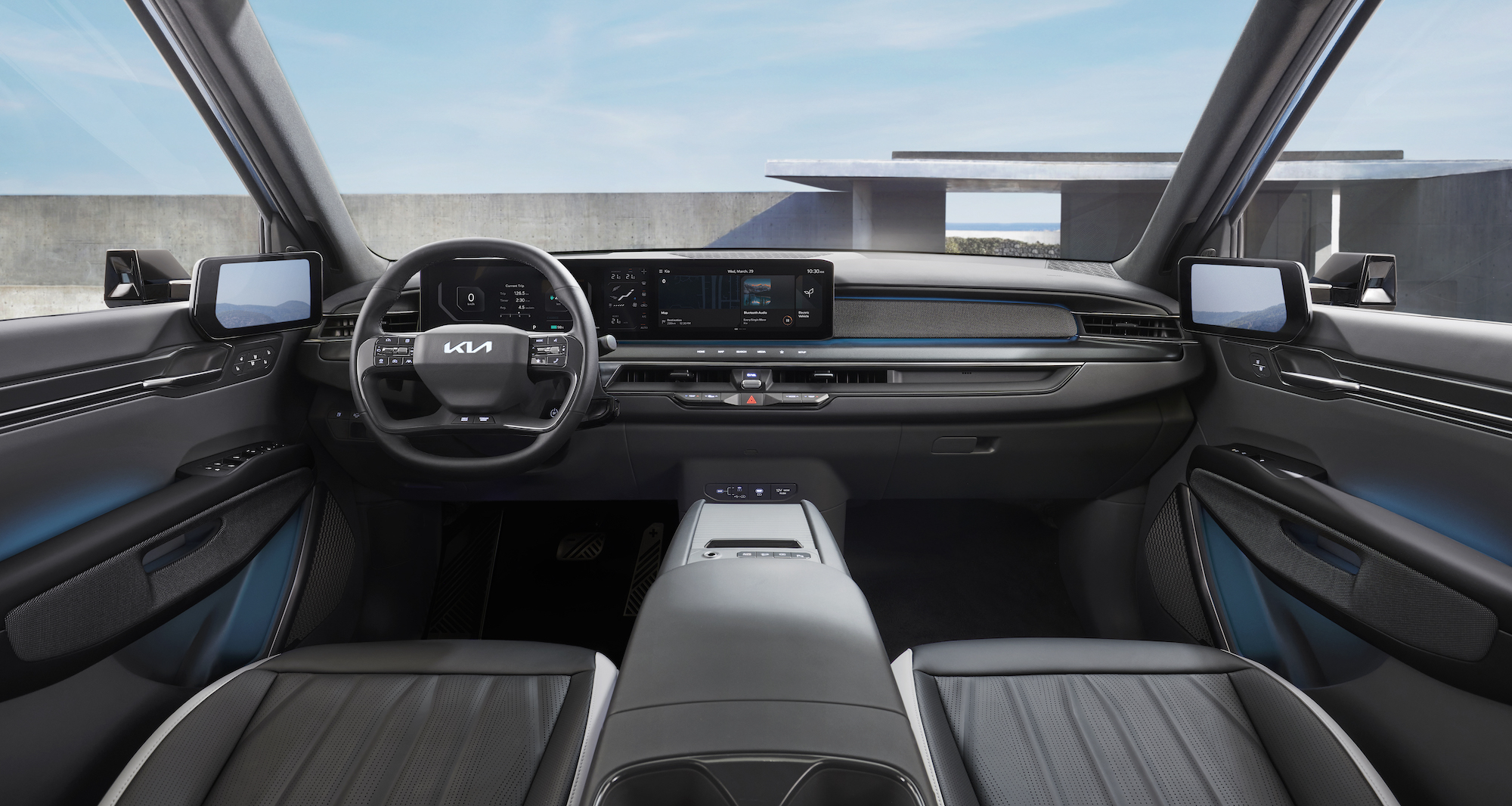
Inside the Kia EV9 is a curved digital screen that extends from the driver seat across the center point.

The Kia EV9 also comes with a few interior options, including a seven-seater or six-seater configuration and a variety of second-row seat options.

One neat feature is the ability for the second-row seats — if they are the special “swivel” ones — to pivot 180 degrees to allow passengers to face each other. This option is meant to be used while the SUV is charging. The vehicle is also equipped with charging points and cup holders, including in the third row.

Kia is also leaning into the sustainability angle for this vehicle. But it appears to be more than mere greenwashing. The company is phasing out the use of leather and increasing bio-based materials such as corn, sugar cane and natural oils in its aim to increase the proportion of recycled plastics it uses to 20% by 2030.

The company is using 70 PET bottles in each EV9 as well as recycled fishing nets for the floor mats.

Power source

The Kia EV9 will also have vehicle-to-load capabilities, which is a fancy way of saying it can act as a mobile power source. The EV9, like its EV6 sibling, will be able to supply up 3.68kW of power.  That’s enough to power to charge a smartphone or laptop or even camping equipment “for the ultimate driving adventure,” the company said.

By the way, that data points tied to the 3.68kW of power pertains specifically to the European market, where the standard voltage is 230V. Data on maximum power varies by market, according to Kia)

ADAS

Kia EV9 GTL

Image Credits: Kia

Kia is targeting an advanced driver assistance system in the Kia EV9 GT-line that allows for unsupervised hands-free driving on highways in select markets. The system, called highway driving pilot, would provide so-called Level 3 automated driving, which would theoretically allow for a driver to be hands off and eyes off in certain conditions.

To allow for that, Kia is adding 15 sensors, including two lidar, radar and cameras for a full 360-degree field of view that lets the system detect and react to the road and other users to prevent potential collisions.

The highway driving pilot (HDP) system will only be available in certain markets, according to the company.

There will be a number of other active safety features in the vehicle, including a rear cross-traffic collision-avoidance assist to prevent collisions with oncoming vehicles when reversing. The ADAS will also keep the vehicle in its lane, maintain speed and distance from vehicles in front of it and a detection system to ensure drivers are engaged.

The EV9 is set to make its inaugural physical debut at the Seoul Mobility Show 2023 later this month. It will then be showcased at this year’s New York International Auto Show in early April.


All the tech and features in the all-electric Kia EV9 SUV by Kirsten Korosec originally published on TechCrunch


from TechCrunch

Are cryptocurrencies commodities or securities? Depends on which US agency you ask

It’s a confusing time to be a crypto company. The markets are volatile and trading activity is shaky right now, but the biggest problem for crypto firms seems to be that there’s no clarity at the moment around the laws they’re supposed to be in alignment with.

Take, for instance, what the U.S. Commodity Futures and Trading Commission (CFTC) considers crypto to be: In its lawsuit against the crypto exchange Binance and its CEO, the CFTC alleged the firm violated trading and derivative rules, and referred to the two largest cryptocurrencies, bitcoin and ether, as commodities.

Per the CFTC’s filing against Binance, the regulator said certain digital assets, including bitcoin, ether, litecoin, and “at least two fiat-backed stablecoins,” tether and the Binance USD, “as well as other virtual currencies as alleged herein, are ‘commodities.’”

The complaint also alleged that Binance and the respective parties charged “solicited and accepted orders, accepted property to margin and operated a facility for the trading of futures, options, swaps and leveraged retail commodity transactions involving digital assets that are commodities.”

This stance is “a significant issue if the same company [and] exchange is sued by multiple agencies for the same tokens,” Yankun Guo, partner at Chicago-based law firm Ice Miller, told TechCrunch+. “This stand is also a stark contrast to the position taken by the SEC and possibly weakens the SEC’s argument that the tokens are securities.”

The CFTC’s viewpoint diverges from another major U.S. government agency, the Securities and Exchange Commission (SEC), which views most crypto assets (aside from Bitcoin) as securities.

Earlier this month, SEC Chair Gary Gensler told Bloomberg that the crypto market, while smaller than capital markets, is “not necessarily compliant” compared to traditional finance.

At the SEC, there’s “one goal,” Gensler said: “For them to come into compliance. […] They can call themselves crypto exchanges or lending or staking-as-a-service or other intermediaries. [Our goal is for them] to come into compliance and ensure that they don’t mislead the public or commingle the funds or take the publics’ funds and do things we don’t allow in our financial markets.”

Gensler compared it to how the SEC doesn’t allow the New York Stock Exchange to play with customers’ funds, make markets, run hedge funds or be in the clearing business. “We separate out those conflicts,” he added.

The CFTC and SEC did not immediately respond to requests for comment.

So are cryptocurrencies commodities or securities? Well, it depends on who you ask. As someone who’s been covering this space, I can empathize with firms offering crypto trading on this, as it feels wishy-washy. Almost like if your mom told you one thing, but your dad told you another. Who are you going to listen to?

Are cryptocurrencies commodities or securities? Depends on which US agency you ask by Jacquelyn Melinek originally published on TechCrunch


from TechCrunch

Google Search is adding new ‘Perspectives’ and ‘About this author’ features to help users verify info

Google is introducing new ways for users to verify information on Search, the company announced on Tuesday. The search giant is launching new features called “Perspectives” and “About this author,” while also expanding some of its current tools, including “About this result.”

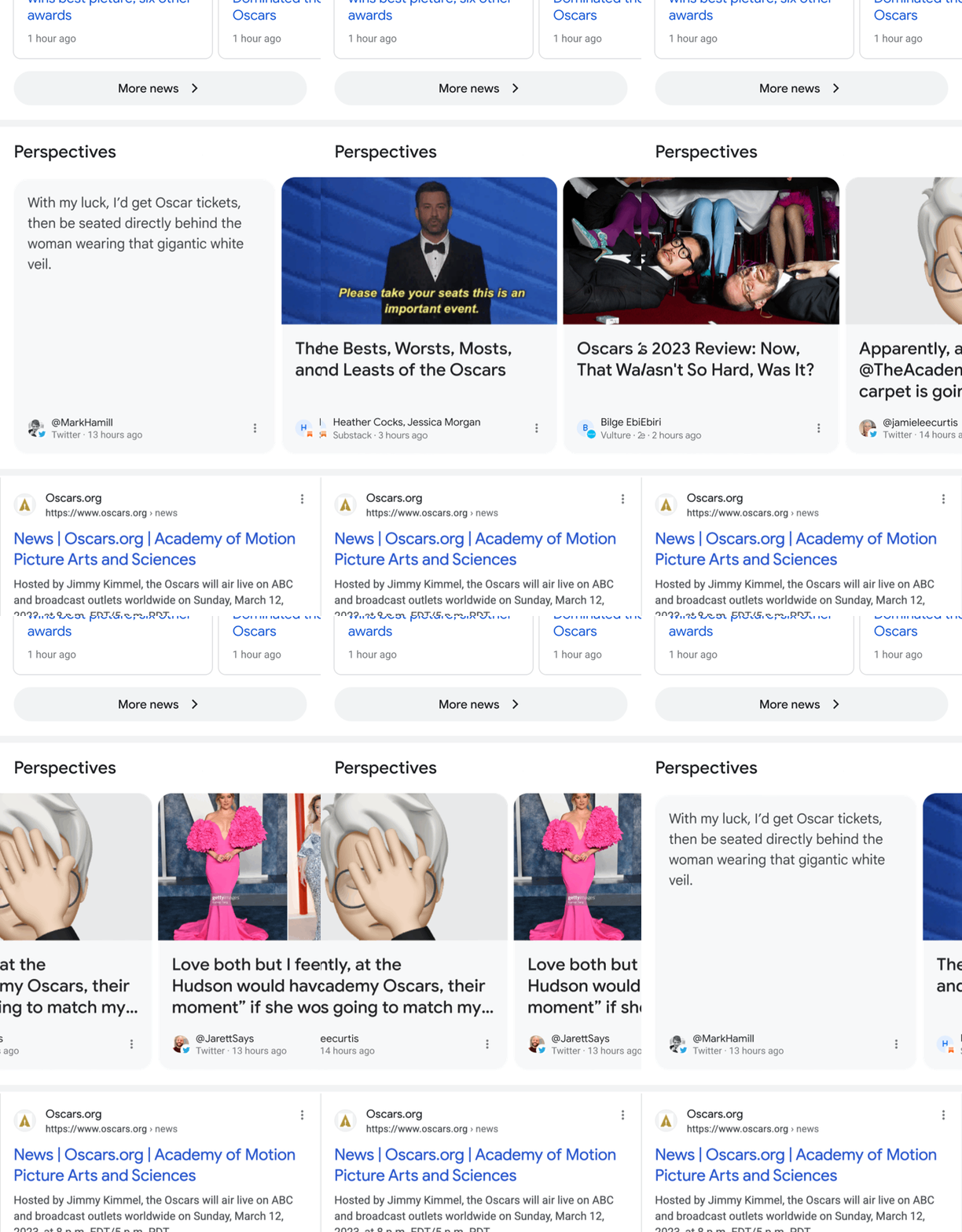
The new Perspectives feature is a carousel that will appear below Top Stories and showcase insights from a range of journalists, experts, and other relevant voices on the topic you’re searching for. The idea behind the feature is to give users a variety of noteworthy voices on a news topic to broaden their understanding of the subject matter. The carousel will launch soon in English in the U.S. and will be available on desktop and mobile, Google says.

Image Credits: Google

Google is also launching a new feature called “About this author” that lets users easily learn more about the authors behind the content they are reading. With this new feature, users will be able to find more information about the background of the authors that Google surfaces on Search. The feature is launching on Search results in English globally and on the Perspectives carousel in the U.S. in English.

The “About this author” feature is an expansion of Google’s current “About this result” feature, which first rolled out in 2021 in English. The company announced that it’s now launching the “About this result” feature globally in all languages where Search is available in the coming days. Now, all users will see three dots next to most results on Google Search. Tapping those three dots gives users details about where the information is coming from and how Google’s systems determined it would be useful for the query.

Image Credits: Google

In addition, Google announced that it’s making it easier for users to access its “About this page” feature starting today.

“When you click on the three dots next to a result, you can learn more information about the source and topic of a particular page,” the company said in a blog post. “Now we’re making this information even easier to access. Say you’re searching for a rainforest protection organization. Starting today, you can type in the URL of the organization in Google Search and information from About this page will populate at the top of Search. You’ll be able to quickly see how the website describes itself, what others on the web have said about a site and any recent coverage of it. From there, you can evaluate whether you want to visit the website and learn more. This feature is now available globally in English.”

Last August, Google rolled out advisories in Search results that are triggered when its systems don’t have high confidence in the overall quality of the results available. The company is now expanding these advisories to languages, including German, French, Italian, Spanish and Japanese in the coming months. The idea behind these advisories is to provide context about the whole set of results on the page. It’s worth noting that you can always see the results for your query, even when the advisory is present.

Google also gave an update on its $13.2 million grant to the International Fact-Checking Network to launch a new Global Fact Check Fund, which was initially announced last year. The company says the fund will open in the coming days and support more than 130 fact-checking organizations from 65 countries covering over 80 languages.

Google Search is adding new ‘Perspectives’ and ‘About this author’ features to help users verify info by Aisha Malik originally published on TechCrunch


from TechCrunch

Ask Sophie: What to do if selected/not selected in H-1B lottery?

Here’s another edition of “Ask Sophie,” the advice column that answers immigration-related questions about working at technology companies.

“Your questions are vital to the spread of knowledge that allows people all over the world to rise above borders and pursue their dreams,” says Sophie Alcorn, a Silicon Valley immigration attorney. “Whether you’re in people ops, a founder or seeking a job in Silicon Valley, I would love to answer your questions in my next column.”

TechCrunch+ members receive access to weekly “Ask Sophie” columns; use promo code ALCORN to purchase a one- or two-year subscription for 50% off.


Dear Sophie,

After three tries, I was finally selected this year in the H-1B lottery! What do we do next?

— Wondering Winner

Dear Sophie,

I’m on STEM OPT. My employer put me in this year’s H-1B lottery for the third time, but I wasn’t selected again! What do I do?

— Lottery Loser

Dear Wondering and Lottery,

USCIS received enough electronic lottery registrations to max out the number of H-1Bs that can be allocated in the new fiscal year.

Thank you both for reaching out to me! Since your questions are on the minds of thousands of others who are in the same situation, I wanted to address them together. My colleague Nadia Zaidi and I offer some guidance on both of these questions in this podcast.

Yesterday, U.S. Citizenship and Immigration Services (USCIS) announced that it received enough electronic lottery registrations to reach the maximum total number of H-1Bs that can be allocated in the new fiscal year. All employers have been notified if their candidates were selected and the attorney and employer can download the PDF confirmation through the USCIS portal.

The selection notices started trickling in over the weekend, including on Saturday and Sunday, well before the end of the month. We don’t yet know how many H-1Bs were submitted in this year’s lottery, but based on the selection percentages, many experts are estimating that there could have even been more than last year’s record-breaking number of 483,927 for the 85,000 available spots, because selection rates for the master’s cap and regular cap both seem to have decreased for many colleagues in the field.

Let me dive into Wondering’s question first in a little more detail and provide some insight on what employers and beneficiaries need to do now for individuals who are selected. Keep in mind — this is only a stepping stone to having an H-1B, and getting selected means that you have the chance to apply, so you need to continue to pay careful attention to this process.

What do I do now that my H-1B registration was selected?

A composite image of immigration law attorney Sophie Alcorn in front of a background with a TechCrunch logo.

Image Credits: Joanna Buniak / Sophie Alcorn (opens in a new window)

First of all, congratulations to you and your employer! This is a significant milestone for both of you. If you were an international student in the U.S., this amazing step might provide you with a little more ease, especially if you have gone through the lottery for multiple successive years.

You and your employer should familiarize yourself with the process and upcoming deadlines. Your employer will have at least 90 days, likely until June 30, 2023, to submit an H-1B application on your behalf to USCIS. This requires that you first get U.S. Department of Labor (DOL) approval of a Labor Condition Agreement (LCA) to include with the H-1B application. For the LCA, your employer agrees to pay you the prevailing wage based on your position and geographical location to ensure you are compensated fairly. Your employer also attests that hiring you will not have a negative impact on the wages and working conditions of American workers.

You’ll need to confirm key details, and I always recommend that all employers work with experienced immigration attorneys to file their H-1Bs — they are high-stakes and getting the details right matters. Some of the factors to pay attention to include where you are in the world and your international travel plans, how long you are maintaining status if you are in the U.S., whether you’re applying for a change of status or consular processing, and if you plan to work from home or have multiple worksites.

The earliest you can begin working on an approved H-1B is Oct. 1, 2023, the beginning of the federal government’s fiscal year. If you are an F-1 student on Optional Practical Training (OPT) or STEM OPT, which is the two-year OPT extension for STEM graduates, and your final year of eligible work authorization is scheduled to end before Oct. 1, you’ll be ok!

Ask Sophie: What to do if selected/not selected in H-1B lottery? by Jenna Routenberg originally published on TechCrunch


from TechCrunch

DNA Exclusive: Analysis Of Gangster-Turned-Politician Atiq Ahmed`s Criminal Records

Atiq Ahmed, a five-time MLA and a one-time MP, was on Tuesday held guilty in the 2006 Umesh Pal kidnapping case and sentenced to life imprisonment.

from Zee News :India National

Monday, 27 March 2023

DNA Exclusive: Analysis Of Gangster-Turned-Politician Atiq Ahmed`s Fear Of Encounter

In today's DNA, Zee News' Rohit Ranjan makes an analysis of Atiq Ahmed's 'fear of being killed' in an encounter by Uttar Pradesh's police.

from Zee News :India National

Epic Games produces documents in antitrust case showing Googlers avoiding its litigation hold

In a new filing in Epic Games’ antitrust case against Google, lawyers for the plaintiffs have submitted a number of exhibits that attempt to demonstrate Google employees’ tendency to switch off chat history on internal discussions. Epic believes this behavior is meant to destroy sensitive communications related to its lawsuit, but it’s not the only one making this claim. The issue with Google’s deletion of chat history was also recently cited by the U.S. Department of Justice in its own antitrust investigation, where it alleged Google had for years “routinely destroyed” an entire category of communication.

That makes the new discovery of communications where Google employees often instructed others to turn off chat all the more interesting.

In one particularly notable instance, Google CEO Sundar Pichai asked for the chat history to be turned off and then tried to unsuccessfully delete the preceding message. It’s not clear, however, from the exhibit shared with the court, that the topic of the conversation would have had bearing on Epic’s antitrust case against the tech giant.

However, in other chats, Google employees were found to be asking others to switch off chat history when discussing more potentially relevant matters, like Revenue Share Agreement (RSA) contracts, Mobile App Distribution Agreements and a topic called “Project Runway,” which was the internal codename for a project that involved changing the Google Play commission rate in response to developer complaints and the threat of regulation.

In another example, Google’s Head of Platforms & Ecosystems Strategy for Android, Margaret Lam, remarks “I talk about RSA related things all day and I don’t have have history on for all my chats :),” after another employee had informed her that any conversation about RSA needed to have chat history turned on “per policy.”

“We cannot delete it. I am also on multiple legal hold,” the employee advised her, to which she responded, “Ok maybe I take you off this convo,” followed by a laughing face emoji. When pressed as to why she was going against the company training on the matter, Lam said “it’s just causing more touchpoints on my end,” then added she would ping others directly — seemingly a choice meant to route around the chats with history, rather than allowing the conversation to be documented.

In other conversations, Lam is spotted again asking employees to turn off history, the exhibits show.

In a separate 2021 conversation, one Google employee asks another if they can discuss Project Runway and was reminded to “communicate with care” because everything said would be subject to discovery if there were any regulatory or legal proceedings in the future.” They were also reminded that group chats can’t have history turned off, “unlike 1:1 chat threads where you can turn off history and they disappear in 24 hours.”

Another couple of conversations features Google VP Tian Lim (who has since changed jobs to join Roblox) asking to turn chat history off. But the same employee had testified on January 12, 2023, that he had made “a good-faith effort to comply with obligations to preserve chat communications that were subject to the legal hold.”

Of course, it’s again not clear from the filings that Lim’s subsequent conversations would have been relevant to Epic’s case, but the point of these exhibits is to raise the question as to why switching off chat was such a common practice.

Epic originally filed suit against Google over the alleged antitrust violations in August 2020, shortly after it forced Google to remove its Fortnite mobile game from the Play Store by intentionally violating Google Play policies around in-app purchases. (The company had done the same thing with Apple, but both parties were unhappy with the outcome of that case, which is now in the hands of an appeals court.) As most of the chats submitted in this new discovery are from the following year, it would have been clear to Google employees by then that a litigation hold on their conversations was necessary.

That said, across the 35 new exhibits featuring various Google employees discussing when or if to turn off chat history, or asking others to do so, it’s not clear that they were actively planning to discuss Epic Games or its antitrust claims, specifically. Instead, it appears the Google employees were having business-related conversations that may or not have ultimately been relevant to the case — something it will be hard at this point to determine, as many chats had been moved to off-the-record locations.

What the records attempt to show is that many at Google had a habit of switching off chat history or shifting conversations to places where they couldn’t be tracked. However, it will be up to a judge to determine whether or not Google should be sanctioned for this behavior. But the judge’s determination could then be referenced in the DoJ case against Google, which is making similar claims about Google’s alleged destruction of evidence.  

Google has been asked for comment.


Epic Games produces documents in antitrust case showing Googlers avoiding its litigation hold by Sarah Perez originally published on TechCrunch


from TechCrunch