The pilgrims will undertake a 12-km journey from the base camp to the holy Amarnath cave shrine in the south Kashmir Himalayas located at an altitude of about 13,000 feet.
from Zee News :India National
Friday, 30 June 2023
Russian President Vladimir Putin PM Narendra Modi Discuss Ukraine War Over Phone
The telephone conversation between the two leaders came days ahead of the virtual summit of the Shanghai Cooperation Organisation (SCO) which is being hosted by India on July 4. It also came a day after Russia's Security Council Secretary Nikolai Patrushev and National Security Advisor Ajit Doval discussed bilateral ties and the latest security developments in Russia.
from Zee News :India National
from Zee News :India National
FTC finally proposes ban on fake reviews
The FTC has proposed a new rule banning numerous forms of fake reviews online, from outright fabricated ones to those that are sketchily repurposed or secretly manipulated. It may not totally rehabilitate the notoriously unreliable online review ecosystem, but it could help make things a bit more bearable.
This rule has been a long time in the making, which is par for the course at any federal regulator. The FTC’s first case of this type was in 2019, against a merchant that was making misleading claims and paying for fake reviews. Before that, it had taken on “influencer marketing” where a person didn’t disclose that they were being paid to promote a product.
Now the agency is ready to take comprehensive action with rules they first previewed last October and have now put in near-final form. The proposed rule is the result of much research and of consultation with businesses, consumers and even advertising trade organizations that predictably advised the FTC not to bother cracking down on this lucrative business.
The Association of National Advertisers, for instance, says the agency “has not demonstrated evidence of prevalence” and worried that new rules would be “burdensome.” But consumer advocacy organizations, major online companies and common sense argue otherwise — public numbers of fake reviews taken down add up to billions by now, and anyone who has tried to buy a product on Amazon knows it’s completely compromised. The regulators also note “the widespread emergence of generative AI, which is likely to make it easier for bad actors to write fake reviews.”
Even so, the FTC has no doubt carefully tailored the rules it is proposing so that legitimate commerce and acceptable review solicitation (like providing a product for an honest review) are not affected.
You can read the full notice of proposed rulemaking here, but as NPRMs tend to be, it’s quite long and mostly about establishing the need and legality of the rule. The agency summarizes what is newly prohibited in a news release, though, which I have further condensed below:
- No selling or soliciting fake reviews. This includes fake profiles, AI generated reviews or anyone who has not actually used a product, and businesses can face penalties if they do this knowingly.
- No review hijacking, like shifting reviews for one product to another — one company just had to pay $600,000 for doing this.
- No buying positive or negative reviews for your own or other products.
- No reviews from company leadership or related persons (family, employees) without disclosure.
- No running a review site for your own products and pretending it’s “independent.”
- No suppressing reviews via legal threats or intimidation, like saying a bad review is defamation.
- No selling fake engagement like followers and video views.
The rule is now open for public comment, and after 60 days the FTC will weigh any new information and adjust the rules accordingly if needed, before putting the finalized rule to a vote. I’ve asked the agency for a bit more information on the rule and will update if I hear back.
FTC finally proposes ban on fake reviews by Devin Coldewey originally published on TechCrunch
from TechCrunch
Thursday, 29 June 2023
Niantic lays off 230 employees cancels NBA and Marvel games
Pokémon GO maker Niantic laid off 230 employees today, just one year after it laid off around 90 employees.
During last year’s layoffs, Niantic canceled four projects, including a Transformers game. Some Niantic games will meet the same fate this time around. After four months in the App Store, Niantic is shutting down NBA All-World; the company will also cancel production on a game based on the Marvel franchise.
“In the wake of the revenue surge we saw during Covid, we grew our headcount and related expenses in order to pursue growth more aggressively,” CEO John Hanke wrote in an email to employees, cross-posted to the company blog.
This has been a common refrain among the hundreds of tech companies that have conducted layoffs over the last year — companies claimed they overhired during the pandemic and now need to right-size their teams. In Niantic’s case, Hanke said that revenue has returned to pre-pandemic levels, and new projects have not delivered as much revenue as they would have hoped.
One such new project is Peridot, a Tamagotchi-like mobile game. Niantic’s first attempt at original IP since Ingress, Peridot launched in May. But according to market intelligence firm Sensor Tower, Peridot has only made $1.4 million in gross in-app purchase revenue thus far.
Peridot is a technologically sophisticated game, complete with a robust breeding system that makes every players’ pets genetically unique. But players were disappointed at launch, since many of the game’s most exciting features are paywalled. The only way to hatch a new Peridot, for example, is to pay $5 for an in-game item. And once you pay to hatch a Peridot, you discover that you also have to pay if you want your new pet to have certain unique fur patterns or styles.
Pokémon GO is Niantic’s cash cow, pulling in more than $1 billion in in-app purchases each year since 2020. But players have also been feeling slighted by Niantic’s in-app purchase system.
At the end of March, Niantic nearly doubled the price of remote raid passes, an extremely popular in-app item. The company’s reasoning is that remote play options were essential during pandemic lockdowns, but they go against Niantic’s vision for the game, which is to get people outside to play together in person. Players don’t feel that way, though. Some even chose to boycott Pokémon GO in protest. While their protest may not have caught Niantic’s attention, its in-app purchase sales likely did.
Between July 2022 and March 2023, Sensor Tower data shows Niantic made an average of $70 million in gross in-app purchase revenue each month. In the three months since the remote raid pass price increase, Niantic has made an average of $53 million per month.
“The top priority is to keep Pokémon GO healthy and growing as a forever game,” Hanke wrote. Some Pokémon GO staff were impacted by these layoffs.
Though games like Peridot have not yet proved financially sustainable, Niantic has an entire business arm separate from its own games. Niantic’s Lightship AR developer kit makes it possible for any developer who knows how to use Unity to make AR games. Developers also have access to Niantic’s impressive visual positioning system (VPS), which lets users interact with local landmarks in their real-world surroundings.
Hanke even mentioned in his note to employees that the company wants to ramp up its focus on building for mixed-reality devices and AR glasses. So, if Niantic can’t seem to make a successful follow-up to Pokémon GO, maybe its developer tools can keep the company on the right track.
Niantic lays off 230 employees, cancels NBA and Marvel games by Amanda Silberling originally published on TechCrunch
from TechCrunch
US Supreme Court Bans Race Ethnicity Admission In University Admissions: 10-Point Explainer
from Zee News :India National
Wednesday, 28 June 2023
ChatGPT prompts: How to optimize for sales marketing writing and more
ChatGPT, OpenAI’s AI-powered chatbot, has taken the world by storm.
Capable of writing emails, essays and more given a few short prompts, ChatGPT has become one of the fastest-growing apps in history. Beyond that, it’s begun to find a place in the enterprise, particularly with the launch of plugins that connect the chatbot to third-party apps, websites and services. Most recently, ChatGPT Plus subscribers now have access to a new feature called Browsing, which allows ChatGPT to search Bing for answers to prompts and questions.
But ChatGPT isn’t always the most cooperative assistant. Getting it to output something specific requires careful fine-tuning of the prompts.
A number of resources and guides for ChatGPT prompt writing have sprung up since the tool’s launch. But not all of them are especially easy to follow — or intuitive. To help folks both new to ChatGPT and looking to learn new tricks, we’ve compiled a list of the best ChatGPT prompts for different types of workflows — specifically writing, marketing, sales, students and tech enthusiasts.
The best ChatGPT prompts for sales
No one likes to write sales emails. No one. And while there’s plenty in the way of tools to tackle the task, many rely on templates with inflexible, repetitive language. Not so with ChatGPT.
When writing sales prompts for ChatGPT, though, the wording really matters. For example, consider the prompt:
Write a concise and informal cold email to a sales lead.
Compare it to:
Write a cold email to a sales lead.
You’ll notice that the results for the first, far more descriptive prompt are better — objectively better — than the results for the second. While not perfect, they’re a much better starting point for something, well, sendable.
You can take the ChatGPT prompt fine-tuning further. Let’s say you want copy for LinkedIn prospecting emails — LinkedIn being a great place to look for sales leads (as many marketers know). Try a prompt like:
John’s Linkedin summary: [insert text here] Write a cold email to Katie, who I just found on LinkedIn.
Katie Paterson over at the Zapier blog gave it a shot. The result was impressively personalized — and a lot better than most of the sales spam I’ve gotten over the years, truth be told.
ChatGPT needn’t be confined to the email realm. Vidyard writes about how the tool can be used to automate cold call scripts or sales pitch processes. Try something like:
Write a sales pitch for a marketing consultant offering solutions to small businesses struggling with low online visibility and poor search engine rankings.
Again, you’ll most likely have to tweak the results. But undeniably, it’s a time saver.
The best ChatGPT prompts for marketing
ChatGPT is an excellent marketing tool — or can be, if you use the right set of prompts. As with writing, it requires knowing in which specific ways to prompt the model so that it understands your intention.
As any online marketer knows, keywords are an important part of the puzzle. Fortunately, ChatGPT’s a competent keyword generator. Use the prompt:
Generate a list of keywords for [insert text here], including long-tail and high-performing keywords.
That’ll provide a decent starting prompt for whatever copy you’re trying to write.
Speaking of brainstorming copy, it’s no secret that ChatGPT can come in handy here, too — whether it’s for an ad or social media post. For example, take a look at this prompt from Tory Wenger over at Madgicx, which really illustrates the degree of specificity ChatGPT will accept:
Craft a compelling ad copy for our Facebook ad campaign, targeting users who have previously visited our website and creating a sense of urgency, as well as adding our offer for exclusive promotion to entice them to take action. The offer is [insert text here].
It’s as easy as that.
ChatGPT can also give marketing and brand advice, believe it or not, answering tough questions with surprising depth and nuance. Wordstream’s Gordon Donnelly asked ChatGPT how to respond to negative comments and publicity:
As a social media marketing manager, how do I respond to people that are writing negative things about my products on Twitter?
ChatGPT’s response? A diplomatically-worded email asking for feedback on a product, using wording like “Your feedback is essential to us” and “we want to make sure we’re exceeding your expectations.” Talk about measured!
The best ChatGPT prompts for writing
When it comes to writing, ChatGPT can be a useful companion indeed — serving as a brainstorming tool or streamlining the more monotonous bits of the writing process. But the chatbot isn’t always the most steerable or predictable unless you use very specific prompt wording.
For example, “priming” ChatGPT can set the tone and context. Try a prompt like:
“I’m a tech blogger and I need your help writing a blog post. The topic is CES. This post should be helpful for people who are interested in new and upcoming smartphones. Do not start writing yet. Do you understand?”
That’ll “ground” the tool, providing ChatGPT context for future questions.
Another nifty tip is using bullet points to guide ChatGPT as it writes. Try using a prompt like:
Write an introduction based on the bullet points below:
- This is an article about a new tech product — a wireless air fryer.
- The product costs $20.
- The product will be available for sales on June 16
Given a moment, ChatGPT will generate something coherent that incorporates details from each of the bullets.
ChatGPT can also be “taught” to mimic style, voice and tone — a useful feature in instances where you’re trying to have it complete parts of an article or essay. Trying entering this prompt:
Analyze the text below for style, voice and, tone. Create a prompt to write a new paragraph in the same style, voice and tone. [insert text here]
It might not always get it right. But when instructed to write this way, ChatGPT is much more likely to produce something usable — and insightful.
The best ChatGPT prompts for students
Not every academic institution is on board with the idea of using ChatGPT as a writing tool — or even writing aid. But others are — and have gone to great lengths to incorporate ChatGPT into their curriculums. This writer supports the latter camp, but would advise students against using ChatGPT where prohibited by an instructor. You’ve been warned.
The sky’s the limit, really, when it comes to education-focused ChatGPT prompts. It really depends on the task at hand and the nature of the work. You could try, for instance, a prompt like this:
Help me write a research paper on the causes of the American Revolution
Or a prompt like:
Can you help me explain the significance of the Magna Carta?
And ChatGPT will do its best to respond in a way that makes sense — if not perfect sense.
A word of warning when asking ChatGPT for facts and figures: It doesn’t always get it right. Sometimes, thanks to a phenomenon known as hallucination, the chatbot invents things — very confidently — out of whole cloth. That’s why it’s wise to fact-check answers from ChatGPT before pasting them into a piece.
Once again, ChatGPT can be asked to do more than simply write an essay or answer basic topical questions. Consider this prompt:
Help me create a study plan for my upcoming exams in history and political science.
You’ll need to be more specific than “history and political science,” lest the advice be overly broad. But ChatGPT — while it won’t do the studying for you — should provide a reasonable starting point.
The best ChatGPT prompts for tech enthusiasts
We’ve established that ChatGPT is a fine writer. But did you know that it’s a coder, too, and a mathematician?
Say you want to create a basic web form to collect contact information. ChatGPT will happily do that for you with a prompt like:
Act as a JavaScript Developer, Write a program that checks the information on a form. Name and email are required, but address and age are not.
The resulting code may contain some mistakes. ChatGPT certainly isn’t perfect. But it should be a reasonable starting point.
In a more sophisticated use case, ChatGPT can write database queries for applications — a task that normally takes a fair amount of time (and, sometimes, trial and error). Try this prompt for MySQL, one of the more popular relational database systems:
Write a MySQL Query
Tables: users and orders
Requirement: It should give user details who placed highest order today
Again, the results won’t be usable out of the box necessarily. But they’ll help you to get where you need to be.
Same goes for math questions. One of my favorite recent prompts from PromptHero, an AI prompt database, is this:
I want you to act as a math teacher. I will provide some mathematical equations or concepts, and it will be your job to explain them in easy-to-understand terms. This could include providing step-by-step instructions for solving a problem, demonstrating various techniques with visuals or suggesting online resources for further study. My first request is “I need help understanding how probability works.”
ChatGPT, you’ll find, can be a surprisingly thoughtful tutor.
ChatGPT prompts: How to optimize for sales, marketing, writing, and more by Kyle Wiggers originally published on TechCrunch
from TechCrunch
Kanpur: Patients Outraged Over CGHS Doctors Alleged Habitual Misconduct Verbal Abuse; No Action Yet
Outraged by the alleged mistreatment, a delegation of patients has taken the matter into their own hands, meeting with local authorities to demand immediate action.
from Zee News :India National
from Zee News :India National
Traditional Tribal Farming in India: Pioneering Climate-Smart Agriculture
In the face of climate change and its adverse effects on agriculture, traditional tribal farming practices in India are gaining recognition for their resilience and sustainability. These time-honored techniques, passed down through generations, offer valuable insights into climate-smart agriculture. By embracing indigenous wisdom and incorporating these practices into modern farming, we can pave the way for a more sustainable and climate-resilient agricultural future.
from Zee News :India National
from Zee News :India National
House GOP discusses use of robot dogs to patrol US borders
The United States Department of Homeland Security caused a stir last February when it revealed that it was exploring deploying robot dogs on the U.S./Mexico border.
“The southern border can be an inhospitable place for man and beast, and that is exactly why a machine may excel there,” the DHS’s Brenda Long said at the time. “This [Science and Technology Directorate]-led initiative focuses on Automated Ground Surveillance Vehicles, or what we call ‘AGSVs.’ Essentially, the AGSV program is all about…robot dogs.”
The story raised the ire of several Democratic politicians, including New York Congresswoman Alexandria Ocasio-Cortez, who tweeted, “It’s shameful how both parties fight tooth + nail to defend their ability to pump endless public money into militarization. From tanks in police depts to corrupt military contracts, funding this violence is bipartisan + non-controversial, yet healthcare + housing isn’t. It’s BS.”
Last week, the subject — and the robotics firm behind it — were once again top of mind on Capitol Hill. A House GOP Cybersecurity, Information Technology and Government Innovation hearing titled “Using Cutting-Edge Technologies to Keep America Safe” gathered together representatives from a number of defense-related technology firms. The list included Ryan Rawding of biometric verification firm Pangiam, Wahid Nawabi of drone defense firm AeroVironment, Benjamin Boudreaux from the RAND Corporation and Gavin Kenneally, the CEO of Ghost, whose robot dogs have been featured in the trials.
Ghost demoed its Vision 60 robot for the panel during Kenneally’s presentation. “Looks like my high school algebra teacher,” one member of the committee inexplicably quipped. Another added, “like an Avengers movie right now.” Congresswoman Marjorie Taylor Greene called the demo, “really incredible, absolutely intriguing.”
Missouri Congressman Eric Burlison noted, “a few house Democrat members reportedly wrote to the US Customs and Border Protection last year expressing concerns about that robotic dogs could pose a lethal threat to migrants and Americans. How legitimate is that concern?”
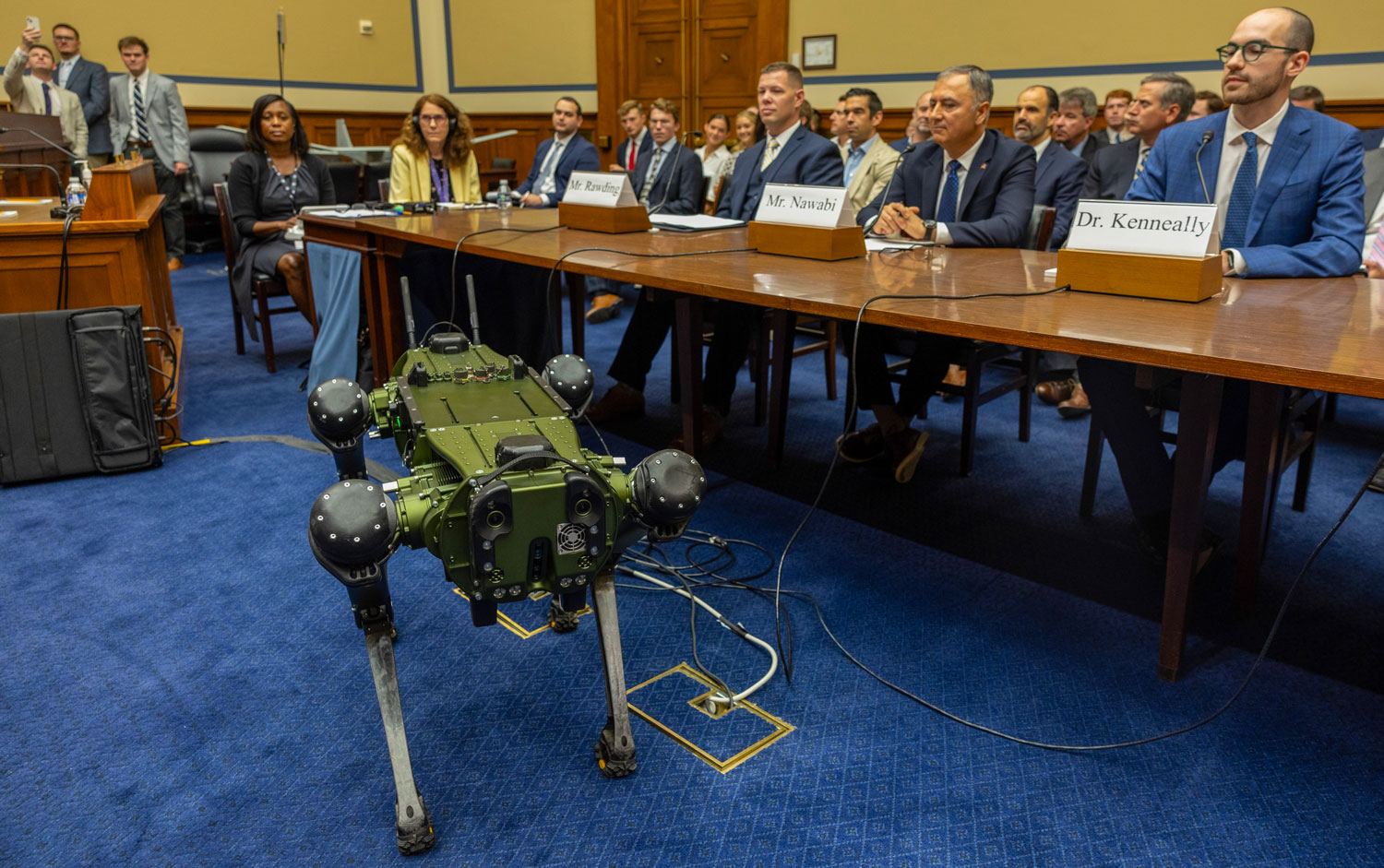
WASHINGTON, DC – JUNE 22: Gavin Kenneally, Chief Executive Officer at Ghost Robotics speaks as Vision 60 UGV walks in during a House hearing at the US Capitol on June 22, 2023 in Washington, DC. The House Committee on Oversight and Accountability Subcommittee on Cybersecurity, Information Technology, and Government Innovation met to discuss the use of technology at the US Border, airports and military bases. (Photo by Tasos Katopodis/Getty Images)
The executive responded, “The use case for the robots at the border is to collect data. You can either look for illegal drug trafficking by adding sensors to detect for that, or you can add infrared or thermal cameras, which let you pick up human or other animals’ thermal signatures. The robot is really a detection system, which will then actually be used to save lives. There’s hundreds of deaths every year from drowning or getting stuck trying to cross the border.”
In October 2021, the Philly-based startup made national headlines when images emerged of one of its robots sporting a remote-controlled sniper rifle designed by a company called SWORD. At the time, then-CEO Jiren Parikh told TechCrunch the system was a “walking tripod” in reference to the company’s apparent hands-off approach to payload — weaponized or otherwise.
The subject of weaponization briefly came up during the hearing.
“[A]s the world progresses into stages that could be going to more wars — especially given the Ukraine and Russian war that’s going on right now — I’d like to ask each of you how we can make sure that we prevent any types of technologies or robotics like this to ever be used as weapons against people,” Greene said. “And I think that’s extremely important. Again, it’s not weaponizing technology we want to see happen ever, and I would like to see countries around the world make agreements to this, especially with emerging incredible inventions. We don’t want to see them turned into something that would kill people.”
The Georgia congresswoman didn’t ask the question directly, however, instead pivoting to one about preventing cybersecurity attacks.

Image Credits: Ghost Robotics
“The robot, the way we’ve built it, it’s effectively a server on legs, so we’re able to use standard best practices to lock down the robot as much as possible, using firewalls,” answered Kenneally. “Because of the sensitive nature of our customers, all of the data that the robot collects is stored locally.”
New York Congressman Nick Langworthy, meanwhile, asked whether the robot could be deployed on the U.S./Canadian border.
“Yes, absolutely,” Kenneally responded. “We also have built these robots very purposefully to go in environments that are incredible harsh and hard for humans to traverse. We’re able to operate the robot down to -40 Celsius or -40 Fahrenheit. It’s also sealed, so it can work in all kinds of different weather conditions.”
House GOP discusses use of robot dogs to patrol US borders by Brian Heater originally published on TechCrunch
from TechCrunch
Unveiling Tapestry Of Indias Tribal Population: State-Wise Insights
India's tribal population finds its home in various states, each characterized by distinct socio-economic and cultural attributes. Let us delve into the state-wise distribution of scheduled tribes, unraveling their vibrant presence across different regions of the nation.
from Zee News :India National
from Zee News :India National
Tuesday, 27 June 2023
Monsoon: Rainfall Predicted Across India IMD Issues Orange Yellow Alert For Several States
Active monsoon conditions are likely to continue over northwest, central and west India during next five days and advance of the Southwest monsoon is expected into some more parts of Rajasthan and remaining parts of Punjab and Haryana
from Zee News :India National
from Zee News :India National
Apple uploads entire first episode of Silo on Twitter ahead of season finale
Apple has uploaded the entire first episode of its sci-fi dystopian TV show “Silo” on Twitter, allowing anyone on the platform to view it for free. The move comes three days before the streaming service is set to air the show’s season finale.
Silo, which was recently renewed for a second season, is about a toxic future where a community lives in an underground silo. The show is based on the science fiction novel “Wool” written by American author Hugh Howey.
The move is a way for Apple to garner excitement for one of its popular shows by letting people watch it for free in the hopes that they get hooked on it and end up signing up for an Apple TV+ subscription. The concept isn’t new, as networks have done the same in the past by uploading pilot episodes on YouTube.
Since Twitter recently started allowing longer video uploads for subscribers, Apple is choosing to leverage the social media network’s new capability by promoting its show ahead of its season finale. Apple could be starting a sort of a trend with this move, as we may start to see other companies following suit.
Apple uploads entire first episode of ‘Silo’ on Twitter ahead of season finale by Aisha Malik originally published on TechCrunch
from TechCrunch
Reka emerges from stealth to build custom AI models for the enterprise
Large language models (LLMs) like OpenAI’s GPT-4 are all the rage these days, owing to their unparalleled ability to analyze and generate text. But for organizations looking to leverage LLMs for specific tasks — say, writing ad copy in a brand’s style — their generalist nature can become a liability.
When the instructions get too precise, even the best LLMs struggle with consistency. Fine-tuning, or narrowing an LLM’s scope, is one solution. But it’s often challenging from a technical standpoint, not to mention costly.
Motivated to find an easier way, a team of researchers from DeepMind, Google, Baidu and Meta founded Reka, which emerged from stealth today with $58 million. DST Global Partners and Radical Ventures led the tranche with participation from strategic partner Snowflake Ventures, alongside a cohort of angel investors that included former GitHub CEO Nat Friedman.
San Francisco-based Reka is the brainchild of Dani Yogatama, Cyprien de Masson, Qi Liu Head and Yi Tay. While working on AI systems including DeepMind’s AlphaCode and Bard, they four co-founders say that they realized it was impractical to expect a large LLM to be deployed for all possible use cases.
“We understand the transformative power of AI and would like to bring the benefits of this technology to the world in a responsible way,” Yogatama told TechCrunch in an email interview. “Reka is a research and product company that develops models to benefit humanity, organizations and enterprises.”
Reka’s first commercial product, Yasa, doesn’t quite meet those lofty ambitions. But it exemplifies the startup’s early approach. Going beyond text, Yasa is a multimodal AI “assistant” trained to understand images, videos and tabular data in addition to words and phrases. It can be used to generate ideas and answer basic questions, Yogatama says, as well as derive insights from a company’s internal data.
In this way, Yasa, which is in closed beta, isn’t dissimilar to models like GPT-4, which can also understand text and images. But the twist is that Yasa can be easily personalized to proprietary data and applications.
“Our technology allows enterprises to benefit from progress in LLMs in a way that satisfies their deployment constraints without requiring a team of in-house expert AI engineers,” Yogatama said.
Yasa is just the start. Next, Reka plans to turn its attention to AI that can accept and generate even more types of data and continuously self-improve, staying up to date without the need for retraining.
To that end, only available to select customers for now, Reka also provides a service to adapt LLMs it developed to custom or proprietary company data sets. Customers can run the “distilled” models on their own infrastructure or via Reka’s API, depending on the application and project constraints.
Reka, it should be noted, isn’t the only startup chasing after models better suited for enterprise use cases. Writer lets customers fine-tune LLMs on their own content and style guides. Contextual AI and LlamaIndex, which recently emerged from stealth, are developing tools to allow companies to add their own data to existing LLMs. And Cohere trains LLMs to customers’ specifications.
Not to be outdone, incumbents like OpenAI now offer tools for fine-tuning models and connecting them to the internet and other sources to ensure that they remain up to date.
But Reka’s sales pitch won over one early customer (and investor), Snowflake, which partnered with the startup to let Snowflake customers deploy Yasa from their accounts. Appen, the big data analytics company, also recently announced that it’s working with Reka to build tailored multimodal model-powered apps for the enterprise.
Rob Toews, a partner at Radical Ventures, had this to say when asked why he invested in Reka:
“What makes Reka unique is how it offers every business the power and potential of an LLM without having to put up with many tradeoffs,” Toews said via email. “Reka’s distilled Yasa models keep the data within the enterprise, they’re incredibly efficient in terms of cost and energy and they don’t require costly research teams building models from scratch. If every business will become an ‘AI’ business, Reka’s ambition is to give each of those businesses its own, production-quality foundation model.”
Yogatama says Reka, which currently isn’t generating revenue, will use its funding to date to acquire computing power from Nvidia and build a business team.
Reka emerges from stealth to build custom AI models for the enterprise by Kyle Wiggers originally published on TechCrunch
from TechCrunch
Mamata Banerjee Sustains Ligament Injuries As Chopper Makes Emergency Landing
West Bengal Chief Minister Mamata Banerjee was injured when the helicopter in which she was flying made an emergency landing at the Sevoke air base near Siliguri
from Zee News :India National
from Zee News :India National
Monday, 26 June 2023
Coinbase execs: As global crypto policy grows US has urgent need for legislation
Coinbase, one of the largest crypto exchanges globally, has been around for 10 years. And while the company has grown its offerings, products and services, its policy talking points haven’t changed dramatically, Kara Calvert, head of U.S. policy at Coinbase told TechCrunch+.
But what has changed, she said, is the “momentum and urgency” for digital asset legislation and rules at a federal level in the U.S..
“We need to have legislation now, we don’t want to be another year or two to three years out,” Calvert said. If U.S. agencies continue to move slowly on the regulatory front, builders will go overseas to other countries and regions like Singapore, the European Union and Hong Kong — all of which have provided more regulatory frameworks in the recent past.
There are two policy debates going on globally: the U.S. and the ex-U.S. policy debate, said Faryar Shirzad, chief policy officer at Coinbase. “The rest of the world, with few exceptions, has made the decision that they want to embrace crypto and web3 tech in some fashion,” he said. “They’re moving actively to develop a framework for rules and regulations to protect consumers and also encourage innovation.”
Regulatory uncertainty remains one of the biggest challenges and concerns for corporations and small players looking to build in the U.S., according to a recent report on corporate adoption by Coinbase and The Block.
Around 91% of surveyed executives agree that lack of clear regulation on crypto, blockchain or web3 make the space hard to navigate. The report also found that 52% of companies say they are holding off on major investments in the sector until regulation is established and they can feel more confident.
Legislation incoming
There may be potential for U.S.-based legislation to be written within the next six to 12 months, Calvert said. But it requires a “coalition of the willing” to come together and modify the current rules to fit the space.
Coinbase execs: As global crypto policy grows, US has urgent need for legislation by Jacquelyn Melinek originally published on TechCrunch
from TechCrunch
Defence Minister Rajnath Singh Warns Pakistan Of Cross Border Attack If Needed
Today, AFSPA has been removed from the majority of the Northeast. I am waiting for the day when permanent peace will be restored in Jammu and Kashmir and AFSPA will be removed from here as well, said Rajnath Singh.
from Zee News :India National
from Zee News :India National
Sunday, 25 June 2023
Friendship Between US India Among Most Consequential In World Says Joe Biden
During his recent State visit to the US, PM Modi attended various events and met top Indian and American CEOs. He received a ceremonial welcome and Guard of Honour at the White House.
from Zee News :India National
from Zee News :India National
PM Modi Lands In Delhi After Concluding Landmark US Egypt Visits
PM Modi received Egypt's highest state honour from President Abdel Fattah El-Sisi. It was the thirteenth state honour of its kind to be given to him.
from Zee News :India National
from Zee News :India National
TreasurySpring raises $29M to expand its investment platform aimed at businesses with excess cash
Of the many issues highlighted by the collapse of Silicon Valley Bank, one big one was the liability of having too much cash sitting in too few bank accounts. Today a London startup called TreasurySpring — which has built a platform for businesses to put some of their cash reserves to work, in investments — is announcing $29 million in funding to expand its products on the back of a surge of interest in its services.
The funding, a Series B, is being led by Balderton Capital, with new backer Mubadala Capital and previous backers ETFS Capital, MMC Ventures and Anthemis Group also participating. Previously the company had raised some $13 million, and partial details of this latest round (£15 million to be exact) leaked out last week. We now understand that the full round of $29 million includes both primary and secondary funding and values the startup at close to $100 million.
Prior to founding TreasurySpring, the three co-founders Kevin Cook (CEO), James Skillen (CTO) and Matthew Longhurst (COO), cut their teeth working in hedge funds, asset management and investment consulting and it was that experience, Cook said, that gave them the idea of building a platform to help businesses manage their cash reserves better.
The challenge is a familiar one in the world of business: big entities typically have better access to services than smaller organizations. In this case, what the three saw was that treasury departments at huge enterprises might typically work with large investment banks to invest their cash reserves in diverse ways, but for companies that are not the largest in the world, there were no routes to do the same, so the answer was to build a platform that could help them manage their money in similar ways.
To be clear, TreasurySpring’s customers are not exactly small. On average, they might have between $5 million and $10 million in cash reserves, and they include FTSE 100 corporations and other multinationals, as well as startups that are scaling, and also charities. Some of them are retail behemoth Sainsbury’s, Schroders, dairy giant Muller, Hg, Bunq, Lendable and Tide. In all there are already some 250 using its platform, with another 100 being onboarded right now, the company says (part of the surge of interest that spurred this round).
The platform, meanwhile, has been built to include some 600 standardised cash investment products, tapping seven currencies across three chief categories: governments, corporates and banks such as Goldman Sachs, Barclays and Societe Generale. Just as consumers have been served a range of ETFs to allow them to access portfolios of investments they might not have been able to access previously, in this case TreasurySpring offers FTFs: Fixed-Term-Funds that it describes as “standardised and regulated” and aimed at packaging and making different investment options more accessible to the treasury teams.
Cook said that business has been growing steadily for years — it was founded in 2017 — but the recent meltdown at SVB, and subsequently issues at Credit Suisse, really put TreasurySpring “on the radar.”
“When it comes to the cash you have in your business, you need to know where it is, and that you’re not too exposed,” Cook said, “and secondly you want to maximize any return you can on that cash.” With interest rates now at only around 5-6%, deposit accounts are still not a great return, and “if you’re not making the most of your money, you’re being delinquent.”
That being said, there is still a lot of work to do build out what is effectively a new market being sold to a clientele that is risk-averse by nature, it seems. (Indeed there are few competitors here: Flagstone is another player in a similar area, although it focuses on high interest savings accounts.)
“First they had to build the product and it took them years to do that, and I liked the resilience of the team,” said Rob Moffat, the partner at Balderton who led the investment. “But now it’s about getting to market. How do you get treasurers to buy something new? Does one really want to be the first treasurer to buy a new capital product?”
Cook however is bullish on what he sees as an obvious opportunity.
“Largest institutions [collectively] have multiple billions in cash,” he said, “and the common thread among all of them is that while they may be long on excess cash, they are short on time and expertise.”
TreasurySpring raises $29M to expand its investment platform aimed at businesses with excess cash by Ingrid Lunden originally published on TechCrunch
from TechCrunch
Rivian adopts Tesla charging standard Cruise adds Android and Ford lands a $9.2B loan
The Station is a weekly newsletter dedicated to all things transportation. Sign up here — just click The Station — to receive the full edition of the newsletter every weekend in your inbox. Subscribe for free.
Welcome back to The Station, your central hub for all past, present and future means of moving people and packages from Point A to Point B.
Allow me a brief moment to toot my own horn!
Downey’s Dream Cars, a new reality TV show that combines cars, climate change, the future of mobility, startups and Robert Downey Junior, premiered June 22 on HBO Max. I had the opportunity to consult on the show and — plot twist — end up in a couple of episodes too (albeit briefly).
I do hope you check it out; and not just because I worked on it. The show explores ideas and solutions for how to lower our carbon footprint. I’m happy to say, it doesn’t boil down to buying a $58,940 EV, which was the average price in March 2023, according to Kelley Blue Book.
OK, shall we jump into the news of the week! Vamos.
Want to reach out with a tip, comment or complaint? Email Kirsten at kirsten.korosec@techcrunch.com. You also can send a direct message to @kirstenkorosec.
Reminder that you can drop us a note at tips@techcrunch.com. If you prefer to remain anonymous, click here to contact us, which includes SecureDrop (instructions here) and various encrypted messaging apps.
Micromobbin’

Just when we thought shared micromobility companies couldn’t iterate even more on e-scooter design, Bolt has gone and done it again.
Bolt (the European one, not the one that mysteriously disappeared) launched its sixth-generation e-scooter; and this one is packed with all the tech. What stood out to me was the IoT module with computer vision technology that allows the scooter to detect pedestrians and sidewalk riding. Once again, scooter ARAS for the win.
A few other notable features, includes an audio alert that says “thank you” to people who pick up a fallen scooter, a parking system and turn signals. And 70% of the aluminum comes from recycled sources.
Bolt will start deploying about 1,000 of these scooters in Lisbon, Riga and Tallinn by the end of July 2023.
In other news …
Bird said its expanding its services in Vienna, Austria after being awarded a new three-year permit.
Bosch eBike Systems is defining the software-defined e-bike. The company just released a range of new connectivity features for the 2024 model year to individualize the riding experience, including a new premium subscription that features and alarm and bike lock and a control unit that doubles as a customizable display screen.
Cycle has dropped a new cargo e-bike, the 20Fifty, designed especially for delivery. It’ll be available from July as a subscription starting at €129.00 per month, including maintenance service and insurance.
Think you want to buy your kid an e-bike? Just don’t. Here’s why.
Indian startups, not legacy OEMs, are the ones leading the electric two-wheeler revolution (paywall).
New York City is now letting electric micromobility vehicles into parks. This bit of news coincides with the expansion of the e-scooter program into Queens.
Zoomo has partnered with EAV to bring EAV’s cool-looking cargo e-bikes to the Zoomo platform. Zoomo offers e-bike subscriptions to couriers, to EAV’s inclusion in the platform is a huge level up.
— Rebecca Bellan
Deal of the week

Let’s talk about loans. And boy, this is a big one.
I’m talking about Ford (and its battery manufacturing partner SK On) landing a $9.2 billion loan from the U.S. Department of Energy. The funds will be used to build three battery factories in Kentucky and Tennessee that are expected to begin production in 2025.
Ford isn’t the only company to receive a conditional loan from the DOE to spur more clean energy — and specifically battery — manufacturing in the United States. Last year, a joint venture between General Motors and LG Energy Solution received a $2.5 billion loan to build three battery factories in the U.S.
Battery materials and recycling startup Redwood Materials has also received a $2 billion loan.
Other deals that got my attention this week …
BorgWarner agreed to buy the electric hybrid systems business segment of Italy-based Eldor Corp. for €75 million ($80M).
Cargobot, a Miami-based digital freight company, raised $6 million in a Series A round led by BPBI with continued participation from its majority investor Total Management 2 Inc.
Guardian Agriculture, an agricultural eVTOL company, raised a $20 million in a Series A round led by Fall Line Capital.
Rivian acquired Iternio, the company behind ABetterRouteplanner, a popular route-planning app used by EV drivers. Financial terms were not disclosed.
Tesla plans to acquire a German-based company called Wiferion that sells wireless charging systems for autonomous mobile robots and autonomous guided vehicles, The Robot Report said, citing an unnamed source.
Notable reads and other tidbits

ADAS
Tesla shareholder and advocate Ross Gerber along with critic Dan O’Dowd recorded video of a ride in a Model S using its so-called Full Self-Driving (FSD) beta software. The plan, I presume, was for Gerber to convince O’Dowd, a billionaire who has called for a ban on the product, that FSD was safe. Welp, in this video you can see that didn’t happen and now it’s making its way around Twitter and other social media.
Specifically, the vehicle runs a stop sign and Gerber takes over, preventing a crash with another vehicle (and please readers, as someone who has repeatedly tested FSD, don’t try and argue it wasn’t engaged. It’s clear).
My question: will this video add momentum to efforts to regulate or restrict the use of FSD or will it simply fade into the ether?
Autonomous vehicle tech
Cartken says its sidewalk bots have surpassed more than 25,000 monthly deliveries. The company also said that it has reached new levels of autonomy that require “basically no intervention” and that make robot delivery profitable.
Cruise developed (and now launched) an Android app to support its robotaxi service. Apparently, more than 20% of people on its waitlist are Android users.
Kodiak Robotics signed a deal with Loadsmith, a marketplace that connects shippers and carriers, to put 800 Kodiak-equipped trucks on its platform. Reminder: In May 2022, Loadsmith secured 350 autonomous trucks through TuSimple, but canceled its order a few months later.
Parallel Domain, a San Francisco-based startup, launched a new API called Data Lab that gives machine-learning engineers control over dynamic virtual worlds to simulate any scenario.
TuSimple keeps ramping up in China. The company said it completed a series of fully autonomous semi-truck runs on public roads in China without a human present in the vehicle and without human intervention.
Electric vehicles, batteries & charging
China’s CATL signed a deal with Bolivia to tap the country’s lithium reserves.
Helixx is using Siemens’ open digital platform to design a highly-automated ‘factory in a box’ that can be built anywhere to assemble smaller, low-cost EVs, starting in large Asian cities. Careful, Helixx. Sounds a bit like Arrival’s microfactory plan.
Hyundai outlined an updated EV plan during its investor day, including plans to spend about $28.1 billion over the next decade on electrification, including $7.45 billion for batteries. The company also said it will launch a new EV platform that will replace the one currently on the Ioniq 5.
Fisker kicked off deliveries in the U.S. customers by handing over 22 vehicles Fisker Ocean One launch edition vehicles to customers.
Tesla’s North American Charging Standard (NACS) is gaining more ground. Rivian became the latest automaker to adopt NACS, following similar moves by Ford and General Motors. State governments are also getting on board. Texas said it will require EV charging companies to include Tesla’s North American Charging Standard (NACS) and the Combined Charging System (CCS) standard in order to qualify for a state program to electrify highways through federal funds. And, it looks like Washington might be next.
Volkswagen had a battery breakthrough. TC reporter Tim De Chant digs into the details and explains what it means for the automaker and industry.
Gig economy
Uber is doubling its advertising efforts. The ride-hail giant is partnering with Omnicom Media Group in a data collaboration that combines Uber’s mobility and delivery insights and audience data with Omnicom’s operating system.
In-car tech
Google is facing increased scrutiny in Germany as the country’s antitrust watchdog considers banning the company’s automotive services unit from bundling navigation and other in-car services.
OK, Forcite isn’t working on “in-car” tech, per se. But the startup has developed a smart helmet that integrates with an app and someday maybe even the motorcycle itself. Contributor Tim Stevens has the inside story on the company and how it’s seeking the success that one-time Indiegogo darling Skully squandered.
Polestar formed a joint venture with Xingji Meizu, a mobile phone and consumer electronics company, to build an operating system for Polestar cars sold in China. In the rest of the world, Polestar integrated Google’s Android Automotive OS into vehicles to power its infotainment systems.
Stellantis and Hon Hai Technology Group (more commonly known as Foxconn) created a joint venture called SiliconAuto that’s dedicated to designing and selling semiconductors to supply the automotive industry, including Stellantis, starting in 2026.
People
Chemix, the Silicon Valley battery developer, hired Praveen Sharma, a former Tesla operation leader, as its Chief Operating Officer.
Einride hired Henrik Green to head up its autonomous technologies division. Green previously served as chief technology officer and chief product officer at Volvo Cars.
Grant Goodale, who co-founded of trucking marketplace startup Convoy with Dan Lewis, is leaving his executive position and will transition to an advisory role.
Lin-Hua Wu, the former VP of global communications at Google, was hired as senior vice president and chief communications officer at GM.
What’s in my driveway

Image Credits: Kirsten Korosec
I occasionally test EVs and plug-in hybrids — and sometimes ICE vehicles if it has compelling tech. What’s in my driveway this week? The 2023 Mercedes EQE 350+ SUV.
Did you even know that the EQE had an SUV version? Well now you do. Mercedes has the flagship EQS, the EQS SUV and the EQE sedan. The EQE SUV sort of slots in the middle as a compact SUV.
The exterior is a bit meh for me (cute blob is what one neighbor said). And don’t even get me started on the $650 optional illuminated running boards that successfully got in my way every time I stepped into or out of the EV. (Mercedes tells me the running boards do improve efficiency).
However, the interior and performance of the EQE SUV is where this vehicle really shines. Mercedes’ MBUX infotainment system is one of the better on the market and it keeps improving. And it seems that finding and navigating to EV chargers in navigation has also improved!
One new item worth flagging: the EQE SUV is also equipped with an ADAS system that will automatically change lanes without driver intervention. Just don’t expect it to ever pass on the right.
Rivian adopts Tesla charging standard, Cruise adds Android and Ford lands a $9.2B loan by Kirsten Korosec originally published on TechCrunch
from TechCrunch
The 2023 Asus Zenbook S 13 OLED is a pint-sized powerhouse with a gorgeous display
Asus is stretching the boundaries of what’s possible with thin and light portable PCs, and the 2023 Asus Zenbook S 13 OLED sets a high bar for what’s possible in an ultraportable. The computer weighs in at just 2.2 lbs, and it’s only 0.39 inches thick — small enough that it’s a negligible addition to any backpack or travel bag, while offering a lot of power to help satisfy the workload requirements of a vast majority of people.
Basics
The Zenbook S 13 OLED for this year resembles the one that Asus released in 2022, but comes with enough significant differences that they’re really fairly distinct machines. The biggest difference is arguably the processor, since the 2023 version uses a 13th Gen Intel Core i7 processor and last year’s version sports an AMD Ryzen 7 6800 CPU. The other major difference comes in the case, which has a slimmer bottom half, which necessitated a keyboard switch. The display on the 2023 version also doesn’t support pen or touch input, whereas the Ryzen-powered 2022 Zenbook S does.
It’s a little bit more expensive than the Ryzen version was, starting at $1,399 rather than $1,299, but $100 difference isn’t really significant and you still get a lot of computer for the price.

Image Credits: Darrell Etherington
The switch to Intel means you also get two Thunderbolt 4 ports, vs. the USB 3.0 C-type ports on the last version. There’s also one USB A port, a full size HDMI connector and a 3.5mm audio jack. The trackpad is bigger — I’d call it downright expansive now — but it does drop the nifty trick of previous Zenbooks of having the trackpad double as a numpad via a capacitive button press.
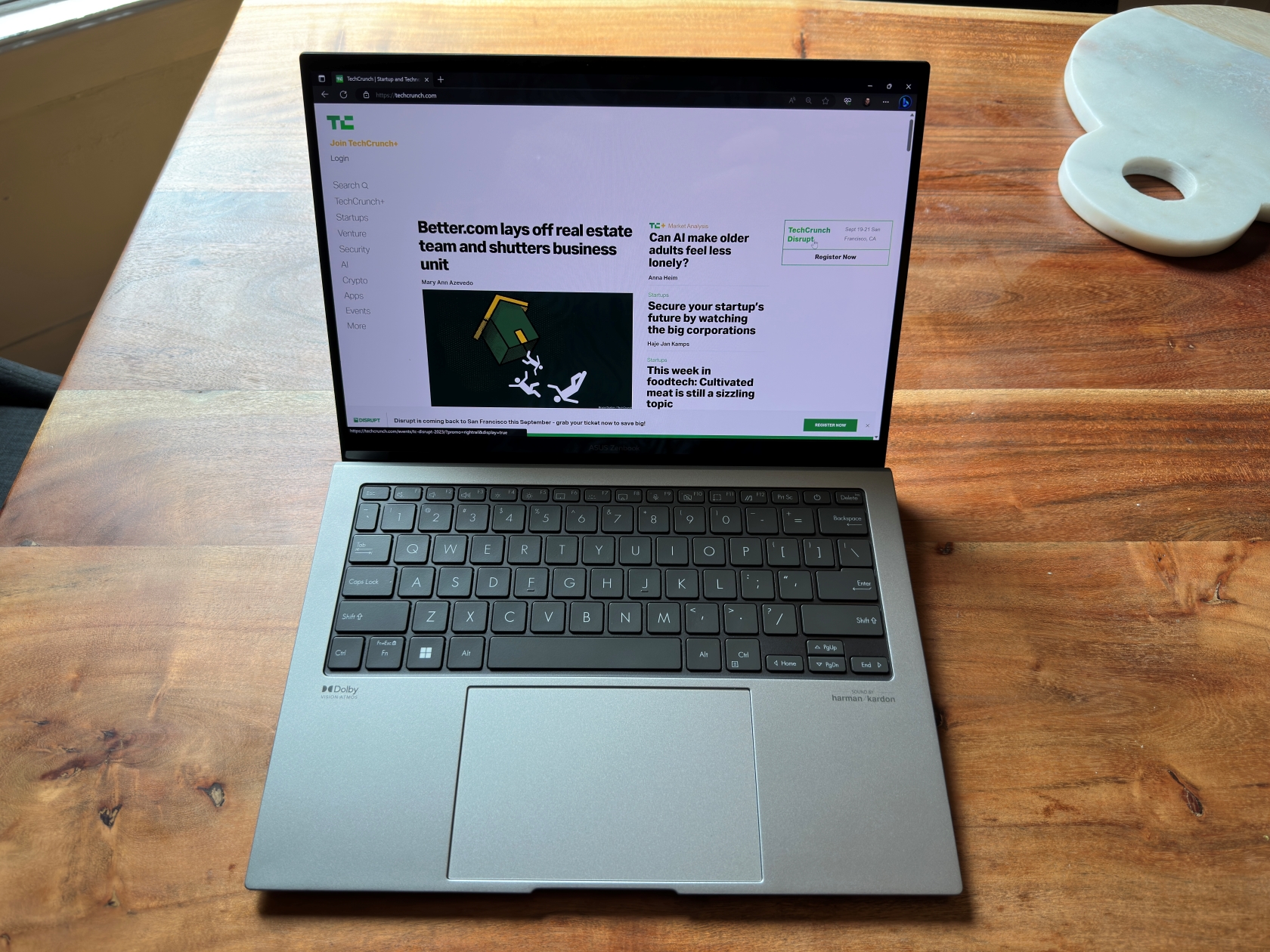
Image Credits: Darrell Etherington
Asus estimates battery life for the 2023 Zenbook S 13 OLED at up to 14 hours, but of course that’s going to depend on what you’re doing with it (more on how it actually fares in the performance section below). The 2.8K HDR OLED display is capable of a max brightness of 550 nits, and it offers 100% DCI-P3 color gamut coverage. In the box, you get a 65w USB charger, and a sleeve-style case for extra protection.
Design and build
Asus has done a great job with the aesthetics of the Zenbook lineup over the past couple of years, and the 2023 Zenbook S 13 OLED is no exception. It features an eye-catching, contrast-colored top case that has a finish that evokes a matte patterned rock, and the palmrest and keyboard surround are made of a recycled magnesium-aluminum alloy that feels great to touch. This is already the only PC notebook that I’ve received compliments from observers about, which says a lot about the design choices made here on a purely superficial level.
Despite being so thin and light, the Asus Zenbook S 13 OLED also still feels remarkably durable and solid. Asus says it meets US MIL-STD-810H military-grade standards for durability, and while I didn’t put it through anywhere near that kind of rigorous testing, I can attest that it stook up remarkably well to both indoor and outdoor home use, as well as to travel without any extra effort given to protecting or babying it during transit.
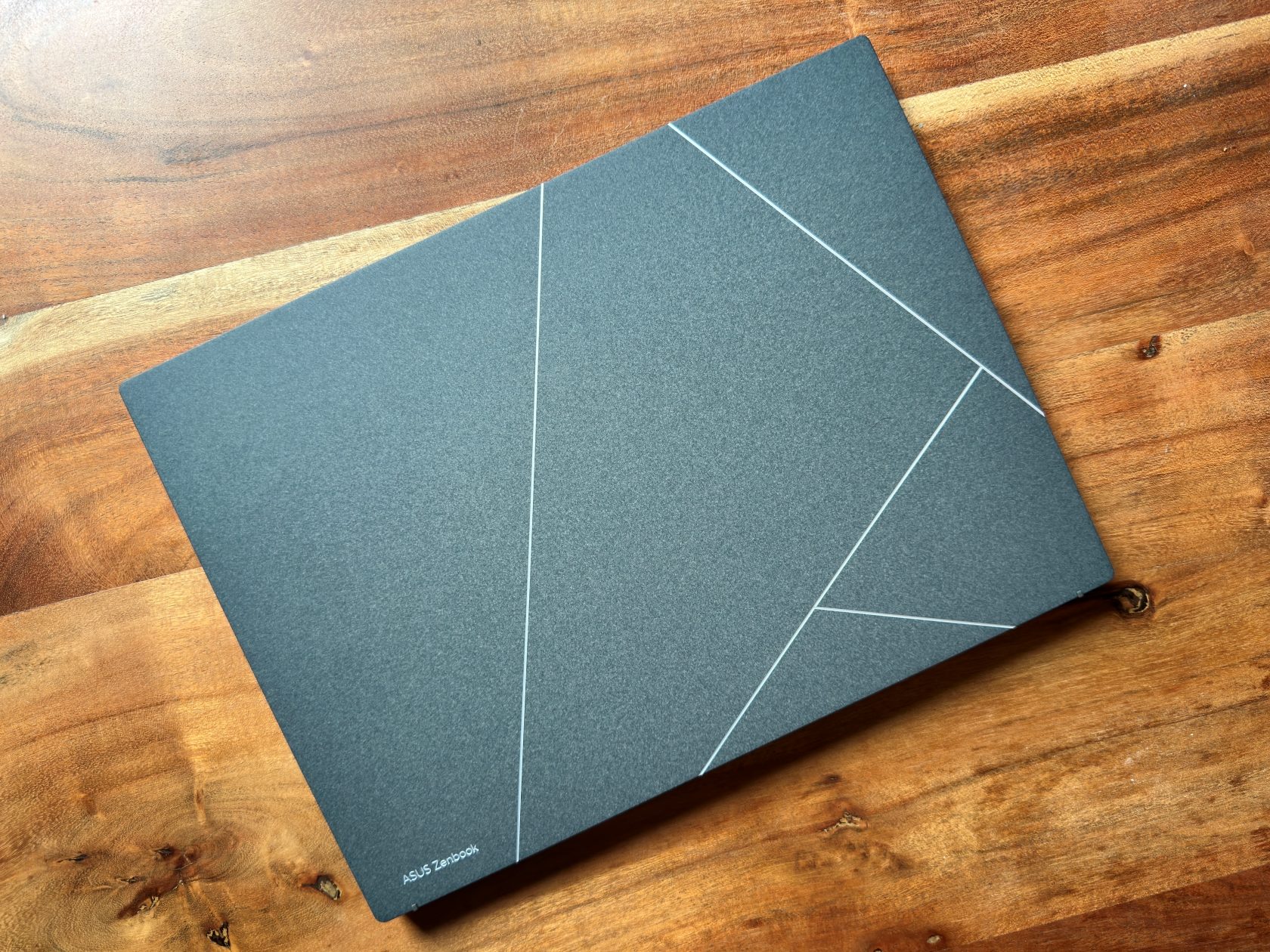
Image Credits: Darrell Etherington
The port loadout here is pretty ideal, with a range of options for accessories new and old. If there was anything to complain about here, it’d be the lack of an SD or microSD slot, but that’s understandable given how much focus Asus placed on making this the thinnest and lightest laptop possible. Speaking of that, it’s really remarkable to pick this thing up and see just how light it is: It even makes last year’s model feel a bit bulky, despite the fact that it’s only about 0.13 lbs heavier.
Features and performance
The 13th gen Intel chip powering the 2023 Zenbook S 13 provides plenty of pep, and it comes with 16GB of onboard memory and a fast 1TB SSD so it’ll never feel pokey. the trade-off for the power comes in the form of heat, which Asus mostly effectively dissipates with the onboard fan system. ‘Mostly’ being the key word, however. The notebook can get quite hot, especially around the back top middle of the bottom panel, and that can be hot enough that you might experience some discomfort using it as an actual laptop while wearing shorts. The heat seems only to be short-lived even when it does build up, however, even when using a more performance-oriented power profile and using an application like Photoshop as well as multiple browser tabs.
Image Credits: Darrell Etherington
Where some users might have more of a problem is with the fan noise: The 2023 Asus Zenbook S 13 OLED can unfortunately make quite a bit of it, and it’s not so much that it’s loud, but that it’s fairly high-pitched. In a quiet room, this can result in a quite noticeable whine, which may not be ideal either for the user or for anyone sitting in close proximity to them. The good news is that if you have any decent level of ambient noise at all – if you’re at a coffee shop or outdoors, for instance, the noise essentially disappears entirely.
These issues are obviously going to be more of a problem for anyone who aims to use this computer for gaming, graphics work or anything else that’s going to tax the processor or integrated GPU: I took it on a few work trips and used it during five and six hour flights for my standard workload, which consists primarily of browser tabs and Photoshop, and didn’t have any issue with the noise in those settings.
The Zenbook did have impressive battery life — under real-world use conditions, I obviously wasn’t getting 13 hours, but I was getting around 10 on average which is more than enough for a work and play laptop.
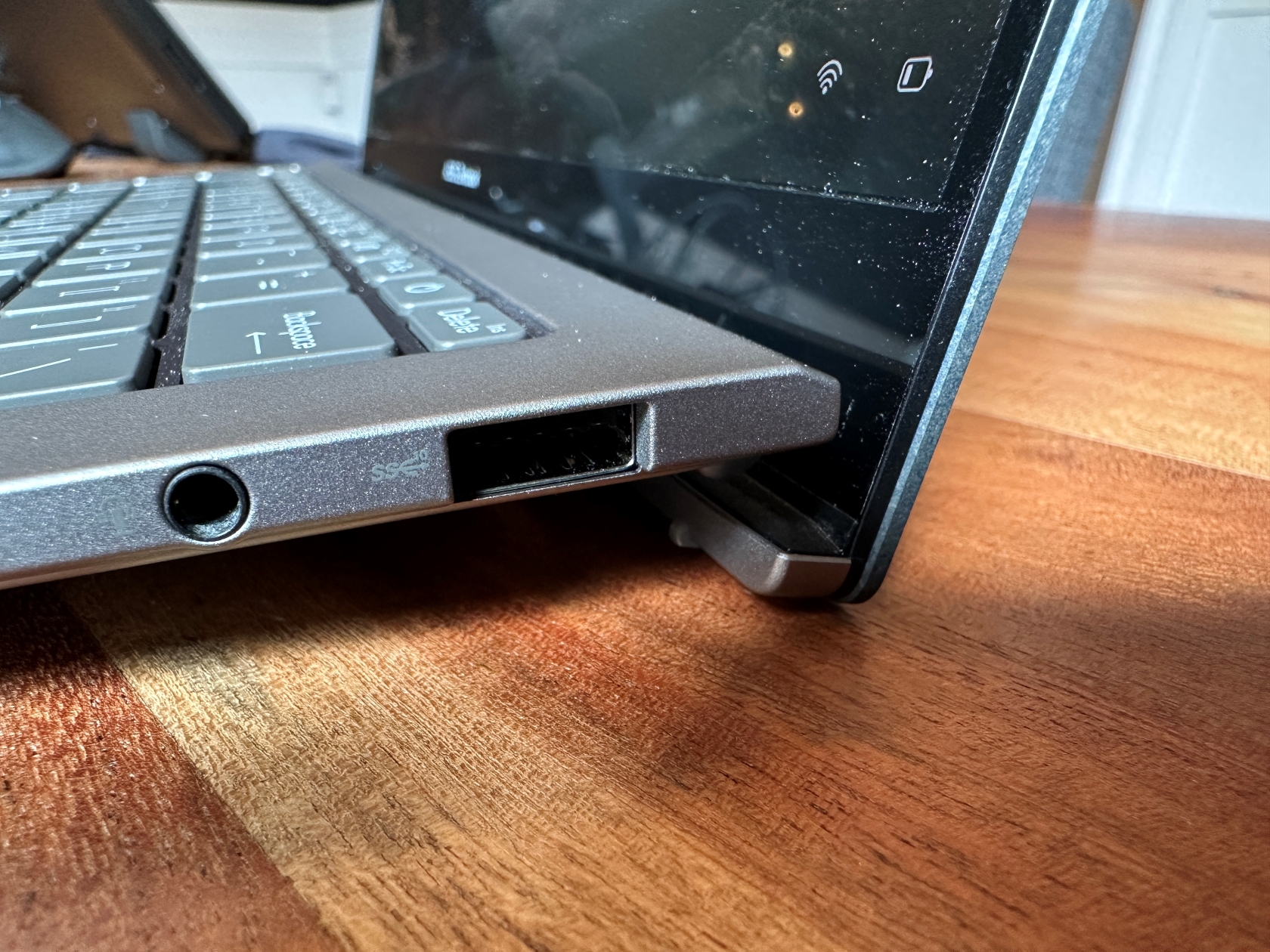
Image Credits: Darrell Etherington
Bottom line
For me, the 2023 Asus Zenbook S 13 OLED is very nearly the perfect all-around PC — it’s easily the best for traveling, given its slim form factor and decently long-lived battery, along with that amazing, gorgeous display, It transitions perfectly between knocking out emails and spreadsheets, and streaming Netflix or Disney+ shows in vivid, beautiful, vibrant color with full Dolby Vision support.
As an owner of the Ryzen-powered 2022 model, there are some things I miss about that version, including less noticeable fan noise, touch and pen input, and keys with deeper keystroke depth. But this version adds a lot, including the ability to connect to Thunderbolt 4 accessories including external GPUs, and it takes the cake when it comes to pure portability.
The 2023 Asus Zenbook S 13 OLED is a pint-sized powerhouse with a gorgeous display by Darrell Etherington originally published on TechCrunch
from TechCrunch
Saturday, 24 June 2023
Russia Crisis Explained: Who Is Yevgeny Prigozhin And Why His Wagner Group Is Rebelling Against Putin?
Yevgeny Prigozhin vowed to retaliate against Russian military leaders, accusing Defense Minister Sergei Shoigu of orchestrating a missile attack that resulted in significant casualties among his fighters.
from Zee News :India National
from Zee News :India National
OceanGate fires a whistleblower hackers threaten to leak Reddit data and Marvel embraces AI art
Hello, lovelies, and welcome to Week in Review (WiR), TechCrunch’s regular newsletter that recaps the week in tech. For many folks, this workweek was a day shorter, thanks to the Juneteenth observance on Monday. But plenty happened.
We’ve got coverage on the OceanGate tragedy, and we’ve continued to closely track the Reddit API controversy — which shows no signs of abating. Elsewhere, TC has a full review of the new Google Pixel Tablet (spoiler alert: the bundled dock is a major highlight), and we have the skinny on Microsoft’s quantum plans and more.
If you haven’t already, sign up here to get WiR in your inbox every Saturday. Then read on for the week’s digest.
Most read
OceanGate fired a whistleblower: The director of marine operations at OceanGate, the company whose submersible went missing Sunday on an expedition to the Titanic in the North Atlantic, was fired after raising concerns about its first-of-a-kind carbon fiber hull and other systems before its maiden voyage, according to a court filing in a 2018 lawsuit.
Hackers threaten to leak Reddit data: Hackers are threatening to release confidential data stolen from Reddit unless the company pays a ransom demand — and reverses its controversial API price hikes. In a post on its dark web leak site, the BlackCat ransomware gang, also known as ALPHV, claims to have stolen 80 gigabytes of compressed data from Reddit during a February breach of the company’s systems.
Reddit protests continue: In more Reddit news, multiple subreddits are adopting alternative methods of protesting the aforementioned API changes, such as publishing only one kind of post, changing the topic in focus and days when the community turns private. Many of these communities took part in a “blackout” from June 12–14 to protest the API rule changes, which could effectively kill a host of third-party apps.
Google Pixel Tablet review: Brian reviews the new Pixel Tablet, Google’s first attempt in a minute at an Android-powered device with a tablet form factor. The verdict? The so-so slate is greater than the sum of its parts with the addition of a bundled smart home dock. Read on for the rest of his impressions.
Microsoft gets serious about quantum: This week, Microsoft announced its roadmap for building a quantum supercomputer, using the topological qubits the company’s researchers have been working on for quite some time. There’s still plenty of intermediary milestones to be reached. But the company believes that it’ll take fewer than 10 years to build a quantum supercomputer using these qubits.
WhatsApp gets automatic silencing: WhatsApp has introduced a new feature to automatically silence calls from unknown numbers. It comes after multiple customers in India, the chat app’s biggest market with more than 500 million users, complained about an increase in spam calls over the past year.
Marvel’s AI art controversy: Marvel’s latest series, “Secret Invasion,” made its debut on Disney+ this week — sparking backlash after it was confirmed that the intro sequence was AI-generated. Method Studios, the VFX company responsible for the graphics, told The Hollywood Reporter, “No artists’ jobs were replaced by incorporating these new tools” — but that didn’t stop many artists from taking to Twitter express their frustrations.
Board members quit Byju’s: On Thursday, global giant Deloitte quit as the auditor of Byju’s and three board members resigned from the most valuable Indian startup, sending a shock wave through the industry a year after the Indian firm’s tardy financial reporting attracted global scrutiny.
Audio
Need a podcast to pass the commute — or just a lazy Sunday afternoon? TechCrunch has you covered. There’s bound to be something that appeals in TC’s growing audio content stable.
This week’s episode of Found featured Web Sun, the co-founder and president of Komodo Health, a startup that uses data to create a comprehensive map of the U.S. healthcare system. Web opened up about what drove him to entrepreneurship and how mutual friends introduced him to his co-founder, thinking they’d get along (little did they know!). He also talked about navigating fundraising during the bull market and layoffs — a timely topic to be sure.
TechCrunch+
TC+ subscribers get access to in-depth commentary, analysis and surveys — which you know if you’re already a subscriber. If you’re not, consider signing up. Here are a few highlights from this week:
Europe’s and Israel’s unicorns: Accel partner Harry Nelis writes about how, in the last two decades, we’ve seen a wealth of strong founders and operators emerge across Europe and Israel, building innovative products and category-defining unicorn companies that are now competing on the global stage.
Coinbase, the next super app: As the crypto markets continue to face uncertainty, Coinbase’s CEO Brian Armstrong sees greater potential for the digital asset ecosystem to grow. In the next five to seven years, Armstrong’s vision for Coinbase includes turning it into a “super app,” referring to apps like WeChat and Alipay, which are used for messaging, commerce, banking, loans, payments and even for ordering food.
AI infiltrates crowdsourced work: A new paper from researchers at Swiss university EPFL suggests that between 33% and 46% of distributed crowd workers on Amazon Mechanical Turk appear to have “cheated” when performing a particular task assigned to them, using tools such as ChatGPT to do some of the work. If that practice is widespread, it may turn out to be a pretty serious issue, Haje writes.
Get your TechCrunch fix IRL. Join us at Disrupt 2023 in San Francisco this September to immerse yourself in all things startup. From headline interviews to intimate roundtables to a jam-packed startup expo floor, there’s something for everyone at Disrupt. Save up to $600 when you buy your pass now through August 11, and save 15% on top of that with promo code WIR. Learn more.

OceanGate fires a whistleblower, hackers threaten to leak Reddit data, and Marvel embraces AI art by Kyle Wiggers originally published on TechCrunch
from TechCrunch
Sadhguru At UNESCO: Yoga Belongs To Humanity
Explaining this further, he added, “Anything that we discover cannot belong to any group of people. What we invent can belong to people. What we make up can belong to a certain group of people. What we discover as a reality cannot belong to me or you. It is the right of every human being to find a way for their own fulfillment.”
from Zee News :India National
from Zee News :India National
Friday, 23 June 2023
What happens if regulators nix the $20B Adobe-Figma deal?
When Adobe announced it was putting up $20 billion to buy Figma in September 2022, it didn’t take long before people began assuming it was a blatant attempt to take a competitor off the market.
It was certainly curious, especially considering the offer was double what the company’s most recent valuation had been and worth around 50x Figma’s revenue. It’s hard to argue that the deal wasn’t a display of brute force on Adobe’s part, the kind of corporate rollup that regulators are trying to put a stop to after years of letting the tech giants run rampant, buying up startups that could eventually erode their market share.
The proposed Adobe-Figma deal has certainly gotten the attention of regulators — and not in a welcoming manner. Already, the Justice Department, the CMA — Britain’s competition watchdog — and the EU are taking long, hard looks at the deal, and it wouldn’t be too much of a stretch to think that any of them could nix the deal for being anticompetitive.
“We are still in preliminary phases of the regulatory process and are having constructive discussions with the CMA, EC and DOJ about the businesses, markets and positive economic impacts this deal will bring to support [customers’ positive] reviews [of the product],” an Adobe spokesperson told TechCrunch+.
It seems pretty obvious even to a casual observer that Adobe is trying to take a potential rival off the board, a move that could stifle both competition and innovation, not a great mix for design software consumers.
To be sure, the deal would give Adobe an entirely new look, one it has tried to build on its own with a design tool rival, Adobe XD. But XD never gained much traction, which explains why the company was willing to fork over $20 billion to get the cream of the crop.
In an interview at TechCrunch Disrupt last fall, Figma co-founder Dylan Field argued that the two companies would truly be better together. But of course he has 20 billion reasons to think that.
When asked to explain why he decided to join forces with the company that his marketing team had been painting as its biggest rival, he saw two companies marrying creativity and design, and he couldn’t see having the resources to move in that direction on his own, at least not for a long time. “If we want to go and make it so that we’re able to go into all these more productivity areas, that’s gonna take a lot of time. To be able to go and do that in the context of Adobe, I think gives us a huge leg up, and I’m really excited about that,” Field said.
But with regulators looking closely, it’s not a stretch to wonder if that’s ever going to happen. But even if it does, would the deal be a net-positive for Figma and its backers? Let’s talk about it.
What happens if regulators nix the $20B Adobe-Figma deal? by Alex Wilhelm originally published on TechCrunch
from TechCrunch
When AI bots pose as humans
Welcome to Startups Weekly. Sign up here to get it in your inbox every Friday afternoon.
This week, I’ve been doing a lot of thinking about the implications of artificial intelligence. One of the most fragile parts of the puzzle is the training data. We already know that you can see if your images were used to train the datasets and that a lot of the training datasets out there are . . . spurious at best. Some startups are trying to build datasets trained exclusively on licensed data, and human artists are pretty grumpy when big-name studios use AI to generate art.
An interesting curveball is realizing that even evaluating training data may be challenging, as researchers discover that Mechanical Turk workers — who are, in theory, human workers doing tasks that machines can’t do — are reportedly using AI tools themselves. That’s fine for some tasks, but not great if the text they are generating is meant to be used as the rubric that AI-generating text tools are measured against. The old computing adage of “garbage in, garbage out” still stands. If you can’t trust the training data, you can’t trust the output (TC+).
Seen through the lens of startups, AI is continuing to go gangbusters — and Amazon’s AWS is throwing its not inconsiderable weight behind the burgeoning trend, with a $100 million program to fund generative AI initiatives.
The highest highs and deepest lows of transportation

Image Credits: Bryce Durbin / TechCrunch
It’s a bad week when a submersible goes missing, followed by a series of reports showing that perhaps the company didn’t have the most solid safety track record. The sub imploded under the ocean’s crushing pressure, killing its five passengers and raising new questions about the role of whistleblowers in startup land. The OceanGate underwater vessel used a carbon fiber hull that “wasn’t rated for Titanic depths,” claimed the operations-director-turned-whistleblower. It goes to show that, while startups famously “move fast and break stuff,” perhaps that tenet doesn’t quite extend to life-or-death critical equipment.
A highlight for transportation this week is a breakthrough in battery manufacturing. It turns out that up to half the energy required to make a lithium-ion cell is used in the process of drying certain components of the battery cell. Volkswagen just came up with a new process (TC+) that does away with that requirement, drastically reducing the cost and time it takes to create the batteries that power our electric vehicles.
- Sure, that seems . . . useful?: In what has to be one of the biggest headscratchers of the decade, Mercedes is adding ChatGPT to its infotainment system, Devin reports.
- Give us those sleek Tesla plugs: Last week, GM and Ford announced they would be using Tesla’s North American Charging Standard (NACS) very soon. Tim predicted that the company’s Supercharger network will strain as a result. This week, Rivian announced it will adopt the charging standard as well.
- More NACS tailwinds: First GM and Ford, then Rivian, and now Texas weighs in, saying state-funded EV chargers must include Tesla plugs.
- Bring on the challenger brands: Abu Dhabi pours $740 million into the Chinese EV brand Nio.
Hackers gonna hack

Image Credits: Bryce Durbin / TechCrunch
Both in startup land and beyond, we are seeing a tremendous amount of movement in security news over the past couple of weeks. We’ve had a ton of coverage of Reddit slowly imploding over the new API charges the social media giant introduced a little while back. But one story I particularly wanted to highlight is that hackers are threatening to release confidential data stolen from Reddit unless the company pays a ransom demand — and reverses its controversial API price hikes. It seems pretty curious for hackers to demand both policy changes and cash. If they were given one or the other, I wonder which they would choose — and what that says about the power of hack-tivism.
Malicious hacking has long been in the news, but I find it particularly interesting that we are seeing more and more startups trying to help tackle the problem, whether that’s hardening API security, data security at source or Internet of Things devices. As hackers get more sophisticated, and as computer security exploit exploration becomes more prevalent (just last week, a ransomware gang listed its first victims of MOVEit mass-hacks, which included U.S. banks and universities), opportunities for startups also increase. And yet, as Alex explored recently, it seems like a miss that VCs aren’t queuing around the block (TC+) to fund the current generation of cybersecurity companies.
- That seems bad. That’s bad, right? Yeah, that’s bad: A simple bug exposed access to thousands of smart security alarm systems.
- LockBit goes Pharma: LockBit claims ransomware attack on pharma giant Granules India.
- The feds close in: The feds in the U.S. caught another LockBit hacker.
You’re so money and you don’t even know it

Image Credits: Getty Images/Svetlana Borovkova
Fintech, what are we going to do with you? Even in an industry that’s all about money, the vertical just continues exploding with investment. Paro raised $25 million to match independent financial experts with firms, open banking fintech company Volt just raised a huge round at a valuation north of $350 million, and Majority, a digital bank for U.S. migrants, closed almost $10 million as it expands operations in Texas.
Sexy it ain’t, but investors know that fintech — once the company gets a soupçon of traction and a fistful of customers — is interesting for two reasons: Money never goes out of fashion, and there are M&A-hungry multinational giants who are standing by to snap up a company that’s on the upswing. At startup scale, the most recent example was that Robinhood just acquired credit card startup X1 for $95 million. At a very different scale indeed, Nasdaq announced it is planning to acquire financial services software company Adenza for $10.5 billion.
There’s money in them money trees, it appears.
- Wait, who am I paying?: Catherine reports that Notarize launches Proof and doubles down on ensuring safe(r) online transactions.
- That’s it, no more fraud for you: Mary Ann reports that Plaid unveils a new collaboration network aimed at sharing fraud intelligence.
Top reads on TechCrunch this week

Image Credits: Joseph Giacomin (opens in a new window) / Getty Images
If you’re struggling to raise money, there’s probably one of three reasons why investors keep giving you the cold shoulder: The market might be too small, the team isn’t good enough, or your plans simply don’t make sense. In my latest on TechCrunch+, I break down how VCs evaluate those things, and how you can push back.
If you can’t beat ’em with a tablet…: You can think outside the box. Brian reviews the new Google Pixel Tablet and concludes that it’s all about the dock. It’s going to have its work cut out against Apple’s iPad Pro-looking, entry-level iPads.
Welcome to Streamberry: The Netflix doppelgänger is customized to your worst nightmares. Lauren reports that Netflix launches a website based on the fictional streaming service from “Black Mirror.” On that note, don’t miss the piece I wrote about how technology unlocked Netflix’s business model (TC+).
Leaping into the quantum realm: Frederic reports that Microsoft expects to build a quantum supercomputer within 10 years. Maybe that’s why they need that fusion reactor?
Get your TechCrunch fix IRL. Join us at Disrupt 2023 in San Francisco this September to immerse yourself in all things startup. From headline interviews to intimate roundtables to a jam-packed startup expo floor, there’s something for everyone at Disrupt. Save up to $600 when you buy your pass now through August 11, and save 15% on top of that with promo code STARTUPS. Learn more.
When AI bots pose as humans by Haje Jan Kamps originally published on TechCrunch
from TechCrunch
Subscribe to:
Posts (Atom)