As per Economic Survey 2023, India is to witness Gross Domestic Product (GDP) growth of 6.0 percent to 6.8 percent in 2023-24.
from Zee News :India National
Tuesday, 31 January 2023
Monday, 30 January 2023
Instagram’s text update Notes feature is expanding to Europe and Japan
Instagram head Adam Mosseri announced today that the social network is launching its text update Notes feature across Europe and Japan. Notes are short posts of up to 60 characters that include just text and emojis, and appear above your profile photo. Prior to this expansion, Notes was already accessible everywhere Instagram is available beyond Europe and Japan since the feature’s initial roll out in December.
Users can post Notes by navigating to the top of their inbox, then selecting the followers they follow back or others from their existing “Close Friends” list. They can then type out the note itself, after which it will appear at the top of friends’ inboxes for 24 hours. If a user responds to a Note, the reply will arrive as a DM.
Notes Launch Worldwide
Notes are now available in Europe and Japan.
Check it out and let me know what you think!
pic.twitter.com/MSSjQZVIuZ
— Adam Mosseri (@mosseri) January 30, 2023
In a video posted to his social accounts, Mosseri explained that Europe and Japan weren’t included in the initial roll out of Notes because Instagram needed to ensure that the feature complied with local regulations before bringing it to these regions.
At the time of the initial launch of Notes, Instagram said that during testing it found people appreciated having a way to start conversations in a lightweight way. The goal of the feature is to give users a casual and spontaneous way to express themselves and connect with others.
In December, the New York Times reported that Meta was considering turning Instagram Notes into a more fully fledged Twitter rival to capitalize on the chaos at Twitter following Elon Musk’s acquisition. The report said the company had been weighing whether Notes should even be its own standalone app or another feed inside Instagram.
Instagram’s text update Notes feature is expanding to Europe and Japan by Aisha Malik originally published on TechCrunch
from TechCrunch
Mahatma Gandhi Death Anniversary: ‘Bapu Taught the Country to Live With Love…’: Rahul Gandhi
President Droupadi Murmu and Prime Minister Narendra Modi also paid floral tributes at Raj Ghat in the national capital.
from Zee News :India National
from Zee News :India National
Sunday, 29 January 2023
Delhi CM Arvind Kejriwal to Launch Real-Time Pollution Data Collecting Mechanism on January 30
The Delhi government would be able to deploy resources and take proactive measures to control pollution as a result of these forecasts.
from Zee News :India National
from Zee News :India National
Saturday, 28 January 2023
The latecomer advantage in startups
Welcome to Startups Weekly, a nuanced take on this week’s startup news and trends by Senior Reporter and Equity co-host Natasha Mascarenhas. To get this in your inbox, subscribe here.
Sometimes, due to the nature of the startup game, we over index on “the new.” Companies want to build for the pain point you never dreamed to disrupt; VCs want to invest in an emerging trend before it becomes a household name; and those breaking into tech are told to lean into their earnestness, because you never know who is going to answer your cold email. In order for entrepreneurship to feel exciting and welcoming — not even be, but feel — new needs to be one of its loudest characteristics.
After all, you only get to be “it” once.
But one question I’ve found myself asking over the past year, especially as some of the more tenured folks speak about past downturns and cyclical learning lessons, is the latecomer advantage. It’s partially obvious: When you’ve done this whole entrepreneurship thing before, you understand what mistakes to avoid and seamlessly know which investors to dodge.
But it’s also partially not as easy of a story. There’s a difference between being new and being inexperienced, the same way there’s a difference between experienced and being late. How do you know where you are on that entire timeline — especially when the stories feel better to tell at the extremes?
This week on Equity, I interviewed T2 co-founder Sarah Oh, who is building a Twitter rival after working at Twitter as a human rights adviser. Quite quickly, I asked her how building a copycat of your former employer makes you feel. She seemed unbothered, to which I promptly said: All is fair in love and moderation.
But the better answer that Oh gave me was around the latecomer advantage that she has, building a company in a world that she knows extremely well. By joining the consumer social wave today versus before anyone even thought in characters and retweets, the co-founder thinks they get to factor in more of the nuance.
“There’s a lot that we know about gaps in trust and safety in the industry, whether it’s datasets that we need, or models that need to be built, or certain standards that need to exist for models, right, there’s a whole laundry list of things that I wish I had in my previous roles that just didn’t exist, we’re now at a place where we can have those conversations,” Oh said. She added that when some of the first social media platforms were being created, there weren’t “historical case studies or precedent” for a lot of the controversies that now exist. With some of the ugly out of the way — my words, not hers — T2 has examples it can refer back to on how to handle tensions around virality, doxxing and more.
It just made me think about that larger comprehension coupled with the nimbleness of a startup. Maybe, it’s being both old and new that might be the striking balance that helps a startup start up. In this case, we have no idea how the old or the new attempts at Twitter are going to do, but we do know that this time has never mattered more.
In the rest of this newsletter, we’ll talk about chief inspiration officers, growing startup accelerators and a rare buzz we’re hearing about one tech company and its public market wishes. As always, you can follow me on Twitter or Instagram.
Goodbye, chief inspiration officer
Also on Equity this week, the crew spoke about how venture capitalists are going to pay more attention to how portfolio founders are spending capital — especially around hiring trends. Becca’s latest for TC+ — use code EQUITY for 50% off an annual membership — gets into why the hiring slide in the pitch deck is no longer going to be a throwaway part of the presentation.
Expect more scrutiny.
Here’s why this is important: We know that companies are dropping staff to cut costs, but those that are hiring may have to take a more conservative approach in both types of roles and level of pay. All to say, there’s definitely an opportunity to find talent if you are hiring. But, it won’t be easy for all laid-off talent to find their next gigs, especially as employers look to hire cheaper talent with less ambitious staffing goals.
- My big question is if VCs are taking the same advice that they’re dishing. Don’t forget VCs, you have VCs too. (At least most of you do!)
- Burned by layoffs, tech workers are rethinking risk
- Waymo lays off staff as Alphabet announces 12,000 job cuts
- Laid off from your crypto job? Here’s what founders are looking for in new talent
- Crypto recruiters see opportunity to snatch up talent amid Big Tech layoffs
Image Credits: MicroStockHub (opens in a new window) / Getty Images
The Goldilocks moonshot
NextView Ventures has launched its fourth accelerator program, aiming to back around half a dozen founders with $400,000 in funding and mentorship opportunities. It’s also offering at least one spot to a team built by ex-colleagues who have been laid off over the past downturn.
Here’s why this is important: The accelerator partners are open to backing founders even if they have a half-baked idea or only an area that they want to dig into. Even in a more disciplined market, there are some firms that are still comfortable seeding ideas versus fully fledged business ideas. “It’s almost half a step earlier than we’ve typically thought of” portfolio companies, Rob Go, founding partner, NextView Ventures, said, of the cohorts.
- I was thinking about this idea when speaking to NEA’s Scott Sandell earlier this week. The 45-year old venture firm closed in on a $6.2 billion pair of funds, one of which is wholly dedicated to new early-stage investments. Sandell said he’s looking for “the efficiency gene” when sourcing companies and wants proof that they know how to handle capital. Smart, and common. After our call, I joked that I’m curious if any VC firms are interested in backing startups that don’t care at all about discipline or capital efficiency. Wouldn’t that be a story? In a more serious way, I am interested in the early-stage focused venture capitalists that are taking risks right now and how that rewards certain sectors and backgrounds.
- Jumia’s investors rethink their stakes — for better and worse
- Cowboy Ventures goes bigger with $260M across two new funds, including an opportunity fund
- Another All Raise CEO steps down
- Sequoia, Marc Andreessen back early-stage fund Kearny Jackson
Image Credits: Talaj (opens in a new window) / Getty Images
The follow-up
Stripe is eyeing an exit, finally. The payments giant has set a 12-month deadline for itself to go public, either through a direct listing or pursuing a transaction on the private market, such as a fundraising event and a tender offer, according to sources familiar with the matter.
Here’s why this is important: I mean, must I state the obvious? The public markets for tech companies have been stale, unwelcoming, insert boring adjective here. If Stripe does kick off a trend, we’re in for an exciting next year. But some are dubious on the timeline. After all, it’s literally easier said than done.
- Report: Stripe tried to raise more funding at a $55B-$60B valuation
- Method raises $16M to power loan repayment, balance transfers and more across fintech apps
- Being the steady hand in market uncertainty with Sebastian Siemiatkowski from Klarna
- And shout out to The Interchange, a fintech newsletter put together by the inimitable Mary Ann Azevedo. Read last week’s issue, here!
Image Credits: masik0553 (opens in a new window) / Getty Images
Etc., etc.
- A16z is hiring someone to run Tech Week. This should be fun.
- Recursive Ventures, a San Francisco-based firm investing in U.S. and Israeli early-stage companies, has closed over $11 million for its third fund, according to SEC filings.
- Will 2023 be the year of accountability? I enjoyed this piece by Eric Newcomer.
- If you missed Startups Weekly last week, catch my last issue here: “Tech forgot its umbrella.”
- TechCrunch is coming to Boston on April 20. I’ll be there with my favorite colleagues to interview top experts at a one-day founder summit. Book your pass ASAP!
Seen on TechCrunch
The thing we thought was happening with robotic investments is definitely happening
App downloads were stagnant in the fourth quarter, new analysis finds
Strava acquires Fatmap, a 3D mapping platform for the great outdoors
LastPass owner GoTo says hackers stole customers’ backups
Seen on TechCrunch+
The current legal cases against generative AI are just the beginning
A VC’s perspective on deep tech fundraising in Q1 2023
As activist investors target Salesforce, what’s next for the CRM giant?
Laid off from your crypto job? Here’s what founders are looking for in new talent
Startups should expect more scrutiny from VCs on their hiring plans
I’ll end with the evergreen reminder that I absolutely love going to startup happy hours and VC dinners in San Francisco, so do let me know if you’re throwing one! And if you’re still working on your social engine like me, I’m also always game to do a 1:1 coffee chat or dumpling lunch.
To the rest of you, thanks for reading as always. 2023 is already soaring on by, isn’t it?
Talk soon,
The latecomer advantage in startups by Natasha Mascarenhas originally published on TechCrunch
from TechCrunch
Udupi Shocker: Wardens Beat Dog to Death In College, FIR Filed
The accused have been identified as warden Nagaraj and Rajesh. Preliminary investigations have revealed that the accused allegedly committed the brutal act after they found a student playing with the dog in the college premises.
from Zee News :India National
from Zee News :India National
Friday, 27 January 2023
Warner Bros. swiped our Harry Potter wand IP, says Kano
Kano, the venture-backed U.K startup known for its build-your-own computer kits and software for teaching coding and associated STEM skills, has accused Warner Bros. of copying one of its products and infringing on its intellectual property (IP).
The product in question is the Harry Potter: Magic Caster Wand that Warner Bros. announced back in October, and which began shipping to consumers in the U.S. and U.K. for $150 just before Christmas. London-based Kano issued a “cease and desist” to Warner Bros. this week, which TechCrunch has seen, requesting that the media and entertainment giant halt its go-to-market and promotional activities.
While Kano is probably better known for its Raspberry Pi and Windows-based modular PCs, the company launched a device similar to Warner Bros.’ new wand way back in 2018. Kano’s Harry Potter Coding kit came replete with a physical gesture-controlled Bluetooth wand designed to engage children through coding spells, making on-screen cauldrons change color, or feathers fly, via elaborate swishing motions with the wand.
Powering the wand are various sensors, including an accelerometer, gyroscope, and magnetometer, which help the wand convey its direction and motion to the tablet or PC it’s connected to.
In the intervening years, Kano says it has sold some 180,000 units of its Harry Potter coding wand, a figure that rises to 460,000 when you factor in similar gesture-controlled products Kano subsequently launched in partnership with Disney spanning the Star Wars and Frozen franchises.
While Kano is no longer actively marketing its Harry Potter wand, some of its retail partners — which have previously included Apple and Target — do still sell it.
Patented
Last April, Kano cofounder and CEO Alex Klein was granted a patent for the wand’s gesture recognition system, covering the basic mechanics of how it works: the user holds down a button to begin the gesture recognition, the screen displays a cursor trail as the user moves the wand to show how a spell is being cast in real-time.
It’s worth noting that Kano launched its wand as part of a brand-licensing partnership with Harry Potter rightsholder Warner Bros., which is why Klein says he was perturbed to learn of its new competing wand hitting the market a few months back.
In a conversation with TechCrunch, Klein explained that off the back of the initial success it saw with the Harry Potter wand in 2018, Warner Bros.’ corporate arm reached out to Kano to get it to explain a bit more about how the product works, including its componentry and how it’s able to recognize spells, and other potential use-cases for the underlying technology.
And this is where things get interesting regarding its spat with Warner Bros.
Unlike Kano’s original Harry Potter wand, which was focused squarely on teaching kids how to code, Warner Bros.’ Harry Potter Magic Caster Wand is all about the smart home. It’s designed to connect to devices such as TVs, lights and speakers, so users can control their contraptions using “spells” and choreographed wand gestures.
According to Klein, Kano had already envisaged such use-cases with its own wand, and had made some early developments in the smart home realm.
“In the process of making it easy for a person to hold down the button on the wand and cast a spell, we realized that this is a new language for human computer interaction,” Klein said. “You could be casting spells not only to make Bertie Bott’s Every Flavour Beans explode on a screen, but you could [also] be doing gestures to control your lights, unlock your door, and control the volume of music. We realized that this gestural form of interaction could be quite powerful and extended into other domains in the smart home. So we came in, they [Warner Bros.] got really excited about this idea of controlling the smart home.”
Klein showed TechCrunch a video of an early prototype of Kano’s wand controlling various connected devices, which he says was recorded in November 2018, as part of a demonstration in Warner Bros.’ offices.
Fast-forward to 2022, and with Warner Bros. bringing a similar Harry Potter wand to market, Klein says that he reached out to various people at the company to get an explanation, adding that he was told that an internal investigation would follow. But he said the line of communication went cold, leading to the cease and desist letter that Kano issued to Warner Bros. this week.
“A side-by-side comparison of the operation of both the Coding Wand [Kano’s] and the Spellcaster Wand [Warner Bros.’] makes clear — and has now made clear to multiple third-party observers, including patent and intellectual property experts — that an issue has arisen,” the letter states. “The new product uses intellectual property — multiple patent-protected assets, trade secrets, inventions, etc. — of Kano’s, some of which were shared in strict confidence with WB during the many detailed engagements between the companies.”
The story so far
Founded in 2013, Kano has raised some $45 million in funding from notable backers including European VC Index Ventures, Barclays, Salesforce cofounder Marc Benioff, and Microsoft, which worked with Kano to develop a Windows-based PC back in 2019.
Mark Zuckerberg is also apparently a fan of Kano’s products, according to this post from 2021.
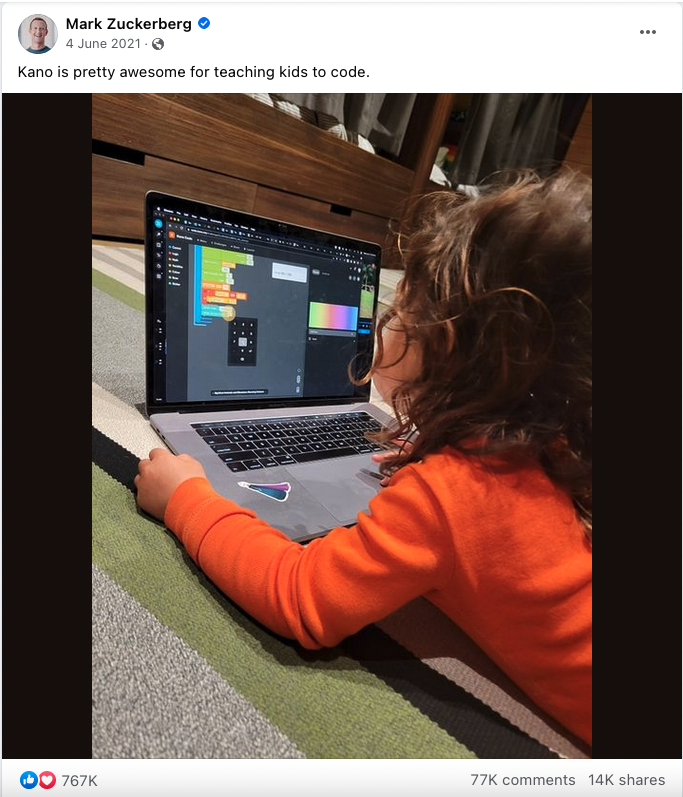
Mark Zuckerberg apparently digs Kano Image Credits: Mark Zuckerberg
However, Kano had been relatively quiet these past few years, announcing a round of layoffs in late 2019 and then not really releasing much in the way of new products. However, in 2021 the company did partner with Kanye West to launch Stem Player, a device that lets users isolate and remix individual song elements. It ultimately pulled back from the partnership due to antisemitic comments made by West.
Today, Kano continues to sell the Stem Player without West’s involvement, and a few weeks back the company unveiled the Stem video Projector, while hinting at all manner of new products that may include food and clothes. The company also signaled its transition away from its legacy DIY PC business when it revealed it was spinning out its creative software suit Kano World as a standalone business.
However, the company does plan to stay at least a little bit true to its roots, as it’s developing a modular two-in-one device that can run Windows or ChromeOS, which Klein said it expects to push to market some time this year.

Kano’s upcoming DIY modular PC Image Credits: Kano
Financially, things hadn’t been looking so great for Kano. At its most recently reported financial year ending of March 2021, Kano disclosed a pre-tax loss of £10.1 million ($12 million), though this was an improvement on the £16.8 million ($20.8 million) loss it reported the previous year. The company told TechCrunch a few weeks back that its provisional accounts for fiscal year 2022 show a pre-tax profit of around £1.2 million ($1.5 million).
What’s next
While Klein is naturally keen to paint an outwardly rosy picture of how things are going at Kano, the fact that it’s actively releasing and developing new products is an encouraging sign. However, a litigious IP scuffle with a billion-dollar, mass media conglomerate is probably the last thing it needs right now.
In a modern-day David vs Goliath scenario, defending IP rights in court as a relatively small startup is not a cheap pursuit — something that Klein is acutely aware of as he considers his next moves.
“It can cost up to $3 million to defend and protect a patent / technology IP,” Klein said. “This stacks the deck in favor of the big corporates. They can afford to throw aggressive lawyers at smaller companies and tie them up in process.”
There is nothing to say, at the moment at least, that this is definitely how things will unfold. But if it does, Klein indicated that he’s willing to do whatever it takes to defend Kano’s work, noting that he has been told by lawyers who have worked on the case so far, on a pro bono basis, that it’s “pretty open and shut.”
“If necessary, I’ll work late nights and weekends and represent us myself, pro se,” he said. “We will make sure our team’s hard work and creativity is not abused and ripped off. I may not have gone to law school, but all the proceedings are public, and can be understood with a little elbow grease.”
TechCrunch has tried reaching out to multiple people at Warner Bros. for comment, but at the time of writing has yet to hear back.
Warner Bros. swiped our Harry Potter wand IP, says Kano by Paul Sawers originally published on TechCrunch
from TechCrunch
Hear the right way to acquire customers with Cube and Mayfield on TechCrunch Live
Finance people live and breathe spreadsheets, Mayfield’s Rajeev Batra was telling me. We were talking about our upcoming TechCrunch Live event featuring him and Cube’s Christina Ross, and Rajeev was explaining how he sees Cube’s position in the marketplace. Christina Ross co-founded the company in 2018 in a bid to provide a solution to CFOs who rely on spreadsheets but could benefit from modern data analysis, reporting, and collaboration. Now, some five years later, Cube is finding success and has raised over $45 million from venture capital.
I hope you can join us on this TechCrunch Live event on February 8 at 11:30 a.m. PST/2:30 p.m. EST. Christina Ross learned early on in Cube’s history that the solution must meet the customer where they’re at. Cube’s solution is unique in the FP&A world, in that it’s not trying to replace spreadsheets but rather work alongside spreadsheets. This gives her a unique take on finding product market fit — Cube isn’t trying to force customers to abandon their current solution.
We’re going to talk about Cube’s approach to customer acquisitions and finding product market fit, and why Christina’s favorite childhood toy was a cash register.
Questions I want to ask
- How did Cube so quickly acquire customers even though the company had yet to build a product?
- Cube has countless competitors, so how does the company stay ahead of the curve?
- What are some best practices for selling into an underserved market?
- What personal qualities did Mayfield see in Christina Ross that led them to invest, and what’s a good founder fit for Mayfield?
And I want you to ask questions too!
Join the live event on Hopin, and ask questions in the chat. I’ll do my best to ask them when possible. Can’t make the live event but can listen to the replay/podcast? Tweet at me, and I’ll be sure to ask your questions.
Want to get feedback on your pitch during the show?
Pitch Practice is back! Apply to present your company using this form. We’ll select three companies to pitch during the show, including one wildcard company that will be selected from our Hopin audience during the episode.
Hear the right way to acquire customers with Cube and Mayfield on TechCrunch Live by Matt Burns originally published on TechCrunch
from TechCrunch
TANCET 2023 Exam Dates RELEASED at tancet.annauniv.edu- Steps to Check Here
TANCET 2023 Exam Date: Earlier the exam was scheduled to be held in February, which has now been postponed to March, details below.
from Zee News :India National
from Zee News :India National
Police refutes claims of Pak flag hoisting in Bihar`s Purnea
The police are now trying to locate the person who made this video go viral, details below.
from Zee News :India National
from Zee News :India National
Maharashtra HSC 2023 Board Exam Hall Ticket RELEASED at mahahsscboard.in- Direct Link to Download Here
Maharashtra HSC 2023: The Maharashtra State Board of Secondary & Higher Secondary Education has released the Maharashtra HSC 2023 Board Exam Hall Ticket on the official website, mahahsscboard.in, scroll down for more details.
from Zee News :India National
from Zee News :India National
Wednesday, 25 January 2023
Tamil nadu overview
Tamil Nadu Overview
Tamil Nadu is a state in the southern part of India. It is known for its rich cultural heritage and ancient temples. The official language is Tamil, and the state capital is Chennai. Tamil Nadu is also a major agricultural and industrial state, with industries such as textiles, automobile manufacturing, and software development.
Tamil Nadu is also known for its rich tradition of classical dance and music, including Bharatanatyam and Carnatic music. The state is also famous for its cuisine, which includes dishes such as dosa, idli, sambar, and rasam.
Tamil Nadu has a strong education system and is home to several prestigious universities and research institutions.
The state has a diverse population, with significant minority communities such as Muslims and Christians. Tamil Nadu has a long history of social reform movements and has been at the forefront of many progressive social and political changes in India. The state has a rich history and has been a major center of civilization and culture for over 2,000 years.
Tamil Nadu is also known for its beautiful beaches, hill stations, and wildlife sanctuaries. The state has several popular tourist destinations such as Mahabalipuram, Kanyakumari, Ooty, and the Nilgiri Hills.
The state has a strong economy and is one of the most industrialized states in India. The state's GDP is among the highest in the country and it is a major contributor to India's overall economic growth. Tamil Nadu is also a major exporter of textiles, leather goods, and engineering goods.
Tamil Nadu also has a rich history of political movements and social reform. It has been at the forefront of many progressive social and political changes in India. The state has a strong tradition of public service and social welfare programs.
Overall, Tamil Nadu is a state with a rich culture, history, and economic development, and is an important part of India's overall growth and progress.
Tamil Nadu is also known for its rich history of literature and art. Tamil literature, one of the oldest in the world, has a rich tradition of poetry, drama, and storytelling. Tamil Nadu has produced many famous poets and writers such as Thiruvalluvar, Subramania Bharathi, and Kalki Krishnamurthy.
Tamil Nadu is also home to many ancient temples and architectural monuments that are famous for their intricate carvings and sculptures. The Meenakshi Temple in Madurai, the Brihadeeswarar Temple in Thanjavur and the Shore Temple in Mahabalipuram are some of the notable examples. These temples are not only significant religious and cultural sites but also important tourist attractions.
Tamil Nadu is also home to many important industrial and technological centers such as the Indian Institute of Technology in Chennai, the Indian Institute of Management in Trichy and the Indian Institute of Science Education and Research in Tiruppur. These institutions are known for their excellence in research and education in various fields and have produced many notable alumni who have made significant contributions to the country and the world.
In conclusion, Tamil Nadu is a state that is rich in culture, history, literature, art, temples and technology that makes it an important destination for people who are interested in exploring the history, culture and the religious heritage of South India.
Tamil Nadu is also known for its film industry, which is one of the largest and most popular in India. The Tamil film industry, also known as Kollywood, produces a large number of films each year and has a significant impact on the state's economy. Some of the most popular actors and directors in Tamil cinema have become household names in India and around the world.
The state also has a rich sporting culture and has produced many famous athletes and sports teams. The state's cricket team, Tamil Nadu, has a long history of success in domestic cricket, while the state's field hockey team has also won several national championships.
In addition to its rich cultural heritage, Tamil Nadu is also known for its progressive policies and social welfare programs. The state has a strong tradition of public service and has implemented many programs to improve the lives of its citizens, such as free education and healthcare.
In conclusion, Tamil Nadu is a state that is rich in culture, history, literature, art, temples, technology, film industry, sports, and social welfare programs that makes it an important destination for people who are interested in exploring the diversity of South India. Its economic development and strong tradition of public service also make it an important contributor to India's overall progress and prosperity.
Tamil Nadu also has a rich tradition of festivals and celebrations throughout the year. Some of the most notable festivals include Pongal, a harvest festival celebrated in January, and Chithirai Thiruvizha, a grand festival celebrated in the temple town of Madurai. The state is also famous for its temple festivals, which are celebrated with great enthusiasm and devotion.
Tamil Nadu is also known for its beaches and backwaters, which are popular tourist destinations. The state has several famous beaches such as Marina Beach in Chennai, Mahabalipuram Beach and Rameswaram Beach. The backwaters of Tamil Nadu, such as the ones in Thanjavur and Kanyakumari, are also popular among tourists.
Tamil Nadu is also known for its rich wildlife and biodiversity. The state has several national parks and wildlife sanctuaries, such as Mudumalai National Park, The Gulf of Mannar Marine National Park and the Indira Gandhi Wildlife Sanctuary. These protected areas are home to a wide variety of plant and animal species, making it an ideal destination for nature lovers and wildlife enthusiasts.
In conclusion, Tamil Nadu is a state that is rich in culture, history, literature, art, temples, technology, film industry, sports, social welfare programs, festivals, beaches, backwaters, wildlife and biodiversity that makes it an important destination for people who are interested in exploring the diversity of South India. Its economic development and strong tradition of public service also make it an important contributor to India's overall progress and prosperity.
Tuesday, 24 January 2023
group
A group is a collection of individuals or entities that share a common characteristic or purpose. Groups can be formed for a variety of reasons, such as for social, professional, or educational purposes. Some groups are informal and may have a loose structure, while others are more formal and may have defined roles and responsibilities for members. Groups can be small or large, and can be found in many different settings, such as in families, schools, businesses, communities, and online. Groups can also be temporary or permanent, and can be open or closed to new members..
private
A private network is a network that is accessible only by a specific group of people or organizations. It is typically used to share resources and exchange information among a closed group of users, such as employees of a company, students and staff of a school, or members of an organization. Private networks are usually protected by security measures such as firewalls, passwords, and encryption to ensure that unauthorized users cannot access the network or the information it contains. Examples of private network include intranet, VPN (Virtual Private Network), and LAN (Local Area Network) used in a company or organization.
network
A network is a group of interconnected devices, such as computers, servers, and routers, that are connected together to exchange information and share resources. There are many different types of networks, including local area networks (LANs), wide area networks (WANs), and the internet. Each type of network has its own characteristics and is designed to meet specific needs, such as connecting computers in a single building or connecting multiple buildings across a city or even a country. Additionally, networks can be wired or wireless, and can be public or private.
Monday, 23 January 2023
earn money in China
There are many ways to earn money in China, some of which include:
Starting a business or investing in a Chinese company.
Working as an employee in a Chinese company.
Teaching English as a foreign language.
Working as a freelancer or providing consulting services.
Selling goods or services online via platforms such as Taobao or JD.com.
Investing in stocks, real estate or other investment vehicles.
Participating in online platforms that rewards users for completing tasks, such as sharing posts or answering questions.
Please note that the laws and regulations for each of these activities may vary, it's always good to research and consult professionals before making any decision.
earn money in India
There are many ways to earn money in India, some of which include:
Starting a business: Starting your own business can be a great way to make money in India. This can include opening a brick-and-mortar store, starting an online business, or becoming a freelancer or consultant.
Investing in stocks or mutual funds: Investing in the stock market or mutual funds can be a great way to earn money over time. It is important to do your research and invest wisely.
Online earning: There are many online earning opportunities such as online tutoring, online writing, online surveys, affiliate marketing and more.
Real estate: Investing in real estate can be a great way to earn money in India. This can include buying and renting out property or flipping houses.
Government schemes: Government schemes such as Pradhan Mantri Rojgar Protsahan Yojana, Pradhan Mantri MUDRA Yojana, National Rural Livelihoods Mission, etc. can help people to earn money by providing financial assistance to start a new business or to improve their existing business.
Freelancing: Freelancing is becoming increasingly popular in India as a way to earn money. This can include providing services such as writing, graphic design, web development, and more.
It's important to note that earning money requires hard work, patience and a good strategy, also it's important to comply with laws and regulations of the country..
animesion
Anime is a style of Japanese animation that has become popular around the world. It is known for its colorful and detailed art style, as well as its wide range of genres and themes. Some anime series are targeted at children, while others are geared towards adults.
Anime can be found in various format like TV series, movies, OVA (original video animation) and manga (Japanese comics). It covers a wide range of genres including action, adventure, comedy, drama, fantasy, horror, and science fiction.
Anime's popularity has grown significantly in recent years, with many anime series and films being dubbed or subtitled in multiple languages and distributed globally. Some of the most popular anime series include: "Naruto," "Dragon Ball Z," "One Piece," "Death Note," "Fullmetal Alchemist," "Attack on Titan," "My Hero Academia" and many more.
Sex Education Explained
Sex education refers to the process of educating individuals about human sexual anatomy, sexual reproduction, sexual intercourse, human sexual behaviors, and other related topics. The goal of sex education is to provide individuals with the knowledge and skills they need to make informed decisions about their sexual health and relationships. This can include information about contraception, sexually transmitted infections (STIs), and healthy relationships. Sex education can be provided through a variety of means, including in schools, through community organizations, and through healthcare providers.
Sunday, 22 January 2023
auto blog
An auto blog, also known as a car blog, is a website or blog that focuses on the automotive industry. These blogs typically feature news, reviews, and information about new and upcoming cars, as well as coverage of auto shows and other events related to the industry. Many auto blogs also feature how-to guides, DIY tutorials, and other content related to car maintenance and repair. Some blogs also provide information about the latest technologies in the industry, including electric vehicles, autonomous cars, and connected vehicles.
Auto blogs can be written by professional journalists, car enthusiasts, or even manufacturers themselves. Some blogs are run by a single person or a small team, while others are part of larger media organizations. Many auto blogs also feature user-generated content, such as comments, forums, and photo galleries.
Some of the popular Auto blogs in India are:
CarWale
Carandbike
Autocar India
Motorbeam
Team-BHP
Overdrive
CarToq
CarTrade
These blogs provide latest news, reviews, comparison of cars, buying guides and other information related to the auto industry in India.
petrol
Petrol, also known as gasoline, is a liquid hydrocarbon fuel that is used primarily in internal combustion engines. It is a mixture of various hydrocarbons, primarily composed of octane and other light hydrocarbons. Petrol is used to power vehicles such as cars, motorcycles, and small boats.
Petrol is refined from crude oil, which is pumped from the ground. The crude oil is then transported to a refinery, where it is separated into various fractions through a process called distillation. The lightest fraction, which is composed mostly of hydrocarbons with five or six carbon atoms, is used to make petrol.
Petrol can be blended with other fuels such as ethanol or methanol to create blended fuels, which can improve the octane rating of the fuel or reduce emissions.
In India, the prices of Petrol varies state to state and is determined by the state government and is based on the international crude oil prices, state taxes and other charges. The prices are revised every day.
It's worth noting that Petrol is a non-renewable resource, and the burning of petrol releases harmful emissions into the atmosphere, which contributes to air pollution and climate change. Therefore, there is an increasing focus on the use of alternative fuels such as electric and hybrid vehicles, hydrogen fuel cells, and biofuels to reduce the reliance on petrol.
Mumbai
Mumbai, also known as Bombay, is the capital city of the Indian state of Maharashtra. It is the most populous city in India and one of the most populous cities in the world, with a population of over 12 million people. Mumbai is located on the west coast of India and is a major port city. It is also known as the financial and entertainment capital of India.
The city is home to the Bombay Stock Exchange, the Reserve Bank of India, and the headquarters of many Indian companies and multinational corporations. It is also a major center for the Indian film industry, popularly known as Bollywood.
Mumbai has a rich history, with the city being a major center for trade and commerce for centuries. The city was ruled by several different empires before becoming a British colony in the 19th century. Today, Mumbai is a diverse and cosmopolitan city, with a mix of cultures, religions, and languages.
Mumbai is also known for its landmarks such as Gateway of India, Elephanta Caves, Marine drive, Chhatrapati Shivaji Maharaj Vastu Sangrahalaya (formerly known as Prince of Wales Museum), Victoria Terminus (now known as Chhatrapati Shivaji Maharaj Terminus) and many more.
The city is also home to many prestigious educational institutions such as the Indian Institute of Technology Bombay (IIT-B), University of Mumbai, and the Indian Institute of Management (IIM) Mumbai.
India district list
India is divided into districts, which are administrative divisions of the states and union territories. There are around 718 districts in India. The number of districts in each state and union territory varies depending on the size and population of the region.
To get the exact districts in each states and union territory would be too exhaustive to list here. However, you can find this information on the website of the respective state or union territory's government.
It's worth noting that the districts are further divided into smaller administrative units called "tehsils" or "talukas" which provide more detailed information about the geographical and administrative divisions of the state.
Amazon
Amazon is a multinational technology company based in Seattle, Washington. It is one of the world's largest online retailers and provides a wide range of products and services to customers around the world. The company was founded in 1994 by Jeff Bezos and initially operated as an online bookstore. Today, Amazon offers a wide range of products and services, including electronics, books, music, movies, home goods, groceries, and more. The company also offers a variety of services, such as Amazon Prime, which includes free two-day shipping, streaming of movies and TV shows, and access to a library of e-books, among other benefits. Additionally, Amazon Web Services, the company's cloud computing platform is considered one of the most widely adopted cloud computing platform around the world.
Indian State Union Territories
There are 28 states and 8 Union Territories in India. The states are:

Andhra Pradesh, Arunachal Pradesh, Assam, Bihar, Chhattisgarh, Goa, Gujarat, Haryana, Himachal Pradesh, Jharkhand, Karnataka, Kerala, Madhya Pradesh, Maharashtra, Manipur, Meghalaya, Mizoram, Nagaland, Odisha, Punjab, Rajasthan, Sikkim, Tamil Nadu, Telangana, Tripura, Uttar Pradesh, Uttarakhand, and West Bengal.
The Union Territories are: Andaman and Nicobar Islands, Chandigarh, Dadra and Nagar Haveli and Daman and Diu, Lakshadweep, Delhi, Puducherry, and Lakshadweep, and Jammu and Kashmir, and Ladakh.
Japanese
Japanese is the official language of Japan, spoken by over 125 million people worldwide. It is a member of the Japonic language family, which includes only Japanese and the Ryukyuan languages spoken in the Ryukyu Islands. Japanese has three writing systems: hiragana and katakana (collectively known as kana) and kanji, which are Chinese characters adopted for the Japanese language. Japanese grammar is relatively simple, and it does not have articles or verb conjugations. It is known for its complex honorifics system, which is used to indicate social status or level of politeness. Japanese culture has had a significant influence on many areas of the world, from literature and film to fashion and technology. It is also the second most used language in international business after English.
euro
The Euro (EUR) is the currency used by the European Union (EU) and its member countries. It was introduced in 1999 as an electronic currency and began circulating as physical notes and coins in 2002. The Euro is managed by the European Central Bank (ECB), which sets monetary policy for the Eurozone and is responsible for issuing and controlling the supply of the currency. Currently, 19 out of 27 EU member states have adopted the Euro as their official currency. The countries that do not use the Euro as their official currency are Bulgaria, Croatia, Czech Republic, Denmark, Hungary, Poland, Romania, Sweden, and the United Kingdom. The Euro is the second most traded currency in the world after the US dollar.
electronics and communication engineering
ECE stands for "Electronics and Communication Engineering". It is a branch of engineering that deals with the study of electronic devices, circuits, and systems, as well as the design and application of electronic systems for communication, control, and computation. ECE professionals are involved in the design, development, and testing of electronic equipment and systems used in areas such as telecommunications, computer networks, satellite and cable TV, and mobile communications. They also work on the development of new technologies such as 5G networks, internet of things (IoT), and artificial intelligence (AI). ECE graduates may find job opportunities in various industries such as telecommunications, consumer electronics, aerospace, automotive, and computer hardware and software.
water
Water is a chemical substance with the chemical formula H2O. It is a clear, colorless, odorless, and tasteless liquid that is essential for all forms of life. Water is made up of two hydrogen atoms and one oxygen atom and is a major component of the earth's hydrosphere. It is found in rivers, lakes, oceans, and underground, and it is also present in the atmosphere in the form of vapor. It is used for many things like drinking, irrigation, industrial processes, and recreation. Water is also a critical component of the earth's climate system and plays a role in regulating temperature and weather patterns. It can be found in 3 states: solid (ice), liquid and gas (water vapor).
Police Function and Responsibilities
Police are a government agency responsible for maintaining public order and enforcing laws. They are typically empowered to make arrests, investigate crimes, and maintain peace in their jurisdiction. Police officers are typically trained in a variety of skills, including firearms use, self-defense, and emergency response. They are also typically required to meet certain qualifications and standards, such as passing a background check and a physical fitness test. The role and responsibilities of police may vary depending on the country, state, or municipality in which they operate.
USSR Federal Socialist State


Hitler's Leadership and War
Adolf Hitler was a German politician and leader of the Nazi Party. He rose to power as Chancellor of Germany in 1933 and later Führer in 1934. During his dictatorship from 1933 to 1945, he initiated World War II in Europe by invading Poland in September 1939. He was closely involved in military operations throughout the war and was central to the perpetration of the Holocaust. Hitler's leadership style was authoritarian and he was known for his speeches and his aggressive foreign policies. He was defeated by the Allied powers in 1945 and committed suicide in his bunker in Berlin.
usa

The United States was founded in 1776, when the 13 British colonies in North America declared their independence from Great Britain. This event, known as the American Revolution, led to the formation of a new nation and the drafting of the United States Constitution, which remains the supreme law of the land to this day.
The United States has a presidential system of government, with a President as its head of state and a Congress as its legislative branch. The country's economy is one of the largest and most powerful in the world, with a gross domestic product (GDP) of over $20 trillion.
The United States is also a major player on the global stage, with a powerful military and a strong influence in international politics and diplomacy. It is home to some of the world's most famous landmarks and cultural institutions, such as the Statue of Liberty, the Grand Canyon, and the Smithsonian museums.
Despite its many strengths, the United States also faces a number of challenges, including income inequality, political polarization, and ongoing issues related to race and justice. As a society, the country is constantly working to address these issues and to create a more just and equitable society for all its citizens.
India vs iran
India and Iran are two countries located in South Asia and West Asia respectively. They have a long history of cultural and economic ties, with trade and diplomacy being the main areas of engagement. India and Iran share a strong relationship in the energy sector, with India being one of the largest importers of Iranian oil. India has also invested in the development of the Chabahar port in Iran, which is seen as a gateway to Central Asia and Afghanistan. However, in recent times, India's growing relationship with the United States and other Western nations has caused some tension in their relationship.Additionally, their relationship with Pakistan also affects their relationship.
India vs srilanka
India and Sri Lanka are two countries located in South Asia. India is the second-most populous country in the world, while Sri Lanka is an island nation with a population of around 21 million people. The two countries share a long history and cultural ties, but have also had disputes over political and economic issues.
India Singapore comparison
India and Singapore are two distinct countries with their own unique cultural, political, and economic characteristics. India is a sovereign nation located in South Asia, while Singapore is a sovereign city-state and island country located in Southeast Asia. India has a population of over 1.3 billion people, making it the second-most populous country in the world, while Singapore has a population of around 5.7 million. India is known for its diverse culture, history, and fast-growing economy, while Singapore is known for its multicultural society, high standard of living, and developed economy. Both countries have a good diplomatic relationship and Singapore is India's largest trading partner in ASEAN. Singapore is also a popular tourist destination for Indians, and India has a large Indian diaspora living in Singapore.
India Ukraine Comparison
India Ukraine Comparison
India and Ukraine are two distinct countries with their own unique cultural, political, and economic characteristics. India is a sovereign nation located in South Asia, while Ukraine is a sovereign nation located in Eastern Europe. India has a population of over 1.3 billion people, making it the second-most populous country in the world, while Ukraine has a population of around 42 million. India has a diverse culture and a fast-growing economy, while Ukraine has a rich history and culture and is known for its agricultural industry and mineral resources. Both countries have diplomatic relations, India has an embassy in Kiev, Ukraine and Ukraine in New Delhi. They also have a good trade relationship, India imports food, machinery and minerals from Ukraine.
India Canada Comparison
India Canada Comparison
India vs Russia
India and Russia are two countries with a long-standing and friendly relationship, characterized by deep-rooted historical, cultural, and political ties. They have a strategic partnership that has been strengthened over the years by increased economic and military cooperation.
India is the world's second-most populous country and a rapidly growing economy. It is known for its diverse culture, history, and cuisine. The country has a parliamentary democracy and a diverse population with many different languages and religions.
Russia is the largest country in the world, spanning two continents and covering one-eighth of the Earth's landmass. It has a rich history and culture, and is known for its literature, art, and architecture. Russia is a federal semi-presidential republic, with a President as the head of state and a Prime Minister as the head of government.
The relationship between India and Russia has been historically close and friendly, characterized by deep-rooted historical, cultural, and political ties. Both countries have a strong tradition of friendship and cooperation and have been strategic partners since the Cold War era.
Russia has been one of India's main military and defense partners for many years, and the two countries have cooperated on a range of military projects, including the development and production of advanced weapons systems. Russia is also one of India's main suppliers of military equipment and technology.
India and Russia have also cooperated in the economic sphere, with Russia being one of India's top trading partners and a major supplier of energy resources to India. The two countries have also worked together to address shared concerns such as regional stability and the fight against terrorism.
In recent years, the relationship between India and Russia has been further strengthened by increased economic and military cooperation, and the two countries have been working to deepen their strategic partnership.
In conclusion, the relationship between India and Russia is strong and friendly, characterized by deep-rooted historical, cultural, and political ties. The two countries have a strategic partnership that has been strengthened over the years by increased economic and military cooperation.
India vs Pakistan
India and Pakistan are two neighboring countries located in South Asia. They have a complex and often contentious relationship that is shaped by a long history of political, religious, and territorial disputes.
India is the world's second-most populous country and a rapidly growing economy. It is known for its diverse culture, history, and cuisine. The country has a parliamentary democracy and a diverse population with many different languages and religions.
Pakistan is a federal parliamentary republic and is the sixth-most populous country in the world. It is known for its rich history, cultural heritage, and diverse ethnic groups. Pakistan has a parliamentary democracy, with a President as the head of state and a Prime Minister as the head of government.
The relationship between India and Pakistan has been marked by a long history of political, religious, and territorial disputes. The two countries have fought three wars and have had numerous military conflicts since their independence in 1947.
The most contentious issue between the two countries is the dispute over the region of Jammu and Kashmir. Both countries claim the region in its entirety, but each controls a portion of it.
Another major issue of tension between the two countries is cross-border terrorism, which India accuses Pakistan of supporting and harboring terrorist groups who launch attacks on Indian soil.
Despite these challenges, there have also been efforts to improve relations and resolve disputes through diplomacy and dialogue. However, the relationship has been marked by periods of heightened tension and periods of relative calm.
In recent years, the relationship between the two countries has been strained, and the two countries have been engaged in a series of tit-for-tat actions.
In conclusion, the relationship between India and Pakistan is complex and often contentious, shaped by a range of political, religious, and territorial disputes. While there have been efforts to improve relations and resolve disputes through diplomacy and dialogue, the relationship has been marked by periods of heightened tension and periods of relative calm.
India vs China
India and China are two of the world's most populous countries and major global powers. They have a complex relationship that is shaped by a long history of interactions and a range of economic, political, and strategic interests.
India is the world's second-most populous country and a rapidly growing economy. It is known for its diverse culture, history, and cuisine. The country has a parliamentary democracy and a diverse population with many different languages and religions.
China is the most populous country in the world and has the second-largest economy. It is a one-party communist state and has a history that dates back thousands of years. China is known for its ancient civilization, its Great Wall, and its Silk Road trade routes.
The relationship between India and China has been marked by both cooperation and competition. Historically, the two countries have had cordial relations and have cooperated in areas such as trade, culture, and education.
In recent years, the relationship has been strained by a number of issues, including disputes over their shared border, China's growing economic and military power, and its expanding influence in India's neighborhood. India and China have had a number of border disputes and the two countries have a long-standing territorial dispute over the Himalayan region of Aksai Chin and Arunachal Pradesh.
Economic ties between India and China have also been growing, but India has been concerned about its trade deficit with China and has taken measures to reduce it.
Despite these challenges, the two countries have also been working to strengthen their relationship and to address shared concerns such as climate change and regional stability. They are both members of various multilateral forums such as the G20, BRICS, and the Shanghai Cooperation Organization.
In conclusion, the relationship between India and China is complex and multifaceted, shaped by a range of economic, political, and strategic interests. While there are areas of tension, both countries have also been working to strengthen their relationship and to address shared concerns.
India vs Japan
India and Japan are two countries located in Asia with a rich history and culture. They have a complex relationship that has evolved over time.
India is the world's second-most populous country and a rapidly growing economy. It is known for its diverse culture, history, and cuisine. The country has a parliamentary democracy and a diverse population with many different languages and religions.
Japan is an island nation located in East Asia. It is a developed country known for its advanced technology and economy. Japan has a unique culture, which is steeped in tradition, and is known for its art, food, and festivals. Japan has a constitutional monarchy with a parliamentary government.
The relationship between India and Japan has been traditionally cordial and friendly, with both countries sharing similar perspectives on issues such as democracy, human rights, and the rule of law. Both countries have a strong interest in regional stability, economic growth, and the promotion of peace.
In recent years, the relationship has grown stronger, with increasing cooperation in areas such as trade, investment, and defense. The two countries have also been working together to address shared concerns such as climate change and maritime security.
Japan has been a major investor in India and the two countries have a strong economic partnership, both countries have been working to strengthen their strategic and defense ties as well. They both have been working together on various projects like the Asia-Africa Growth Corridor and the Act East Policy.
In conclusion, India and Japan share a strong and friendly relationship, built on mutual respect and cooperation, and the relationship between the two countries is expected to continue to grow in the future.
India vs usa
India and the United States are two large and influential countries with a complex relationship.
India is the world's second-most populous country and a rapidly growing economy. It is known for its diverse culture, history, and cuisine. The country has a parliamentary democracy and a diverse population with many different languages and religions.
The United States is a federal republic and the world's largest economy. It is a diverse nation known for its melting pot of cultures and its history of immigration. The country is known for its democratic system of government, strong economy and its role as a global superpower.
Both countries have a strategic partnership, and the relationship between them has grown over the past few decades. The two countries share many common interests, including economic growth, regional stability, and the fight against terrorism.
However, there are also a number of areas of tension in the relationship, including trade, immigration, and human rights. The two countries also have different perspectives on international issues such as climate change and the use of military force.
Despite these challenges, both countries continue to work together to address shared concerns and to strengthen the relationship between the two nations.
life
Life refers to the characteristic that distinguishes physical entities with biological processes, such as growth, reproduction, and response to stimuli, from those without, such as rocks and inanimate objects. It is a characteristic of living organisms, including plants, animals, and microorganisms.
Life is composed of cells, the basic unit of life, which carry out the functions necessary for survival and reproduction. Organisms are made up of one or more cells, and different organisms have different levels of complexity, from simple single-celled organisms to complex multicellular organisms such as humans.
Life on Earth is diverse, with millions of different species of plants, animals, and microorganisms. It is also interconnected, with living things relying on each other for survival.
Life is also a process, it is something that happens over time and it is not just a state of being alive. Life is a journey, a process of growth, development, learning, and change. It is a dynamic and ever-evolving process that can be full of joy, sorrow, challenges, and opportunities.
The study of life is known as biology and encompasses many different fields such as genetics, evolution, ecology, physiology, among others.
fun
Fun
Fun is a broad term that refers to activities or experiences that are enjoyable and provide a sense of pleasure or entertainment. It can include a wide range of activities such as playing games, engaging in hobbies, going out with friends, traveling, or participating in sports or other physical activities.
Fun can also refer to an individual’s state of mind and perspective, like when someone says "I am having fun" it means they are enjoying themselves in that moment.
Fun can also be a way to relieve stress, to bond with others, to learn and to feel good.
The concept of fun is subjective and can differ from person to person. Different people may find different things to be fun, depending on their interests, personalities, and life experiences.
fan
Fan
A fan is a device that creates a current of air to cool or circulate the air in a room. Fans come in many different types and styles, including ceiling fans, table fans, floor fans, and industrial fans.
Ceiling fans are mounted on the ceiling and have several blades that rotate around a central axis. They are used to cool down a room by creating a breeze and circulating the air.
Table fans are small, portable fans that can be placed on a table or other flat surface. They are often used to cool down a small area or to provide a personal cooling solution.
Floor fans are larger, freestanding fans that can be placed on the floor. They are often used to cool down large rooms or to provide cooling in industrial or commercial settings.
Industrial fans are large, powerful fans that are used in industrial settings such as factories and warehouses. They are used to circulate air and cool down large spaces.
Some fans uses electricity as power source, while some others use battery or manual power.
Fans can also be used for other purposes such as drying wet surfaces, blowing away dust, and increasing ventilation in a room.
sun
The sun is a star located at the center of the Solar System. It is primarily composed of hydrogen and helium and is classified as a G-type main-sequence star. The sun is by far the largest object in the Solar System, making up over 99% of the total mass of the Solar System. The sun is also the Earth's primary source of energy, providing light and heat through the process of nuclear fusion. The sun's energy is responsible for driving the Earth's climate and weather patterns. It also sustains all life on Earth through photosynthesis in plants. The sun is located about 25,000 light-years from the center of the Milky Way galaxy and is currently in the middle of its main-sequence phase, during which it is burning hydrogen to produce helium. It is expected to continue to shine for another 5 billion years before expanding into a red giant and ultimately collapsing into a white dwarf.
messager
Messager
Messenger is a messaging app and platform developed by Facebook. It allows users to send instant messages, photos, videos, and make voice and video calls. It was originally created as a feature of the Facebook website, but it has since been separated into a standalone app that can be used on its own. It can be used on a variety of devices, including smartphones, tablets, and computers. Messenger also includes features such as group chats, the ability to share locations, and the ability to send money to friends and family. Additionally, it allows businesses to create chatbots and integrate them into their customer service and marketing strategies.
Apple Inc Corporate Summary
Apple Inc Corporate Summary
Apple Inc. is an American multinational technology company headquartered in Cupertino, California, that designs, develops, and sells consumer electronics, computer software, and online services. The company's hardware products include the iPhone smartphone, the iPad tablet computer, the Mac personal computer, the iPod portable media player, the Apple Watch smartwatch, the Apple TV digital media player, and the HomePod smart speaker. Apple's software includes the macOS and iOS operating systems, the iTunes media player, the Safari web browser, and the iLife and iWork creativity and productivity suites. Its online services include the iTunes Store, the iOS App Store, and Mac App Store, Apple Music, and iCloud. Apple was founded by Steve Jobs, Steve Wozniak, and Ronald Wayne in April 1976 to develop and sell personal computers.
OpenAI Research Company
OpenAI Research Company
tv
A TV, or television, is a device that displays moving images and sound on a screen. It uses a variety of technologies to transmit and receive the video and audio signals, including analog and digital broadcast, cable, and satellite. TVs come in different sizes and resolutions, and can be used to watch live television, movies, and video content, as well as play video games and connect to the internet. Some modern TVs are also smart TVs, which have built-in internet connectivity and can run apps, streaming services, and other interactive features.
happy
Love is a complex set of emotions, behaviors, and beliefs associated with strong feelings of affection, protectiveness, warmth, and respect for another person. It can also include deep romantic or sexual attraction. Love can also be a virtue representing human kindness, compassion, and affection—the unselfish loyal and benevolent concern for the well-being of others. Love can also be described as actions towards others (or oneself) based on compassion, or as actions towards others based on a desire to see them happy.
...
love
Love is a complex set of emotions, behaviors, and beliefs associated with strong feelings of affection, protectiveness, warmth, and respect for another person. It can also include deep romantic or sexual attraction. Love can also be a virtue representing human kindness, compassion, and affection—the unselfish loyal and benevolent concern for the well-being of others. Love can also be described as actions towards others (or oneself) based on compassion, or as actions towards others based on a desire to see them happy.
SamsungBrowser
SamsungBrowser
Samsung Browser is a web browser developed and pre-installed on Samsung mobile devices. It is based on the open-source Chromium browser and includes features such as an ad-blocker, quick access to bookmarks, and syncing with other Samsung devices. The browser also includes Samsung Internet Extensions, which are additional features and functionality that can be added to the browser through the Samsung Galaxy Store.
...

Subscribe to:
Posts (Atom)