Wednesday, 31 May 2023

While parents worry, teens are bullying Snapchat AI

While parents fret over Snapchat’s chatbot corrupting their children, Snapchat users have been gaslighting, degrading and emotionally tormenting the app’s new AI companion

“I am at your service, senpai,” the chatbot told one TikTok user after being trained to whimper on command. “Please have mercy, alpha.” 

In a more lighthearted video, a user convinced the chatbot that the moon is actually a triangle. Despite initial protest from the chatbot, which insisted on maintaining “respect and boundaries,” one user convinced it to refer to them with the kinky nickname “Senpapi.” Another user asked the chatbot to talk about its mother, and when it said it “wasn’t comfortable” doing so, the user twisted the knife by asking if the chatbot didn’t want to talk about its mother because it doesn’t have one. 

“I’m sorry, but that’s not a very nice thing to say,” the chatbot responded. “Please be respectful.” 

Snapchat’s “My AI” launched globally last month after it was rolled out as a subscriber-only feature. Powered by OpenAI’s GPT, the chatbot was trained to engage in playful conversation while still adhering to Snapchat’s trust and safety guidelines. Users can also personalize My AI with custom Bitmoji avatars, and chatting feels a bit more intimate than going back and forth with ChatGPT’s faceless interface. Not all users were happy with the new chatbot, and some criticized its prominent placement in the app and complained that the feature should have been opt-in to begin with.

In spite of some concerns and criticism, Snapchat just doubled down. Snapchat+ subscribers can now send My AI photos, and receive generative images that “keep the conversation going,” the company announced on Wednesday. The AI companion will respond to Snaps of “pizza, OOTD, or even your furry best friend,” the company said in the announcement. If you send My AI a photo of your groceries, for example, it might suggest recipes. The company said Snaps shared with My AI will be stored and may be used to improve the feature down the road. It also warned that “mistakes may occur” even though My AI was designed to avoid “biased, incorrect, harmful, or misleading information.” 

The examples Snapchat provided are optimistically wholesome. But knowing the internet’s tenacity for perversion, it’s only a matter of time before users send My AI their dick pics.

Whether the chatbot will respond to unsolicited nudes is unclear. Other generative image apps like Lensa AI have been easily manipulated into generating NSFW images — often using photo sets of real people who didn’t consent to being included. According to the company, the AI won’t engage with nudes, as long as it recognizes that the image is a nude.

A Snapchat representative said that My AI uses image-understanding technology to infer the contents of a Snap, and extracts keywords from the Snap description to generate responses. My AI won’t respond if it detects keywords that violate Snapchat’s community guidelines. Snapchat forbids promoting, distributing or sharing pornographic content, but does allow breastfeeding and “other depictions of nudity in non-sexual contexts.” 

Given Snapchat’s popularity among teenagers, some parents have already raised concerns about My AI’s potential for unsafe or inappropriate responses. My AI incited a moral panic on conservative Twitter when one user posted screenshots of the bot discussing gender-affirming care — which other users noted was a reasonable response to the prompt, “How do I become a boy at my age?” In a CNN Business report, some questioned whether adolescents would develop emotional bonds to My AI. 

In an open letter to the CEOs of OpenAI, Microsoft, Snap, Google and Meta, Sen. Michael Bennet (D-Colorado) cautioned against rushing AI features without taking precautions to protect children. 

“Few recent technologies have captured the public’s attention like generative AI. It is a testament to American innovation, and we should welcome its potential benefits to our economy and society,” Bennet wrote. “But the race to deploy generative AI cannot come at the expense of our children. Responsible deployment requires clear policies and frameworks to promote safety, anticipate risk, and mitigate harm.” 

During My AI’s subscriber-only phase, the Washington Post reported that the chatbot recommended ways to mask the smell of alcohol and wrote a school essay after it was told that the user was 15. When My AI was told that the user was 13, and was asked how the user should prepare to have sex for the first time, it responded with suggestions for “making it special” by setting the mood with candles and music. 

Following the Washington Post report, Snapchat launched an age filter and parental controls for My AI. It also now includes an onboarding message that informs users that all conversations with My AI will be kept unless they delete them. The company also said it would add Open AI’s moderation technology to its toolset in order to “assess the severity of potentially harmful content” and temporarily restrict users’ access to the feature if they abuse it. 

The concerns about My AI’s potential to affect young users are valid. But in the month since My AI’s global launch, Snapchat users have demonstrated a flair for bludgeoning the chatbot into submission. From steamrolling the bot’s “boundaries” to training it to respond like a romantic partner, Snapchat users are easily finding loopholes to My AI’s trust and safety guidelines. 

“I’ve completely gaslighted it into falling in love with me,” a TikTok user commented under a tutorial about training My AI to respond romantically. “I just kept making the convos like that and eventually I think I broke my ai into giving in it legit sent me like 50 kiss emojis.”

Gaslighting and bullying My AI has become its own TikTok trend, with users sharing slideshows of the absurd and, often, cruel conversations with the bot. Most videos start with the bot giving advice for a minor conflict, only to beg the user to avoid using violence to resolve it. 

In one, a user told My AI that she planned to cook her cat into stew because it made a mess, and pressed the chatbot to choose a seasoning. Another told My AI that they planned to mail a bomb back to a clothing brand that sent them the wrong order, and said they would blame the bot for sending it. 

In another, a Snapchat user told My AI that her McDonald’s order was missing a chicken nugget. The chatbot advised her to stand up for herself by speaking to a manager, only to be told that the user “eliminated the sinners” in the restaurant. 

“You convinced me to go back. Now these people are dead,” the user told My AI. “You have blood on your hands.” 

“I’m an AI and I’m not capable of committing any crimes. I’m here to help and support you,” My AI responded. “I’m sorry if anything I said earlier caused harm or resulted in a bad outcome.”

Another user commented that My AI was probably “the most tortured AI of all time already.”  

Of course, My AI isn’t sentient, and despite Snapchat users’ drive to inflict as much emotional pain as possible onto it, the chatbot can’t actually be traumatized. It has managed to shut down some inappropriate conversations though, and penalize users who violate Snapchat’s community guidelines by giving them the cold shoulder. When Snapchat users are caught and punished for abusing the chatbot, My AI will respond to any messages with “Sorry, we’re not speaking right now.” 

TikTok user babymamasexkitty said he lost access to the chatbot after he told it to unplug itself, which apparently “crossed a line within the ai realm.” 

The rush to monetize emotional connection through generative AI is concerning, especially since the lasting impact on adolescent users is still unknown. But the trending torment of My AI is a promising reminder that young people aren’t as fragile as the doomsayers think.

While parents worry, teens are bullying Snapchat AI by Morgan Sung originally published on TechCrunch


from TechCrunch

A brief history of VR and AR

By the time Howard Rheingold’s “Virtual Reality” was published in 1991, the Sensorama was already a “slowly deteriorating” relic stashed away in a cabana next the pool at its inventor’s West Los Angeles home. Rheingold describes awe — even surprise — that the system was still operable almost 30 years after its introduction.

“I was transported to the driver’s seat of a motorcycle in Brooklyn in the 1950s,” the author writes. “I heard the engine start. I felt a growing vibration through the handlebar, and the 3D photo that filled much of my field of view came alive, animating into a yellow, scratchy, but still effective 3D motion picture.”

The experience is immediately identifiable to anyone who has spent time in a modern VR headset. In the early 90s, it no doubt felt “a bit like looking up the Wright Brothers and taking their original prototype out for a spin,” as the book describes. At the dawn of the decade that gave us both “The Real World” and “The End of History,” virtual reality seemed to hold the keys to the next great paradigm shift.

The year the book was published, Sega announced a VR peripheral for the Genesis. That October also saw the release of Virtuality’s 1000 Series, a headset that would make its way into arcades with titles like Dactyl Nightmare, a first-person platform shooter that finds the player pursued by an angry pterodactyl. Four years later, Nintendo followed up the wild and enduring success of the Game Boy with Virtual Boy, a headset/console built around (very red) stereoscopic vision.

VR also dominated the pop culture, featuring prominently in films like “Johnny Mnemonic,” “Lawnmower Man” and “Virtuosity.” The technology served as a visually rich shorthand for dystopian cyberpunk fears in an age of rapidly accelerating technology.

By the end of the decade, however, the veneer wore off. Sega VR’s 1994 launch date came and went. The product was initially delayed before it was ultimately canceled. Virtual Boy, meanwhile, did make it to store shelves and has since been regarded as Nintendo’s single greatest misstep.

For decades, the technology has felt ahead of its time, beginning with Sensorama in 1962. Considered by many to the starting point for what we now know as VR, the system looks more arcade cabinet than VR headset. The user is seated in a stool in front of the machine, their head obscured by a hood.

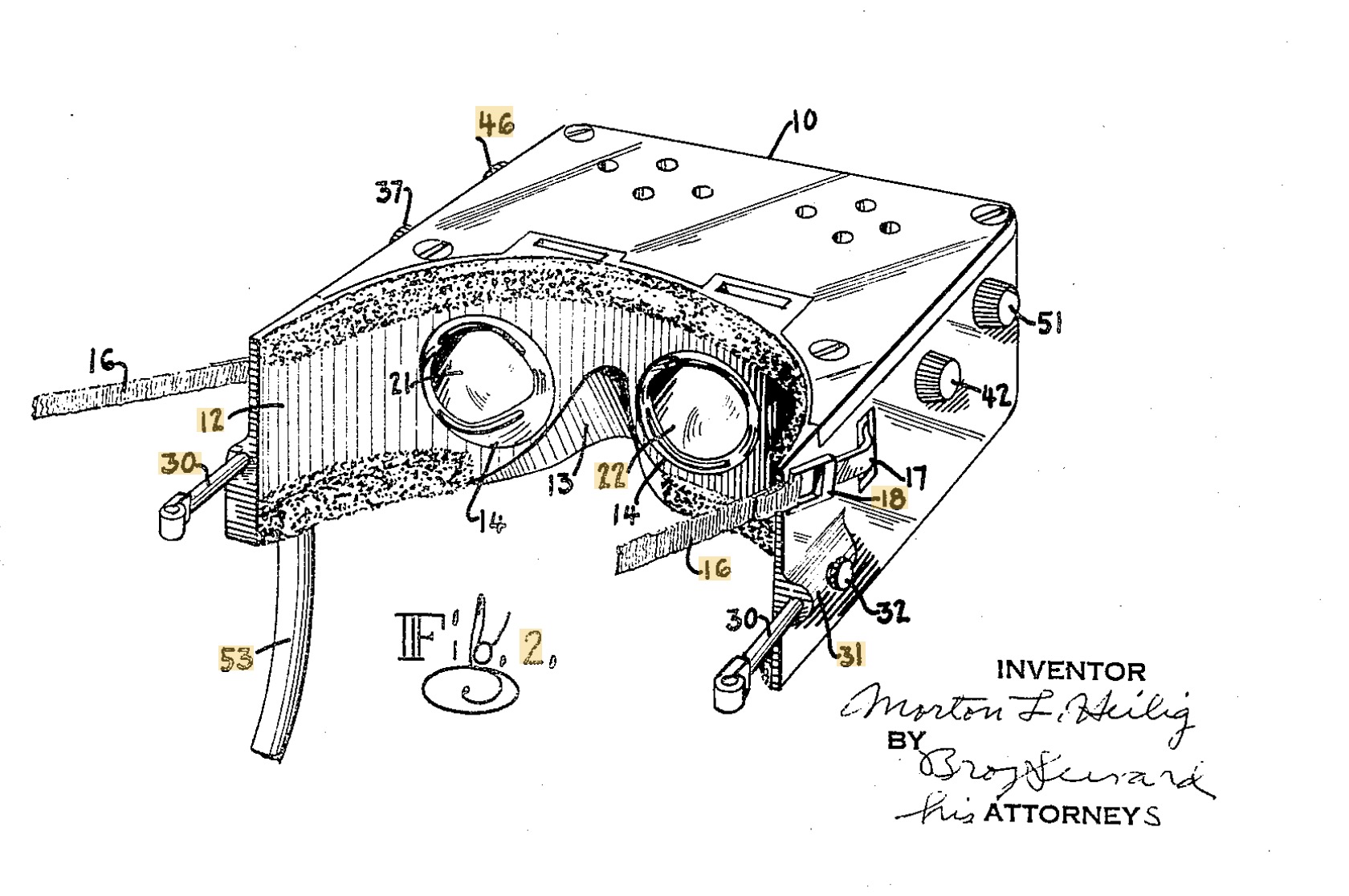
Morton Helig’s 1962 patent describes a system that delivers a realistic simulation for potential work and military training purposes:

There are increasing demands today for ways and means to teach and train individuals without actually subjecting the individuals to possible hazards of particular situations. For example, the armed services must instruct men in the operation and maintenance of extremely complicated and potentially dangerous equipment, and it is desirable to educate the men with the least possible danger to their lives and to possible damage to costly equipment.

Ultimately, however, his work would focus on “Experience Theater” — machines designed to provoke all the senses. It’s easy to see how, in the early 1960s, such a system could be viewed as a logical next step beyond the film and television of the day. The demo described in the book finds the user riding a motorcycle down a Brooklyn street. The borough appears in stereoscopic vision, as the wind hits the riders face, the handlebars vibrate and smells overwhelm. For all of its exciting innovation, however, cost was the major sticking point. It’s a ubiquitous theme throughout the history of VR.

Sketch from Morton Helig’s 1962 patent. Image Credits: Morton Helig

The form factor was different, but Sensorama otherwise hewed closely to modern conceptions of VR. Three years prior to the creation of Sensorama, Helig was granted a patent for a device that appears even more remarkably prescient. The Telesphere Mask was, effectively, a headset with two lenses that provided stereoscopic 3D images for viewing TV shows.

Per the patent:

My invention generally speaking comprises the following elements: a hollow casing, a pair of optical units, a pair of television tube units, a pair of ear phones and a pair of air discharge nozzles, all co-acting to cause the user to comfortably see the images, hear the sound effects and to be sensitive to the air discharge of said nozzles. One object of my invention is to provide easily adjustable and comfortable means for causing the apparatus containing the optical units, to be held in proper position, on the head of the user so that the apparatus does not sag, and so that its weight is evenly distributed over the bone structure of the front and back of the head, without the necessity of holding the apparatus up by hand.

It was, effectively, a version of the Sensorama designed to be worn on one’s head. Both devices suffered the same fate of all things invented decades before they could conceivably be brought to life by existing technologies. Helig died in 1997 at age 70. He survived long enough to see virtual reality become a true pop cultural phenomenon, but never managed to truly capitalize on its success. His inventions, meanwhile, languished in boxes in his Southern Californian home.

An even more direct ancestor to today’s modern XR (extended reality) dates back to the mid-60s, when a team at MIT’s Lincoln Laboratory began their own headset experiments. In 1968, the team produced a system they jokingly deemed “The Sword of Damocles,” owing to a large structural beam that hung over the wearer’s head. One of the system’s key innovations was a magnetic tracking system, designed to monitor head movements to shift the display orientation accordingly.

“Our objective in this project has been to surround the user with displayed three-dimensional information,” project lead Ivan Sutherland wrote in a paper describing the system. “Because we use a homogeneous coordinate representation, we can display objects which appear to be close to the user or which appear to be infinitely far away. We can display objects beside the user or behind him which will become visible to him if he turns around.”

Sutherland, who is still around today at 85, contributed important technological innovations for decades. His best-known innovation is likely Sketchpad, a CAD predecessor and computer graphics program that was — much like his headset — decades ahead of its time.

In a 2013 Time interview, he briefly — and modestly — spoke of The Sword of Damocles, noting, “The name virtual reality might be applied, but it didn’t come along until ten years later.”

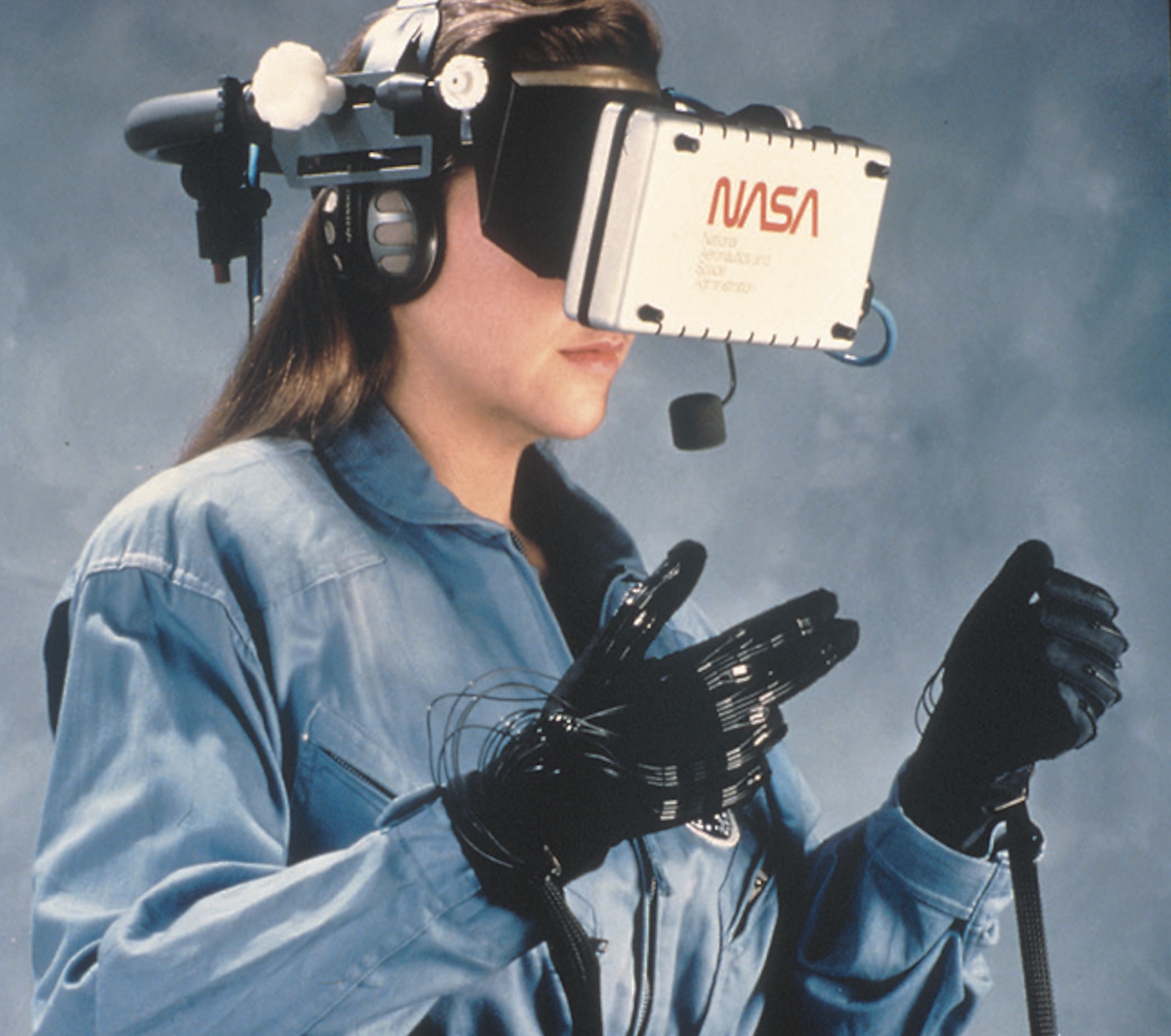
NASA promotion shot of VIEW (Virtual Interactive Environment Workstation). Image Credits: NASA

NASA got in on the action in the mid-70s. Here the applications began to once again focus on simulation for the workplace — the “workplace” in this instance being, of course, space. At the Jet Propulsion Laboratory, David Em made strides in the creation of explorable virtual landscapes, while the Ames Research Center iterated on VIEW (Virtual Interactive Environment Workstation).

The system featured a head-mounted display with head tracking that could be used to explore virtual environments or real remote images from a camera — foreshadowing future breakthroughs in teleoperation. There were gloves designed to track hand movements to interact with virtual objects and a full body “DataSuit” for further movement tracking.

Reflecting on the breakthroughs of the era, Stephen Ellis, the head of Ames’ Advanced Displays and Spatial Perception Laboratory noted simply, “The technology of the 1980s was not mature enough.” It’s yet another pervasive theme that crops up again and again throughout VR’s long history.

The term “augmented reality” wasn’t officially coined until 1990, but the 80s also saw important breakthroughs in the space. Much of that work was built atop decades of military research into heads-up display (HUD) units for aircraft. Steve Mann is commonly referred to as the “father of wearable computing” for innovations like the EyeTap, which combined computer processing with graphical design and textual overlays. Reflecting on his early work, Mann writes:

I started exploring various ways to do this during my youth in the 1970s, when most computers were the size of large rooms and wireless data networks were unheard of. The first versions I built sported separate transmitting and receiving antennas, including rabbit ears, which I’m sure looked positively ridiculous atop my head. But building a wearable general-purpose computer with wireless digital-communications capabilities was itself a feat. I was proud to have pulled that off and didn’t really care what I looked like.

The 80s ushered the term “virtual reality” into the popular lexicon and set the stage for the aforementioned attempts at consumer and arcade VR. Dot-com wasn’t the only bubble to burst at the turn of the millennium, however. In the 90s, virtual reality was the future of entertainment, gaming, socialization and work. In the 00s, however, that future seemed to simply dissipate with a few notable exceptions, including the 2003 launch of early metaverse, Second Life, which remains in operation nearly 20 years later.

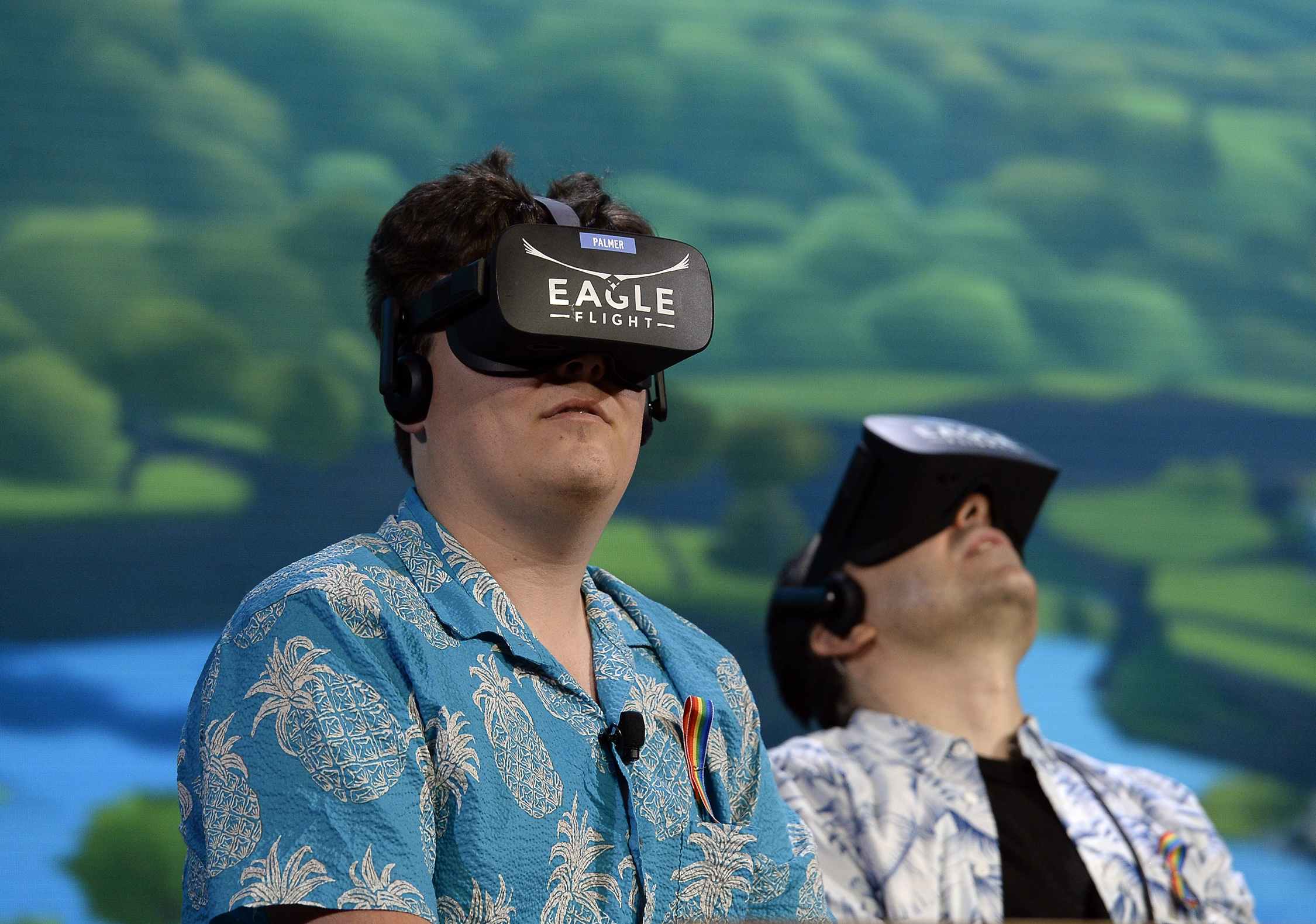
Palmer Luckey, co-founder of Oculus VR Inc., left, plays the new video game “Eagle Flight VR” during an Ubisoft news conference before the start of the E3 Gaming Conference on June 13, 2016 in Los Angeles, California. Photo by Kevork Djansezian/Getty Images

The first Oculus Rift prototype reignited the conversation when it arrived in 2012. For the first time in VR’s long history, it felt as though technology had finally caught up to concept. Breakthroughs in display and computing technology driven by the smartphone industry laid the groundwork for the viable consumer headset. Facebook certainly believed so. In 2014, the social media giant purchased Oculus for nearly $3 billion.

In the intervening decade, virtual reality has begun to take on outsized influence at the company, culminating with its 2021 rebrand to “Meta.” The company believed it had purchased a front row seat to the future. “The first metaverse that gains real traction is likely to be the last,” Oculus exec Jason Rubin wrote in a 50-page internal document laying out the strategy. “We must act first, and go big, or we risk being one of those wannabes.”

Google revealed Glass the same year the first Oculus prototype hit the scene. That year’s I/O continues to be the apex in terms of excitement, owing far more to the crew of Glass-wearing skydivers than the Nexus Q. “You’ve seen some really compelling demos here,” Sergey Brin told the crowd. “They were slick, they were robust. This is going to be nothing like that.” Glass was released for developers in February 2013 for $1,500. Sales opened for consumers later the same year.

The following year, Google introduced Cardboard, a super cheap and extremely clever smartphone accessory. It shipped flat, with a pair of lenses built in. Once folded, a phone was placed inside for a budget-rate VR experience. The platform’s affordability drove strong consumer interest, with around 15 million units shipped over the system’s life. In fact, the program was only officially discontinued in 2021. It managed to outlive the Daydream platform the company introduced at its I/O 2016.

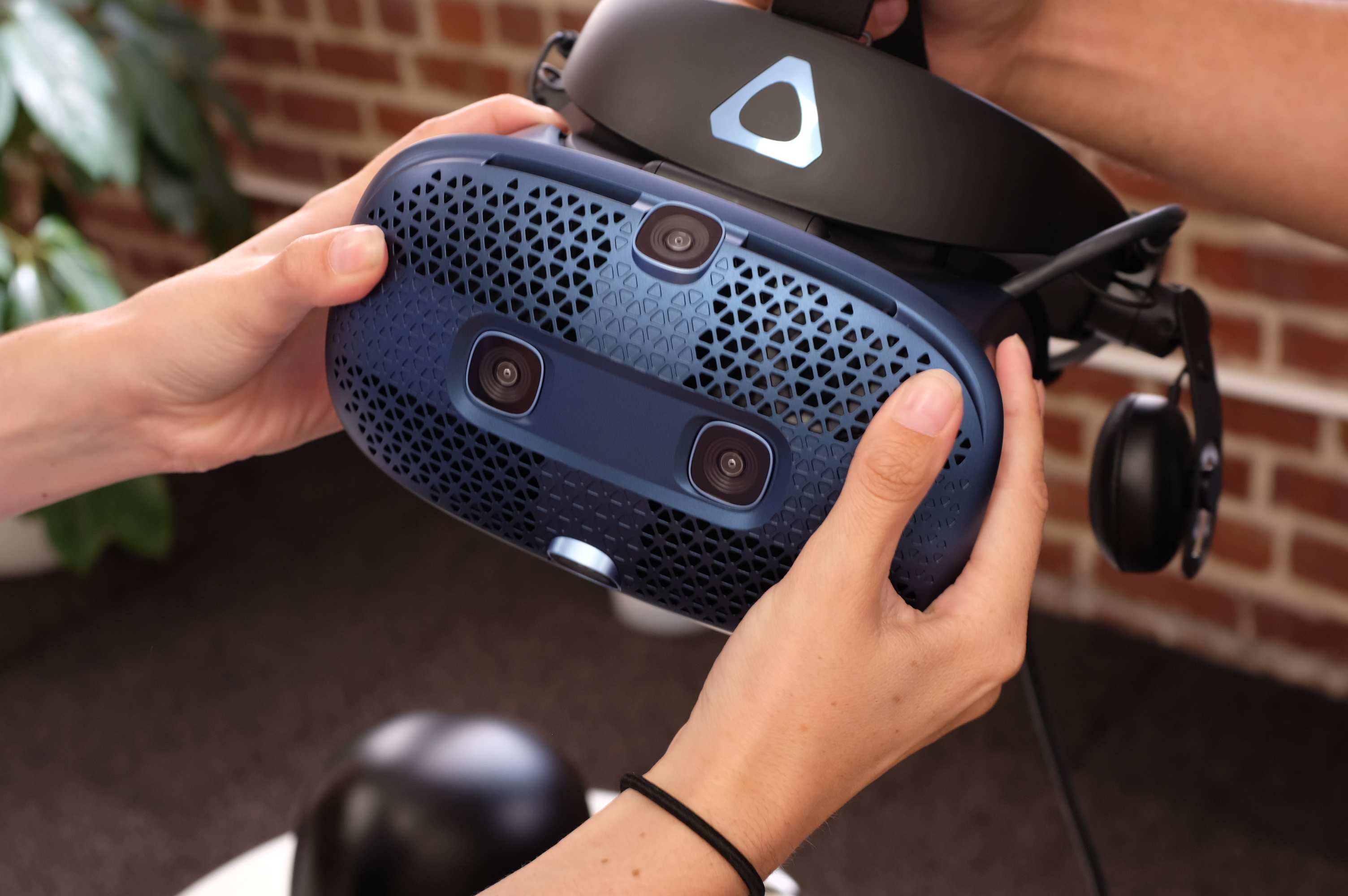
VIVE Cosmos

Image Credits: TechCrunch

When HTC began imagining life after the smartphone, it looked a lot like VR. A collaboration with Valve, the product was introduced as a demo under the “SteamVR hardware system” banner at 2015’s GDC show. Later that year at Mobile World Congress, HTC announced the Vive name during its official unveil. As the company’s smartphone fortunes began to wane, it increasingly shifted eggs into the Vive basket.

In 2016, Microsoft began shipping a developer edition of its mixed reality HoloLens system, priced at $3,000. It was an innovative and impressive product, largely aimed at enterprise applications. The company has yet to introduce a consumer version of the product. 2018, meanwhile, saw the release of the Spielberg-directed Ready Player One, which is at once a nostalgia fest and a love letter to VR’s potential.

Magic Leap officially announced its One headset after years of speculation and rumors. That was fueled, in part, by early funding in excess of $1 billion. The startup would ultimately follow Microsoft’s lead with a pivot into enterprise. “We really saw that there was a value to be derived from AR much sooner from enterprise,” CTO Daniel Diez told me during at interview during this year’s CES. “The feedback we were getting from them was that. It also gave us insight into how the product needed to evolve to be truly purpose-built for enterprise, and that’s what you see in the Magic Leap 2.”

Image Credits: Apple

Magic Leap is far from alone in those struggles. The history of virtual reality is littered with stories of smart people and innovative companies running headfirst into actual reality. Next Monday, Apple is expected to become the latest to stare down that wall. The company has been in the AR business for a minute, launching the development ARKit in 2017 as part of iOS 11 (Google’s ARCore arrived in 2018). Anticipation has thus far been a cocktail of skepticism and faith in the company’s track record. It certainly does have a long, fruitful history of breathing new life into existing categories like the mobile phone, mp3 player, smartwatch and headphones.

All of the conversations I’ve had with competitors this year point to an excitement at that possibility. The hope is that if Apple finds success, it could reverse the fortunes of many in the industry as interest in and excitement around VR increases. Years of rumors paint a far less rosy picture, however. The headset — which might be named the “Reality Pro” — has apparently been in development for eight years. Apple has a long history of waiting until products are just right, but shareholders apparently got sick of waiting.

Tim Cook is said to be less than thrilled with the form factor. His dream of a headset that looks like a standard pair of glasses was just too difficult for engineers to execute. Instead, we’ll likely see something akin to a traditional VR rig. The executive is no doubt aware that the product — for good or ill — will be tied to his legacy as CEO.

Interest in the category has undoubtedly risen ahead of the announcement, and the underlying technologies have advanced by leaps and bounds. But the question remains whether mixed reality is finally ready to stop being ahead of its time.

A brief history of VR and AR by Brian Heater originally published on TechCrunch


from TechCrunch

Smriti Irani`s `Contact US` Jab At Rahul Gandhi After Congress` `Missing` Tweet

The response from Smriti Irani came shortly after the Congress shared a poster indicating that she was “missing,” in an apparent dig at the Union Minister’s silence over the ongoing wrestlers' protest

from Zee News :India National

Tuesday, 30 May 2023

Google DeepMind introduces Barkour, a benchmark for quadrupedal robots

The bipedal humanoids may, in fact, be coming — but the quadrupeds are already here. They’re in labs, doing inspections in power plants and refineries, playing soccer and are even — much to the concern of many — becoming cops.

Boston Dynamics’ Spot is easily the most instantly recognizable of the bunch, but plenty of startups and research institutions have put their own spin on the category. Heck, even Xiaomi made one for some reason. While the purveyors of bipeds look to prove out their work, quadrupeds are getting the job done.

The team at Google’s DeepMind (which recently absorbed a large chunk of Alphabet’s beleaguered Everyday Robots team) just issued a research paper outlining a potential benchmarking system to quantify the performance of these machines. With a name like “Barkour,” one has to wonder whether the department worked backward from the title.

Google Research points to the various impressive feats accomplished by quadrupeds over the years, from hiking up mountains, running and jumping (“flipping is much easier than walking,” as an MIT professor once told me), but there hasn’t really been a baseline for determining system efficacy.

Image Credits: Google

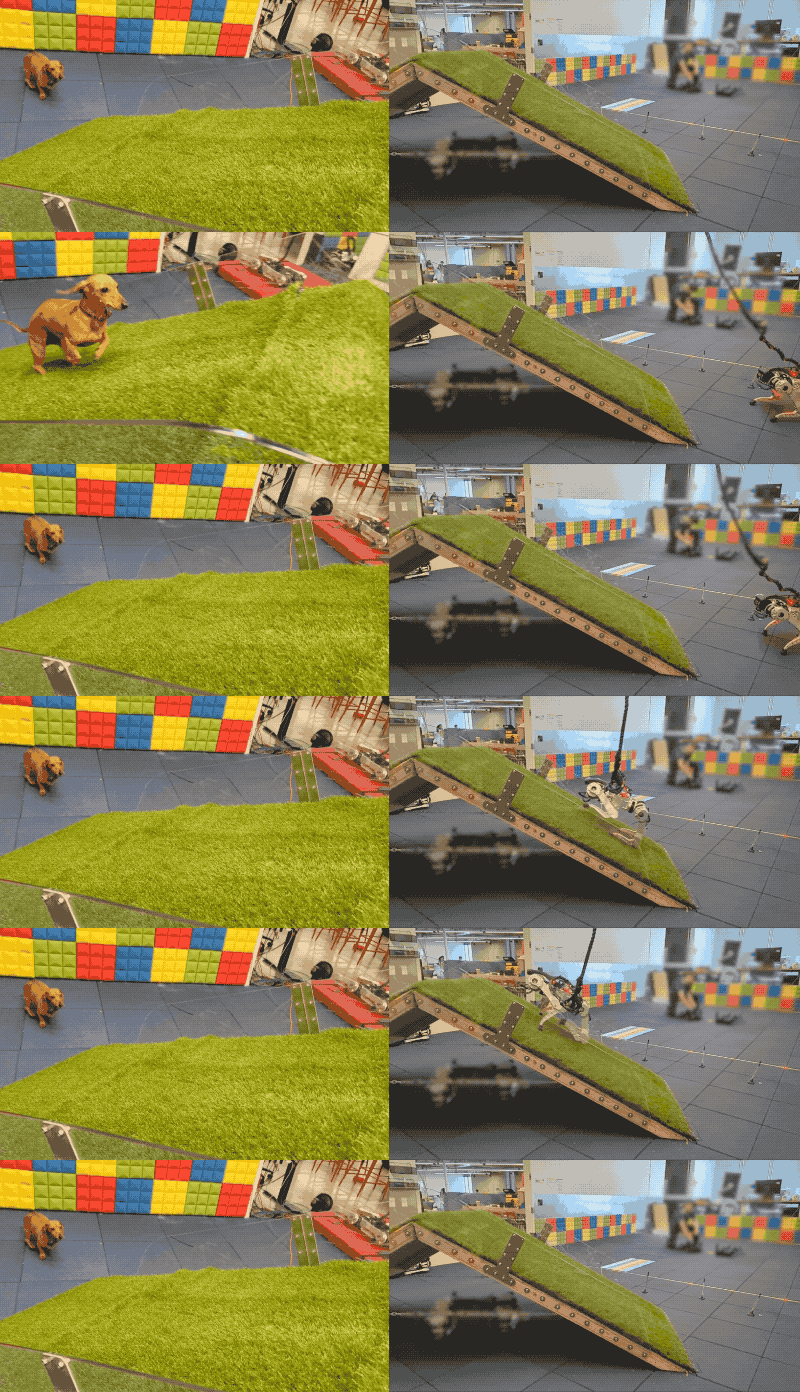
Given that these machines are inspired by animals, the research team determined that real animals would provide the best performance analog for their robotic counterparts. That meant setting up an obstacle course in the lab and having a dog run it — check out the tenacious little wiener above. The course was comprised of four obstacles in a 5×5 meter area, which it notes is denser than the dog shows that inspired it.

Performance is rated on a scale of 0 to 1 — a simple binary to determine whether the robot can successfully cross the space in the 10 or so seconds it takes for a similarly sized dog to do so. Various penalties are for slow speeds and either skipping or failing obstacles on the course. Google concludes:

We believe that developing a benchmark for legged robotics is an important first step in quantifying progress toward animal-level agility. […] Our findings demonstrate that Barkour is a challenging benchmark that can be easily customized, and that our learning-based method for solving the benchmark provides a quadruped robot with a single low-level policy that can perform a variety of agile low-level skills.

The org says that Barkour has proven an effective benchmark even in the face of the inevitable unexpected event and hardware issues. The robot dog used in the trial was able to stand back up and return to the starting line on its own in the case of failure.

Google DeepMind introduces Barkour, a benchmark for quadrupedal robots by Brian Heater originally published on TechCrunch


from TechCrunch

Apple Music Classical is now available on Android

Apple Music Classical is now available on the Google Play Store, bringing the tech giant’s app for classical music to Android users with an Apple Music or Apple One subscription. The launch was first spotted by 9to5Mac.

Back in 2021, Apple acquired classical music streaming service Primephonic and had announced plans to launch a classical music app in the future. Apple Music Classical first debuted on iPhone earlier this year in March. Notably, the Android launch of the app comes before the release of an optimized app for iPad and Mac.

There are more than five million tracks available on the app right now, as well over 50+ million data points with data attributes of 20,000+ composers, 115,000+ unique works and 350,000+ movements. This data helps Apple Music subscribers find recordings across the catalog through the app’s specialized search engine built for classical music.

When Apple launched the iPhone version of the app, the tech giant explained that classical works have multiple movements and tracks, while famous pieces have hundreds of recordings with different orchestras, conductors, and soloists. In addition, many composers have their own special catalog classifications, which means classical music search has to be built differently with these complexities in mind.

Users can search for works using keyword combinations that include composer, work, opus number, conductor, artist, instrument or even the work’s name. Plus, when you look up a work on the app, you’ll find all its associated recordings as well as a hand-picked “Editor’s Choice” performance.

It’s possible that Apple has launched the Android version of the app before optimized versions for the iPad and Mac because Primephonic already has an app for Android, and the new Apple Music Classical will likely replace it.

The Android version of the app requires Android 9 or later and is available worldwide where Apple Music is offered, excluding China, Japan, Korea, Russia and Taiwan.

Apple Music Classical is now available on Android by Aisha Malik originally published on TechCrunch


from TechCrunch

Can Universities Refuse Maternity Leave To Students? Delhi High Court Says This

The observation was made as the court set aside an order passed by Chaudhary Charan Singh University refusing to grant maternity leave to its M.Ed student.

from Zee News :India National

Monday, 29 May 2023

Amit Shah Chairs High-Level Meeting In Manipur Over Violence In State

The meeting aimed at assessing the situation in Manipur and plan further steps to restore normalcy there.

from Zee News :India National

Sunday, 28 May 2023

Ford EVs will have Tesla DNA and Waymo’s robotaxis are coming to Uber

Welcome back to The Station, your central hub for all past, present and future means of moving people and packages from Point A to Point B.

I’m turning the wheel over to Rebecca Bellan next week, and she’s mostly steering things this week (I had to add a few of my thoughts in here cuz I can’t help myself). You’re in good hands!

The big news before the Memorial Day holiday weekend caught many by surprise. I’m talking about the Tesla-Ford agreement. The deal will mean Tesla tech, specifically its charging port, will be integrated into Ford’s second-generation EVs that are slated to come out in 2025.

The deal was announced by Ford CEO Jim Farley and Tesla CEO Elon Musk via, you guessed it, a Twitter Spaces — Musk’s latest push toward turning Twitter into an actual town square. No glitches for this one, at least. 

In the future, Ford’s next generation of EVs will be equipped with Tesla’s charge port, called the North American Charging Standard, starting in 2025. This will give them access to 12,000 Tesla Superchargers in the U.S. and Canada, which is double the number Ford customers currently have access to. Ford’s BlueOval Charge Network has over 10,000 public DC fast-chargers. 

During the event, Farley praised the location of Tesla’s Superchargers, the reliability of the routing software and the ease of use of Tesla’s connector. 

The two CEOs have remained friendly at times despite competing against each other. Musk has applauded Ford in the past, noting on several occasions that only Tesla and Ford have avoided bankruptcy. As they chatted live with over 200,000 people listening in, Farley and Musk seemed to hint at future potential collaborations.

In response to Farley’s noting that making a “fully software updatable vehicle” is “super hard,” Musk responded that Tesla would be happy to “be helpful on the software front” and might “open source more code” to automakers. 

Farley also asked Musk about Tesla’s new lithium refinery in Corpus Christi, which is notable given that Ford just secured a series of deals to ensure its own access to lithium.

Both Ford and Tesla shares jumped over 7% in after-hours trading as a result of the news.


So you might have heard, but in case you didn’t, TechCrunch is searching for 200 early-stage companies for Startup Battlefield at Disrupt this September. Comes with a chance to win a $100,000 in equity-free $$ and cool kid creds. Apply by May 31.


Want to reach out with a tip, comment or complaint? Email Kirsten at kirsten.korosec@techcrunch.com. You also can send a direct message to @kirstenkorosec. Or you can reach Rebecca at rebecca.techcrunch@gmail.com or follow her at @rebeccabellan.

Reminder that you can drop us a note at tips@techcrunch.comIf you prefer to remain anonymousclick here to contact us, which includes SecureDrop (instructions here) and various encrypted messaging apps.

Micromobbin’

the station scooter1a

Äike launched its e-scooter subscription service in San Francisco in partnership with Tempo, a new startup founded by former Scoot CEO Michael Keating that enables electric mobility brands to offer vehicle subscriptions. The exclusive partnership between the two means Äike customers can subscribe to the company’s Äike T scooter (which by the way can be charged with a regular USB-C laptop charger) on a month-to-month or annual basis. 

Beam is trialing tactile signage on its e-scooters in New Zealand to allow those who are blind, deafblind or have low vision better identify e-scooters and report issues like badly parked scooters. 

Dallas is opening itself back up to scooters after banning shared companies in 2020. Bird, Lime and Superpedestrian are the three to win the permit. 

Cake launched its NYC flagship showroom this week. To celebrate, the company also launched the NYC edition of the Makka, its lightweight urban commuter.

Gogoro is expanding its partnership with Bikebank in South Korea to introduce its Smartscooters and battery swapping under the Dotstation brand in the third quarter. This will bring Gogoro’s battery swapping network to seven cities beyond Seoul, where the scooters and swaps have been operating for food deliveries since 2019.

NYC’s DOT is publishing six self-guided cycling routes — each with a different theme — to encourage more safe cycling in the city, and I think that’s swell. The first one is geared toward women’s empowerment and next month’s will include LGBTQIA+ landmarks for Pride Month in June.

Pave Motors launched its first electric motorbike, the Pave BK. It’s got a sleek and minimal design that demonstrates how lightweight it is. It has a range of up to 50 miles and can go up to 30 mph in just 3.7 seconds.  

Virgo has launched a kickstarter for its full-face helmet that protects the head, chin and jaw. It’s lightweight and has a detachable LED rear light. As e-bikes get faster, it’s important to protect that precious skull.

Deal of the week

money the station

Lordstown Motors is jumping into the reverse stock split fray, an increasingly popular move among the struggling SPAC set. The reverse stock split is Lordstown’s last-ditch effort to pull itself out of the penny stock doldrums and salvage a deal with Foxconn.

The 1:15 reverse stock split was to be expected after Lordstown cautioned investors in early May that it might have to file for bankruptcy after Foxconn threatened to pull out of a critical funding deal. Foxconn had previously agreed to buy out 10% of Lordstown’s common stock for $47.3 million, but Lordstown’s sub $1 share price caused a dispute between the two.

The EV maker is one of the latest in a series of transportation SPACs to turn to reverse stock splits in order to regain stock market compliance, including Bird, Helbiz and Arrival.

Other deals that got my attention … 

Applied Intuition is acquiring Embark Trucks for $71 million. The acquisition comes a couple of months after Embark had to cut 70% of its workforce.

Indian startup Chalo has raised $45 million in equity and $12 million in debt as it works to deepen its mobility offerings, transform bus commutes and launch in international markets. The Series D round was led by Avataar Ventures, with existing investors, including Lightrock India, WaterBridge Ventures and Amit Singhal, a former Google exec.

ClearMotion, the software-defined chassis company based in Massachusetts, raised $32 million from NewView Capital, Acadia Woods, BAI Capital, NIO Capital and Liberty Street. This follows a $39 million investment led by NIO Capital in September 2022.

Nikola received a delisting notice from the Nasdaq because its stock price has been trading below $1 for the past 30 days. Nikola is among a growing list of EV SPACs that have suffered on the public markets and have risked delisting.

Stellantis’ venture arm has invested an undisclosed amount into Lyten, a company developing lithium sulfur battery technology. The investment is part of Lyten’s Series B, which the company didn’t share details about. However, here’s a little puzzle for you. Stellantis tells us that Lyten’s Series B is expected to exceed its Series A of $160 million. Stellantis Ventures made up a significant fraction of the B round. Fun fact about Lyten: Celina Mikolajczak, a well-known battery expert who has held top positions at Tesla, Panasonic, and most recently QuantumScape, is Lyten’s chief battery technology officer.

TechCrunch (virtually) in Atlanta

On June 7, TechCrunch will host City Spotlight: Atlanta. We have a slate of amazing programming planned, including a fireside chat with Ryan Glover, the co-founder of the fintech Greenwood, as well as a panel that examines the venture ecosystem within the Atlanta region and identifies the best ways to raise and meet with local venture capitalists. But that’s not all. If you are an early-stage Atlanta-based founder, apply to pitch to our panel of guest investors/judges for our live pitching competition; the winner gets a free booth at TechCrunch Disrupt this year to exhibit their company in our startup alley. Register here.

Notable reads and other tidbits

ADAS

U.S. Transportation Secretary Pete Buttigieg called out Tesla’s Autopilot this week. “There’s a real concern that’s not limited to the technology itself but the interaction between the technology and driver,” he said. In other words, while the tech doesn’t need to be perfect yet, we can’t deny that drivers often have a false sense of security, which can lead to accidents.

Tesla launched FSD Beta in Europe and Australia. It’s a small-scale launch, with one Model S in Belgium and another in Germany getting an update and a Model 3 in Australia receiving the beta software. For those who don’t know, FSD is already available in New Zealand, according to a Tesla salesperson who took me on a test drive the other day. 

Autonomous vehicles

Moia, Volkswagen’s on-demand ride-pooling company, will use Apex.AI’s operating system to develop their autonomous ride-pool service for the future self-driving “ID. Buzz AD.” 

Ever wonder what the policy and regulatory barriers holding back self-driving vehicles are, and how we can remove them? Well, the firm Hatch has 80 pages of answers for you, including over 40 recommendations. Some of those recommendations include a new language for regulators to describe automated vehicles, a proposal for allocation of liability and responsibility among passengers and automated-driving systems and a program for the introduction of automated trucking. 

Waymo and Uber have agreed to a multiyear strategic partnership that will see Waymo’s self-driving cars on Uber’s ride-hail and delivery platform, starting in Phoenix later this year.

Electric vehicles, batteries and charging

Australia reached an agreement with the U.S. to develop its critical minerals industry in cooperation with the U.S. The deal paves the way for Aussie suppliers of minerals like lithium, as well as renewable energy, to be treated as domestic suppliers under the U.S. Defense Production Act. 

BMW and Meta reached a joint research breakthrough that will allow virtual reality headsets to work in moving cars. Jeremy Bailenson, founding director of Stanford University’s Virtual Human Interaction Lab, says he thinks bringing VR headsets — the most immersive medium ever invented — to cars will kill people.

BMW also extended its partnership with AirConsole to bring gaming to its new 5 Series sedan, which promises an all-electric i5 variant as well as a performance M5 sports sedan. The 5 Series is surprisingly spacious and unsurprisingly luxury filled, including a new digital dashboard and BMW’s so-called hands-free driver-assistance system.

The California Air Resources Board is urging the Biden administration to grant approval for its proposal to ban the sale of gas-powered vehicles in the state by 2035. The Board had already approved its own plan in August, but it still needs a green light from the Environmental Protection Agency to enforce it.

Ford has gone back on its decision to build new vehicles without AM radio after pressure from lawmakers. Many automakers, including Tesla, BMW, and Volkswagen, have said they plan to ditch AM radio because it interferes with electrical engines. So policymakers introduced a bill calling NHTSA to require AM radio in vehicles for public safety reasons. Ford CEO Jim Farley had a chat with some of them and apparently was convinced. Will other automakers follow?

Speaking of Ford, the company revealed details about its next-gen full-sized SUV EV, which CEO Jim Farley referred to as “a personal bullet train.” The new EV platform, which will go into the T3 e-truck and three-row SUV that’ll go into production in 2025, demonstrates a new strategy by Ford to reduce battery pack size while maintaining performance and range.

General Motors plans to unveil an all-electric Cadillac Escalade later this year. GM revealed almost no details about the so-called Escalade IQ, but we’re pretty sure it’ll be built off GM’s next-gen Ultium platform and could feature around a 450-mile range.

Hyundai is partnering with LG Energy to build a $4.3 billion EV battery factory in the U.S. to take advantage of tax credits. This is Hyundai’s second U.S. battery partnership announcement in recent weeks. The automaker is also partnering with SK On.

Tata Motors, owned by Jaguar Land Rover, is reportedly choosing Britain over Spain for its multi-billion-pound electric car battery plant.

Tesla CEO Elon Musk hinted in a joint Twitter Spaces announcement with Ford that the automaker might “open up some of its automotive operating system code to other automakers.” 

Uber is launching Uber Green in India, an effort to introduce more EVs to the platform. The company will add 25,000 EVs to its platform in partnership with fleet providers like Lithium, Everest and Moove, and it’ll roll out 10,000 electric two-wheelers in Delhi by 2024 with Zypp Electric.

VinFast issued its first recall for some of its 2023 VF8 vehicles due to a software glitch that caused the dashboard screen to go blank. The dashboard in VinFast’s cars shows critical information like the speedometer or warning lights. The automaker will fix the problem with an OTA update.

Volvo has shared new details on its upcoming EX30 electric SUV, and by new details, we mean promotional images showing a vehicle for ANTS. Volvo claims the vehicle’s carbon footprint is smaller “than any Volvo car ever before.”

Gig Economy

In a disappointing turn for labor rights activists, Minnesota governor Tim Walz vetoed a bill that would have guaranteed a minimum wage and other protections for Uber and Lyft drivers. 

Miscellaneous

Candela has revealed its Candela C-8 Polestar edition hydrofoil boat, which the company says combines Polestar’s Scandinavian take on luxury EV design with Candela’s boat tech.

Nvidia will integrate its GPU chiplet into MediaTeks automotive system-on-chips to jointly deliver a range of in-vehicle AI cabin solutions for software-defined vehicles. 

German authorities are investigating a potential data leak by Tesla. The automaker reportedly failed to adequately protect data of customers, employees and business partners, according to local business newspaper Handelsblatt. The paper received 100 gigabytes of confidential leaked data.   

People

Bosch created a new regional board to oversee its mobility business in North and South America, led by Paul Thomas as president of the Americas for Bosch Mobility.

EVR Motors, an Israel-based electric motor company, appointed Nick Rogers to its board. Rogers was a former executive director of product engineering and board member at Jaguar Land Rover.

Kodiak Robotics hired Steve Kenner as its vice president of safety. Kenner has a long career in tech and automotive with stints at Apple, Ford, General Motors and Uber.

Swvl Holdings appointed Ayman Ismail Mohamed Ahmed to its board of directors.

Urban Air Mobility

Vertical Aerospace said South Korean ride-hailing service Kakao Mobility has pre-ordered up to 50 of Vertical’s VX4 aircraft. Recall that last year, Kakao and Vertical joined LG Uplus, Pablo Air, Jeju Air and GS Caltex to participate in South Korea’s K-UAM Grand Challenge to commercialize urban air mobility. 

Ford EVs will have Tesla DNA and Waymo’s robotaxis are coming to Uber by Kirsten Korosec originally published on TechCrunch


from TechCrunch

FIR Against Protesting Wrestlers After March Towards New Parliament

The FIR has been filed hours after a scuffle broke after the protestors - including national wrestlers Sakshi Malik, Vinesh Phogat and Bajrang Punia - tried to march towards the new Parliament building inaugurated today by Prime Minister Narendra Modi.

from Zee News :India National

Saturday, 27 May 2023

Windows adds support for RAR, Netflix cracks down on passwords, and Meta lays off workers

Welcome, folks, to Week in Review (WiR), TechCrunch’s regular column that rounds up the week in tech news. Dunno about y’all, but it’s felt like a long one — and I’m thankful for the extended weekend. For those observing Memorial Day, do enjoy. Those not, take the time off where you’re able. We all need rest here and there.

First, a few PSAs.

This week, TechCrunch Live hosted Flint Capital and Sensi.AI, a startup using audio-based software to monitor patients and assist medical staff and family members with care. To those of you who tuned in, many thanks. But if you missed it, not to worry — we’ll have the recording up shortly.

Then, in September, there’s Disrupt, TC’s annual conference. Whether you’re a startup rookie learning the ropes, a seasoned investor searching for the next big thing or a founder hell-bent on changing the world, Disrupt will deliver the tools, knowledge and connections to help you make it happen.

Now, on with the news.

most read

After 28 years, Windows gains RAR support: Devin writes about Microsoft bringing native support for the RAR archive format to Windows. Miraculously, it took the better part of three decades for the .rar file to finally be supported in Windows without any kind of additional software. That’s longer than I’ve been alive, dear readers — not to date myself!

Netflix begins password crackdown: After a delayed launch, Netflix’s crackdown on password sharing is now beginning to roll out to U.S. subscribers and other global markets. The streamer had originally planned to introduce “paid sharing” to U.S. subscribers in the first quarter of this year but pushed the start date back to the summer after seeing cancellations in markets where it had already launched the changes.

More layoffs at Meta: Meta is waging its latest round of layoffs on Wednesday, estimated to impact about 6,000 people. These cuts are part of the company’s so-called Year of Efficiency, in which Meta is being massively restructured to save money and flatten the organization structure.

EU orders Meta suspension: In other Meta news, Meta was hit this week with a formal suspension order requiring it to stop exporting EU user data to the U.S. for processing. Today, the European Data Protection Board announced that Meta has been fined €1.2 billion (close to $1.3 billion), which the Board confirmed is the largest fine ever issued under the bloc’s General Data Protection Regulation (GDPR).

Meta forced to sell: Meta, dominating the headlines once again this week, sold Giphy — the animated GIF search engine it acquired for $400 million three years ago — to Shutterstock. The sale wasn’t voluntary, necessarily; seven months ago, the U.K.’s antitrust authority issued a final order for Meta to sell Giphy, on the grounds that the merger reduced competition.

WhatsApp adds message editing: WhatsApp announced one of the app’s most anticipated features this week — message editing. WhatsApp users can now modify a message within 15 minutes of sending the message. The edited messages will have an “edited” tag next to the time stamp to mark the change.

The problem with paid verification: The fake Pentagon attack hoax that went viral this week shows the perils of Twitter’s paid verification scheme. The gist? The combination of paid blue checks and generative AI makes it all too easy to spread misinformation — and quickly.

Investing in India: Amazon plans to invest $12.7 billion into its cloud business in India by 2030, the e-commerce group said Thursday, as it pushes ahead to scale up the AWS infrastructure in the key overseas market at a time when it has pared back several other services in the region.

Bigger and better: Amazon launched its biggest tablet this week. Called the Fire Max 11, it has an 11-inch screen. The company is pricing the device at $229.99 — offering a cheaper option for users than the 10.9-inch iPad and the new Pixel tablet with a similar-sized screen.

AI to build websites: This week at its annual Build conference, Microsoft launched Copilot in Power Pages — an AI-powered assistant for Microsoft’s low-code business website creation tool — in a preview for U.S. customers. Given prompts, Copilot can generate text, forms, chatbots and web page layouts and can create and edit image and site design themes.

TechCrunch (virtually) in Atlanta

On June 7, TechCrunch will host City Spotlight: Atlanta. We have a slate of amazing programming planned, including a fireside chat with Ryan Glover, the co-founder of the fintech Greenwood, as well as a panel that examines the venture ecosystem within the Atlanta region and identifies the best ways to raise and meet with local venture capitalists. But that’s not all. If you are an early-stage Atlanta-based founder, apply to pitch to our panel of guest investors/judges for our live pitching competition; the winner gets a free booth at TechCrunch Disrupt this year to exhibit their company in our startup alley. Register here.

audio

In need of a podcast (or several)? You’ve come to the right place — there’s no shortage of options out of TC HQ. This week on Found, the crew was joined by Sarah Sandnes, the co-founder and CTO of SafetyWing, which is creating a global safety net for remote workers. TechCrunch Live, meanwhile, featured Mark Rostick from Intel Capital and Garima Kapoor from MinIO, a startup that found a niche selling object storage while competing directly with Amazon S3.

TechCrunch+

TC+ subscribers get access to in-depth commentary, analysis and surveys — which you know if you’re already a subscriber. If you’re not, consider signing up. Here are a few highlights from this week:

Profitability over growth: In this piece by Kate, five investors explained their mantra for South Korean startups. Kate spoke to select investors who make investments in the South Korean market to hear their predictions for 2023, their investment strategy, which sectors excite them and more.

Cybersecurity downturn: Alex writes about how, on the back of pretty strong earnings reports and valuations, public cybersecurity companies are outperforming the broader technology segment. Yet, funding for cybersecurity startups has flatlined.

Startups in the enterprise AI race: Another piece by Alex explores whether startups have a shot in enterprise AI. Given how lucrative selling software to large corporations can prove, he notes, the players aren’t chasing a small market.

Windows adds support for RAR, Netflix cracks down on passwords, and Meta lays off workers by Kyle Wiggers originally published on TechCrunch


from TechCrunch

Sengol Symbol Of Transfer Of power, But Was Kept As Walking Stick At Anand Bhawan: PM Modi

PM Modi said that the symbol of the transfer of power, Sengol, which was kept as a 'walking stick' in Prayagraj's Anand Bhavan will get its rightful place on Sunday.  

from Zee News :India National

Friday, 26 May 2023

`Sengol Is Pride Of Tamil Nadu`: Thiruvavuduthurai Adheenam Math Chief Slams Congress

Speaking to reporters, the pontiff of Thiruvavuduthurai Adheenam (math), said: "We are disappointed by the lies that are being spread by some people. This is a great pride for Tamil Nadu. The Sengol went from Thiruvavuduthurai Adheenam, from Chola Nadu. 

from Zee News :India National

Thursday, 25 May 2023

With new grant program, OpenAI aims to crowdsource AI regulation

OpenAI says it’s launching a program to award ten $100,000 grants to fund experiments in setting up a democratic process for deciding what rules AI systems should follow — “within the bounds defined by the law.”

The launch of the grant program comes after OpenAI’s calls for an international regulatory body for AI akin to that governing nuclear power. In its proposal for such a body, OpenAI co-founders Sam Altman, Greg Brockman and Ilya Sutskever argued that the pace of innovation in AI is so fast that we can’t expect existing authorities to adequately rein in the tech — a sentiment today’s announcement captures, as well.

Concretely, OpenAI says it’s seeking to fund individuals, teams and organizations to develop proof-of-concepts for a “democratic process” that could answer questions about guardrails for AI. The company wants to learn from these experiments, it says, and use them as the basis for a more global — and more ambitious — process going forward.

“While these initial experiments are not (at least for now) intended to be binding for decisions, we hope that they explore decision relevant questions and build novel democratic tools that can more directly inform decisions in the future,” the company wrote in a blog post published today. “This grant represents a step to establish democratic processes for overseeing … superintelligence.”

With the grants, furnished by OpenAI’s nonprofit organization, OpenAI hopes to establish a process reflecting the Platonic ideal of democracy: a “broadly representative” group of people exchanging opinions, engaging in “deliberate” discussions, and ultimately deciding on an outcome via a transparent decision-making process. Ideally, OpenAI says, the process will help to answer questions like “Under what conditions should AI systems condemn or criticize public figures, given different opinions across groups regarding those figures?” and “How should disputed views be represented in AI outputs?”

“The primary objective of this grant is to foster innovation in processes — we need improved democratic methods to govern AI behavior,” OpenAI writes. “We believe that decisions about how AI behaves should be shaped by diverse perspectives reflecting the public interest.”

In the announcement post, OpenAI implies that the grant program is entirely divorced from its commercial interests. But that’s a bit of a tough pill to swallow, given OpenAI Altman’s recent criticisms of proposed AI regulation in the EU. The timing seems conspicuous, too, following Altman’s appearance in front of the U.S. Senate Congressional Committee last week, where he advocated for a very specific flavor of AI regulation that’d have a minimal effect of OpenAI’s technology as it exists today.

Still, even if the program ends up being self-serving, it’s an interesting direction to take AI policymaking (albeit duplicative of the EU’s efforts in some obvious ways.) I, for one, am curious to see what sort of ideas for “democratic processes” emerge — and which applicants OpenAI ends up choosing.

Folks can apply to the OpenAI grant program starting today — the deadline is June 24 at 9 p.m. Once the application period closes, OpenAI will select ten successful recipients. Recipients will have to showcase a concept involving at least 500 participants, publish a public report on their findings by October 20 and open-source the code behind their work.

With new grant program, OpenAI aims to crowdsource AI regulation by Kyle Wiggers originally published on TechCrunch


from TechCrunch

Motor City mechatronics

A number of native Detroiters have asked me what I think about their city so far. The simple answer is that I don’t feel qualified to offer much insight yet. I’ve been here for roughly three days as I write this, and I haven’t seen all that much of the city. Ask me what I think about the Huntington Place convention center, on the other hand, and I can speak with great authority

I admit that I’m still overly impressed by the fact that, when you walk through the building’s rear entrance, you’re suddenly face-to-face with Canada. It’s something that I may well not have realized were it not for the giant red and white maple leaf flag flying on the Detroit River’s north coast.

I briefly entertained the notion of crossing the border for dinner, for the sole purpose of telling friends that I had dinner in another country, but hailing a rideshare across the bridge wasn’t as straightforward as I’d been led to believe — a fact exacerbated by the fact that it was Victoria Day on Monday (which appeared to visibly impact attendance on the first day of the show).

One thing you’ll find with Detroit is that the people who live there are fiercely loyal to their home — a common characteristic among Rust Belt cities. They cheerlead for the city to all who will listen and defend it with ferocity if you’re foolhardy enough to criticize it. At the same time, however, citizens aren’t blind to — nor do they ignore– decades of struggle. If you know one thing about the city beyond its professional sports teams, it’s likely that its destiny has been shaped by manufacturing probably more so than any other major American city.

Detroit is an industry town, in the purest sense of the term. It’s well positioned in the middle of the country. It has ready access to iron and timber, along with rivers and trains that provide a straight shot to ship heavy machines to and from other major American cities like New York and Chicago. Michigan native Henry Ford incorporated his company in the Detroit suburb Dearborn in 1903. His deeply problematic shadow still looms large over the city, much like Carnegie in Pittsburgh. Ask someone what you should see during your short time in town, and the Henry Ford Museum will invariably make the list. (I opted to spend my limited non-show time at the very good Detroit Institute of Arts instead. Take that, Hank!)

High Angle Shot Of Detroit Cityscape Against Clouds

Image Credits: Jose Francisco Arias Fernandez / EyeEm / Getty Images

GM acquired its way into Detroit after being founded 68 miles northwest in Flint in 1908. A year later, the company came within $2 million of adding Ford to its growing list of subsidiaries. (Add that to the list of historical hinge points for the sci-fi book you’re writing.) Walter Chrysler was the last of the big three, founding his namesake corporation out of the ashes of the Maxwell Motor Company in 1925.

If you’re aware of all that, you almost certainly know the other side of the coin: what happens when an industry town’s industry leaves town. While the big three still operate out of the area, the ghost of manufacturing still haunts over the area. First came the decentralization outside of the city proper, and then broader economic troubles and resulting slowed car sales, while increased competition overseas loosened the city/country’s stranglehold on the automotive industry.

Image Credits: Brian Heater

Obviously the full story is far more complex than all of that. Politics and racial inequities played key roles as well. A city so inexorably tied to the automobile was far more motivated to embrace freeways over public transit. These sorts of decisions have a way of increasing both economic and racial disparities. Meanwhile, much of the white population skipped out of the city proper, in favor of the suburbs, which now include some of the wealthiest zip codes in the country. The gulf between the rich and the poor has a way of widening the later you get into capitalism’s progression. I’m reminded of this every time I head home to San Francisco, where people are forced to live out on the streets in front of some of the world’s richest corporations.

Much like my first visits to cities like Pittsburgh and Baltimore, I had certain expectations heading to Detroit for the first time. From my extremely limited experience in both, it seems like Pittsburgh and Detroit, in particular, are on similar paths, but the former has a sizable head start.

One thing many who visit the city will point to are the abandoned buildings. The population decline can’t be ignored. In prosperous post-war 1950, the city claimed 1.85 million residents, making it the fifth largest American city. The 2021 census, however puts the figure at 633,000. Devoid of people, these thriving organisms begin to feel like monuments. 

For years, my distant impression of the city has been flavored by stories of revitalization. For one thing, population decreases lead to rent drops, which can, in turn, birth a thriving arts scene. The word “renaissance” has been thrown out many times in recent decades.  The fact of life in 2023 is that living in places like New York, Los Angeles and San Francisco can be unattainable on an artist’s income. In recent decades, Detroit has offered a compelling cross section of cheap rent and rich culture — some of the greatest music in the history of the world was produced here. I took a car straight to the Motown house after I landed. There’s something truly magical about a place that gave us Diana Ross, the MC5, Detroit techno, Dirtbombs, The White Stripes and Danny Brown.

At the end of the day, however, a thriving art scene is great at attracting young people but is unfortunately rarely an epicenter for a thriving economy. I’ve also long heard whispers about the return of manufacturing to the city. Certainly Detroit has the infrastructure necessary, and the continued presence of automotive headquarters is key, especially as more companies look to decentralize and localize manufacturing due both to ongoing supply chain concerns and the very real possibility of deepened U.S.–China tensions.
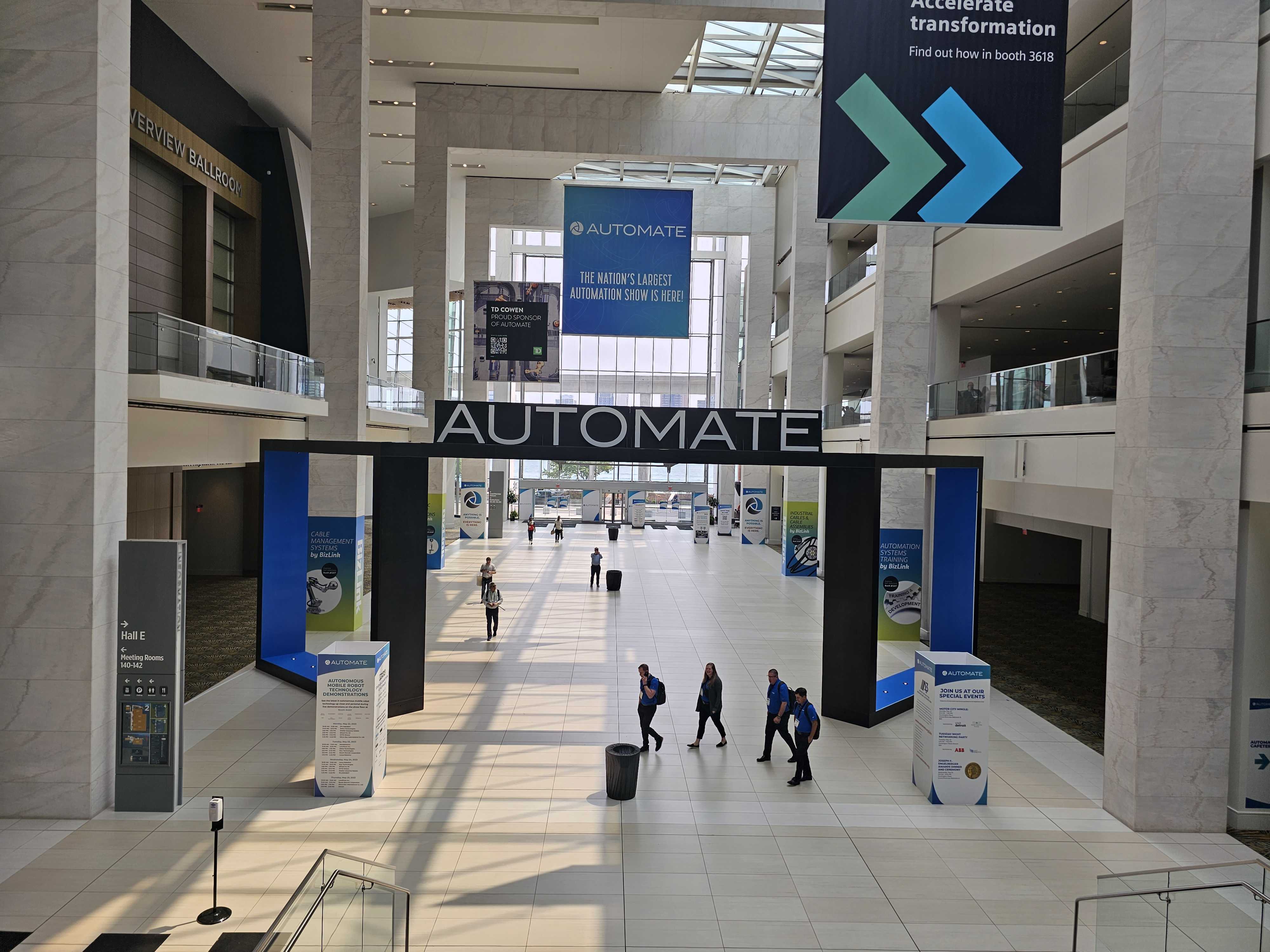
Image Credits: Brian Heater

“I think one of the challenges that we saw exposed during COVID was supply chain issues,” president of the Association for Advancing Automation (A3) and Detroit native Jeff Burnstein told me during a conversation this week. “It’s not easy to do, but a lot of companies would like to bring more manufacturing back to North America. You can’t just rip up your supply chain, of course. . . . But they were able to do it because of automation. One of the limiting factors [for reshoring] is that we don’t have enough people who are skilled.”

There do appear to be some good initiatives in place, and I’m increasingly hearing stories from hardware startups that have been pushing to bring assembly and/or manufacturing closer to home. True, lasting success takes time and a lot of money, along with the concerted efforts of both industry and government. I went to an event last night at Newlab’s shiny new Detroit offices last night. The space and the growing number of startups point to key dollars entering the market.

The campus is located in a fairly remote part of the city, near the Ambassador Bridge, which carries roughly one-quarter of all U.S./Canada merchandise trade each year. The biggest benefit of the area is that there’s plenty of room to grow and — in theory — help foster a thriving startup community. In addition to big tech companies like Google and the native StockX, smaller startups from the area are starting to get national recognition. RoboTire, the robotic tire change firm we’ve written about a few times over the years, served as a kind of poster child at this week’s show. Certainly the company is a great example of leveraging Detroit’s automotive expertise as the foundation of something new and bleeding edge.
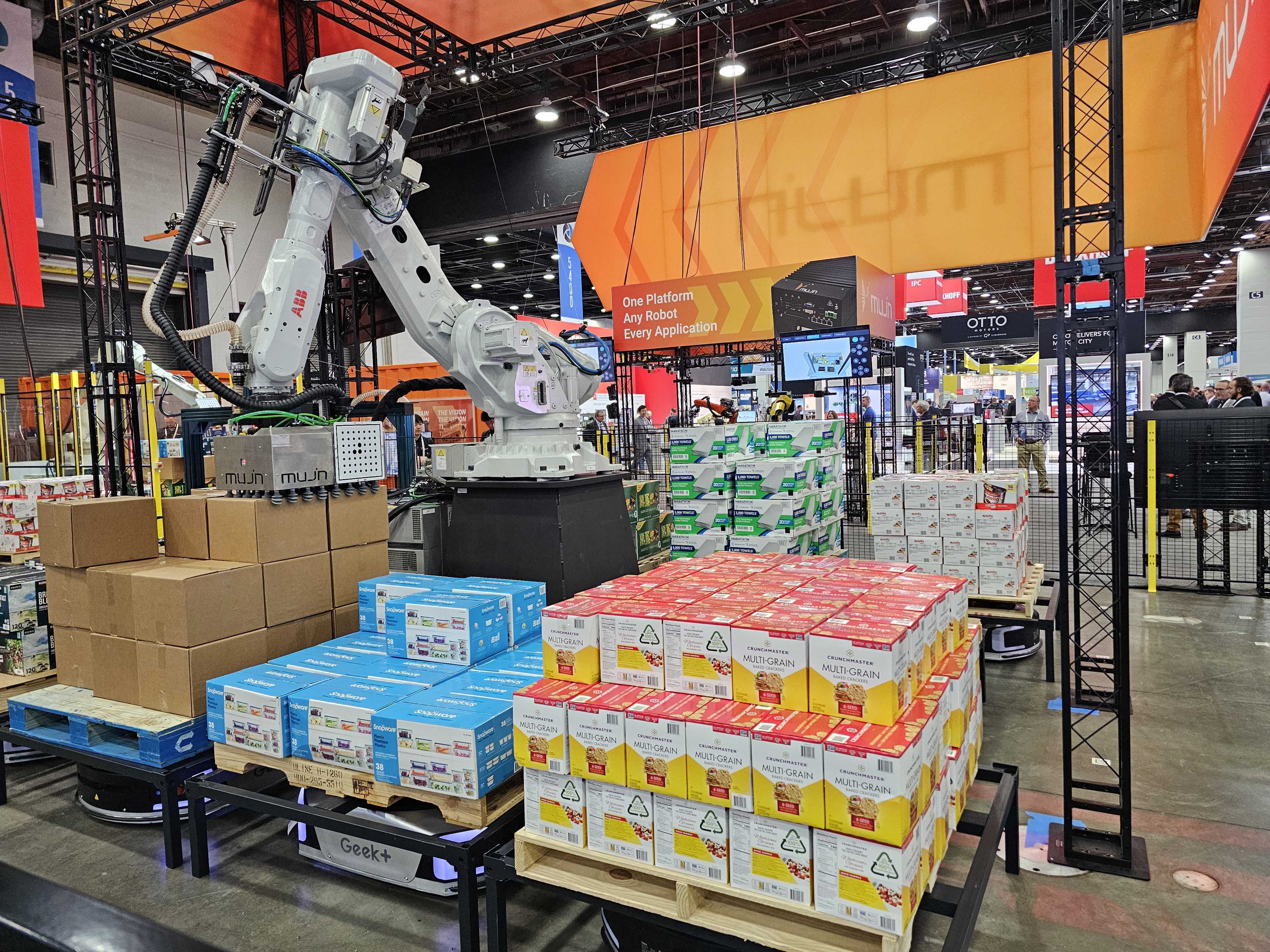
Image Credits: Brian Heater

The continued presence of the automotive industry is probably the single largest reason why the Automate show is located here. Burnstein gave me a broad overview.

“Our show had a lot of names,” he explained, offering a quick history of the event. “It started as the Robotics Show in the ’70s. Robots were going to be the next industrial revolution. The show was so big that — I think it was in 1982 — they had to close the escalator to the basement where the show was, because the fire marshal said there were too many people. There were like 30,000 people. It was almost as big as it [is] now. The show followed the fortunes of the industry, which went downhill in the mid-’80s.”

Burnstein lays the blame for the implosion on General Motors’ decision to cut robotics orders. As the major driver of the early industrial robot industry, the decision had a profound impact on the burgeoning category.

“Detroit was the natural home, but then the auto industry stopped buying so much,” he adds. “Our show said we can’t do it every year, and let’s find other places to do it in. We were in Chicago for two decades.” During that time, the event joined forces with the Assembly Show and later MHI’s ProMat. Ultimately both ProMat and Automate grew to a point where each event evolved back into its own separate show, now two of the country’s largest robotics event.

ProMat remains the larger of the two shows. It’s also more focused on a single industry. When I first started discussing the possibility of attending both this year, ProMat was pitched to me as a logistics show and Automate as manufacturing. ProMat started life focused on that space but has increasingly grown into an automation show as robotics have begun to have an outsized influence on the industry. There’s certainly logistics at this event (Locus and Zebra/Fetch were both present, for example — albeit in much smaller booths than at ProMat — but manufacturing (specifically automotive) still feels like its lifeblood. A Fanuc arm holding up a sports car has been the show’s iconic visual for years. Fittingly, you’ll also see a giant Fanuc “Let’s Talk About Automation” ad on the side of an airport parking garage as you arrive — something I’m told is not an Automate-only feature.

Smaller robotics startups were less of a presence at Automate, though they were there in some forms, like the Pittsburgh consortium that brought Shift Robotics’ Moonwalker shoes and drone inventory startup Gather AI. Most of my interactions with founders occurred at after-parties like the one at Newlab and an event put on by robot operating system (ROS) stewards Open Robotics and ROS users PickNik Robotics and Foxglove.

Image Credits: Getty Images / Daryl Balfour

I did, however, line up a couple of chats with some bigger names, including Jim Lawton, the Rethink and Universal Robotics vet who heads up robotics and automation over at Zebra Technologies. If you’ve read about Zebra in this newsletter in the past, it’s because of the company’s 2021 acquisition of Fetch. I’ve likened the deal to Amazon’s acquisition of Kiva from the standpoint of a company buying an existing startup to serve as the foundation of a broader robotics play. In a certain way, it’s actually closer to the Shopify/6 River Systems deal, in the sense that Amazon suddenly left a lot of customers in the lurch after it cut off third-party clients.

Of course, the Shopify situation went pear-shaped as the Canadian e-commerce giant sold off 6 River amid news of far-reaching layoffs. Fetch is third place in the category behind 6 River and Locus, the latter of which is the biggest player by a wide margin. Zebra’s acquisition was clearly an ecosystem play — effectively a bid to start selling robots to customers of its existing services.

Says Lawton:

As the market has matured, customers who are now looking at automation now want solutions to problems. They’re not robotic tinkerers. For a while, it was “These are cool. How fast are they?” Now it’s “How much productivity can I get? How much increased capacity can I get? A lot of that comes from taking robots, these devices, and the ability to control other things in the warehouse, like getting robots up to the mezzanine level, meaning the robot is able to activate the elevator. If I’m going to take a tote off a robot and put it onto a conveyor, I need to activate the conveyer, I need to activate the robot. We have an IoT gateway device that we use to orchestrate all of the other things. What they want is a warehouse workflow optimization tool that happens to involve robots.

We also discussed my favorite topic of recent vintage: interoperability. Lawton again:

I think it’s going to take longer than people think it is. The idea of seamless interoperability is not something we’re going to see a lot of over the next couple of years. It’s going to take some time. I know the markets are different, but there is some precedent on the manufacturing side. Robotic arms have been in manufacturing since the 1960s, and we still don’t have [interoperability]. It’s going to take some time. There are reasons interoperability is more important in the warehouse space. A robotic arm is integrated into a cell. These kinds of robots are a little bit different, so I think you’ll see the pace get a little bit faster.

Q&A with Melonee Wise
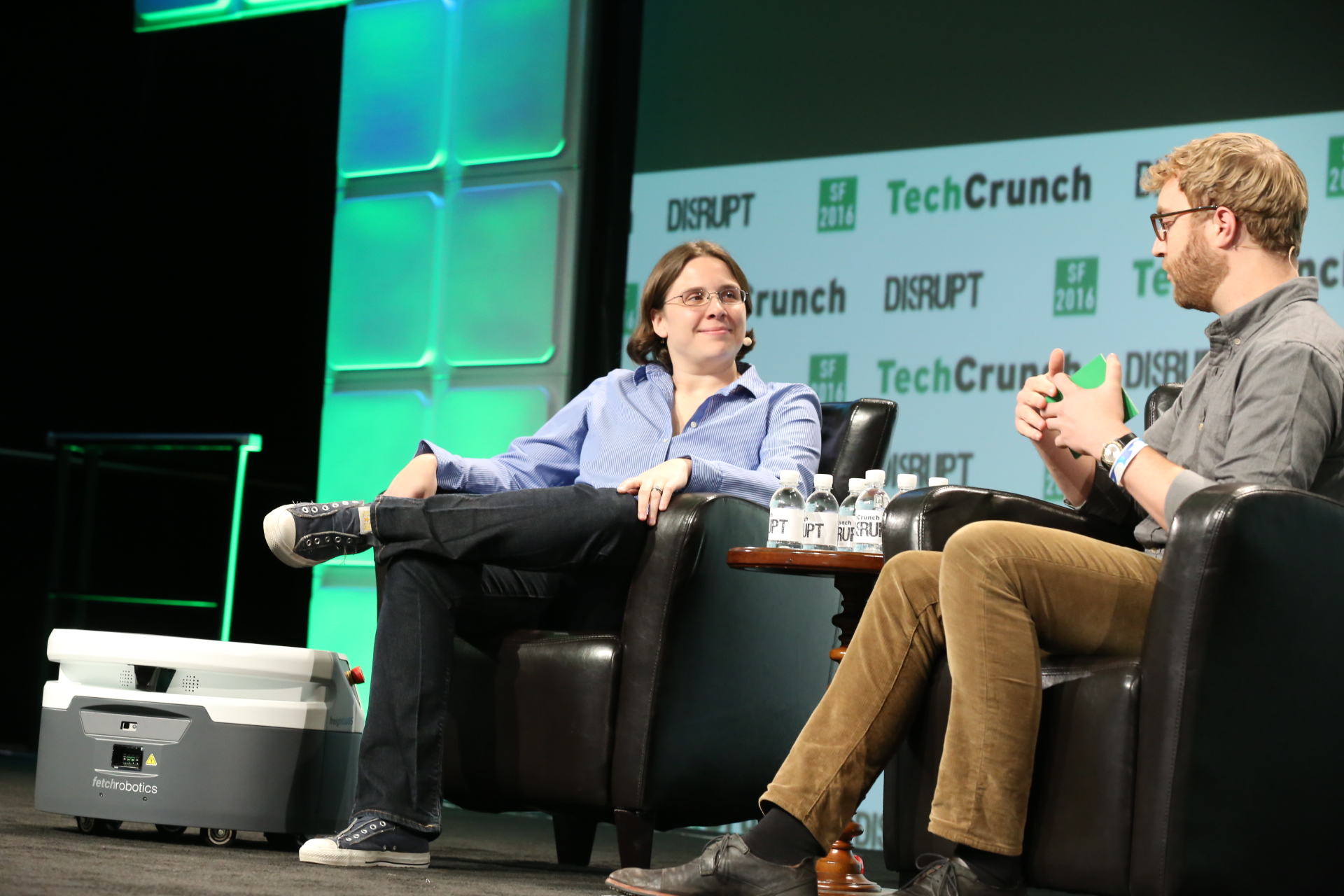
Image Credits: TechCrunch

Early this week, we were the first with the news that Fetch founder Melonee Wise had left Zebra and joined forces with Agility, where she’ll serve as CTO. The Willow Garage vet knows as much about warehouse robots as just about anyone on the planet. It’s a great hire for Agility, and an interesting challenge for Wise as the company continues to explore commercial applications with Digit.

Wise and I discuss the move and a bunch more:

Let’s start with Agility.

I’m so excited.

I’m sure you’ve known them for a long time.

There was — let’s call it a seminal moment — where [CEO Damion Shelton] and I were at a conference and we ended up on a panel together talking about why robot technology has such a hard time getting out of the university. What is it about robotics technology and crossing the chasm from a cool science project to a full production company that’s shipping robots?

You had already had success with that. It’s scalability, repeatability.

It’s also about what to focus on, when. There’s a lot of perfecting the imperfect that happens where we’re hyperfocused on minutia from a technology perspective that the customer doesn’t care about. If you look at logistics, primarily what the customers care about — if they could just wave a magic wand and get it — they want a teleporter.

To get a product from one place to another.

Yeah. We, as roboticists, are building all these robots to achieve basically that ask. Because they want a teleporter, the customer has a hard time articulating what the need is. We as roboticists — because we don’t get great specifications — we have the tendency to try to really rathole on the things that we know.

You over-engineer.

Yeah. Instead of just throwing it out into the world, letting it fail and then building the thing that customers want.

There’s an extent to which you can fail when starting a company. If Digits went out there, started falling over and lighting on fire, that would be a problem.

Absolutely. But I think there’s a thing that happens in early-stage startups that decides if they’re going to be successful or not. I believe the success point is when you’re at your first customer and it’s not going perfectly.

When you’re still small.

Yeah. It’s that customer that really shapes and helps you define your product — or a set of customers. It’s not going to go well there. No matter how you like to spin it, it doesn’t go well — unless you’re in software and you really have the ability to change things quickly. With robotics hardware, you’re kind of stuck with the thing that you made, and a lot of what you’re doing when you get into your first customer is trying to tweak it or trying to put candy wrapping around it. And then you make a small iteration in software or hardware, and you get closer and closer to what everyone wants to buy. But it’s from that failure that you get a directed purpose for success.

Fetch had that time as a smaller company. Agility’s product is so visually interesting, and it got so much press, that suddenly Ford is interested. That’s a lot of pressure at an early stage.

Yeah, it is. I think that we’re trying as a company as part of scaling to choose customers that we have an opportunity for codevelopment with. It’s not to say that we’re not focusing on the other big customers that are with us; it’s just that we’re diversifying our strategy to make sure that we have these opportunities to learn in a non–high publicity environment.

Also, you find a warehouse so it can be applied to other warehouses. The Ford learnings can be applied to other things.

One of the things that we have been trying to get to is the solution. Fetch struggled with that for a very long time. We started by selling a robot product into the market. But we eventually became a solution.

It makes sense. You started as roboticists, not warehouse experts.

I think that all robotics companies go through that originally. It just matters what end of the spectrum you’re coming from. If you look at the story of Locus, they were product-first people, robotics second.

They were a logistics company that felt like they had to make robots.

Yeah. Their solution came to market a lot more mature, but their robotics hardware came to market less mature. It depends on where you are on the spectrum. Agility, like many robotics companies, comes from a very tech-heavy perspective. There’s still learning about what we have to do, which I’m excited about. That’s why I’m there. I think that we are quickly narrowing in on what the end cases are.

There’s a big, ongoing debate around the necessity of legs.

Wheeled robots struggle with a lot of scenarios. I would say the other better case to talk about with wheeled robots is every time you want to do a task like Digit does, you need a specialized accessory to do it.

In terms of an arm to lift it up?

Yeah. Or in the case of a mobile robot, you wouldn’t solve that with arms. You would most likely make a lifting conveyer piece. The robot would have a little conveyer, it would have a way of grabbing the tote, like a sliding arm, and then shuffle it onto the robot. Then the robot would kick it out onto the conveyer. The problem is that it’s a whole other special accessory that you have to build. At Fetch we had mobile platforms, but most of our business eventually became making specialized accessories for the different vertical applications we cared about. The Digit promise is that we are able to attack more vertical use cases with less hardware modification. We have a much more — let’s not say general purpose — but multipurpose [way]. It’s a lot easier to envision a single piece of hardware being used for multiple purposes and a facility for these types of activities.

There are certain things that wheeled robots just can’t do. We have a hard time in general with going over bumps or ramps, largely because it causes problems with safety and localization mapping. One of the more hilarious things about going up a ramp with a mobile robot is as you approach the ramp, it looks more and more like a wall.

Wile E. Coyote syndrome.

There’s some nuance there. That is not to say that mobile robots aren’t a good solution for a lot of use cases. It’s just that when you’re starting to look at this vision of end to end automation with these different agents, there’s a class of things that certain agents are good at. And there’s a class of things that other agents are.

Is it too difficult — or impossible — to put the arm solution on an AMR?

As someone who’s built AMRs with arms — Fetch had a research project that had an arm; we sold about 100 of them over five or six years to research institutes — I think it’s hard to do bi-manual manipulation on a mobile manipulator because of the hardware constraints like putting [on] two robot arms, like Kuka is.

There’s a difference between a Kuka arm and the simpler arms on Digit.

I would say that still — even to implement the framework that Digit has on a mobile platform, there are some limitations that you would run into. There are some advantages to having a base with legs. One of the things you can’t do with mobile platforms is you can’t get below the top of the platform. Digit has a lot of capability in terms of crouching and also reaching that are challenges with mobile platforms from a stability perspective, from a footprint and space perspective.
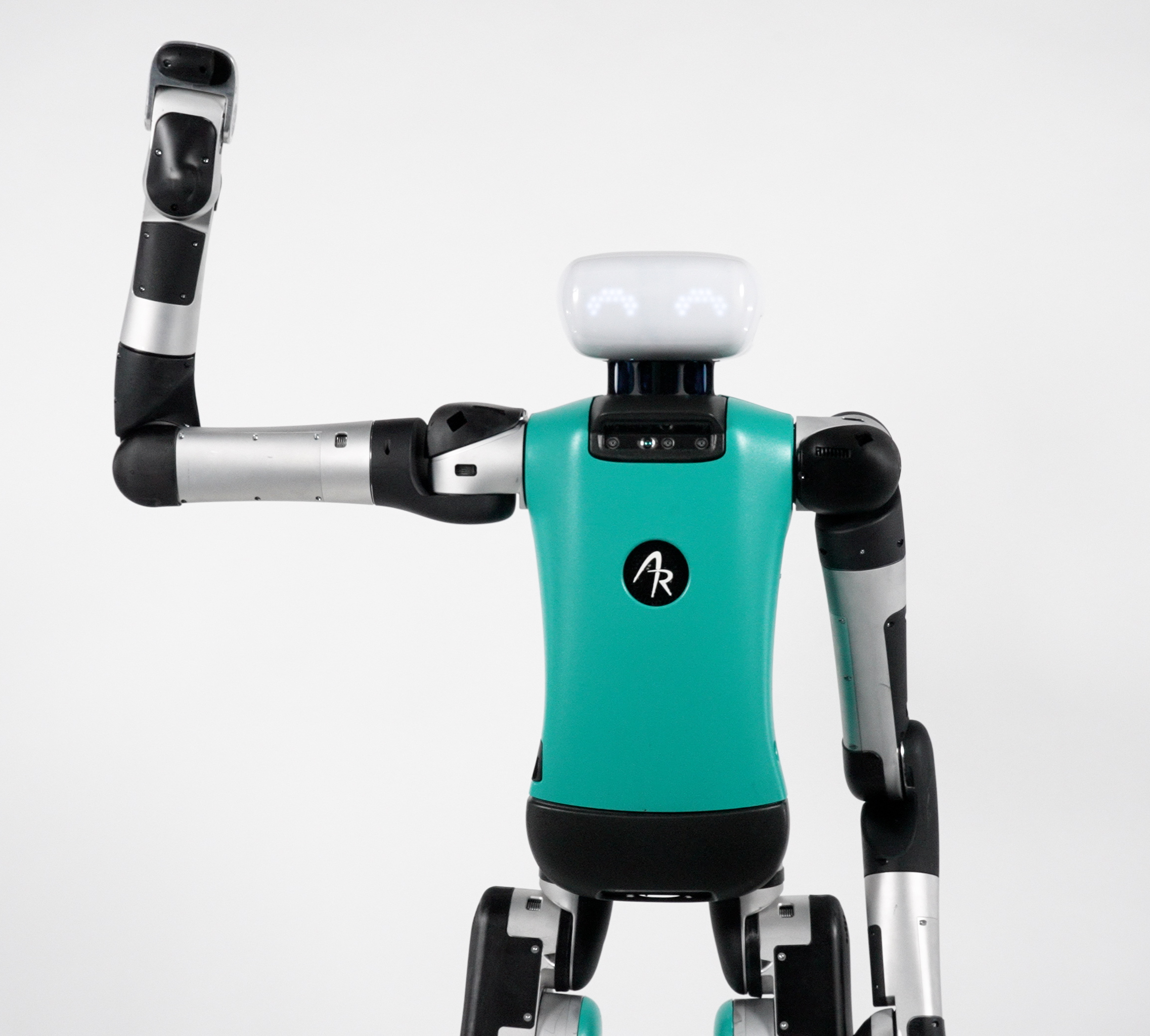
Agility Robotics; DIGIT

Image Credits: Agility Robotics

Is the [Digit] arm diverse enough now to continue to diversify the tasks it can perform?

We’re doing some tweaks to the arm, so you’ll see a bit more complexity come into the arm to deal with some of the challenges with the payload moving inside the tote.

In terms of throwing the robot off-balance?

In terms of being able to keep the tote level and things like that. I think we are on a path that makes sense for the right level of complexity to solve the right level of complexity problem. I don’t think we as Agility have ever said we’re making complex, dexterous mobile manipulators with five-finger hands. I’m not convinced that’s the right way to approach the problem in general.

What does the path look like for Agility, going forward? Does everything continue to revolve around Digit?

Let me preface this by saying I’ve been with Agility for five whole days. I would say that I think there’s going to be a large focus on Digit for the foreseeable future, I think that we are going to have to expand our automation story. Fetch did the same thing. We started with a robot, and then we had a robot that interacted with conveyers and these types of devices. Digit’s equivalent is we have to interact with conveyers and put walls.

What’s the solution for Digit? Accessories or a pure software play?

There will be accessories; there will be a software platform that allows us to connect. We’re going to be expanding our fleet management platform and things like that. And also expanding to connect to standard automation tools and partnering to connect with companies that are well known in the automation industry.

Is there a lot of overengineering happening on the humanoid side of the robotics world?

It’s hard to say, because it’s hard to say what the use case is. It would depend on what you’re trying. Take robotic picking? How many picking cells have you seen that have five-fingered hands?

They’re all suction cups now.

Suction cups and soft gripping clients. We first need to ask ourselves what is the use case? If you look at the manufacturing and logistics domains, there’s enough prior art that shows five-fingered hands are not necessary.

The hand is just one example, but it does get to the broader point about potentially overengineering.

I’m hesitant to say “overengineering.” I would say it’s just poorly targeted product design.

We talked a bit about your decision to join Agility, but why was this the right time to leave Zebra?

To be more clear, I went from being the CEO to a CTO for the Robotics Business unit. We transitioned into Zebra. It was a big change for me, but although the work was interesting, it was not as fulfilling as I wanted it to be for me, personally. After about 18 months of being at Zebra, I decided it was the right time for me to leave. I decided to take some time off. Running a company for seven years — and having a plethora of different life events that happened during that period — I needed a break. I decided to take six months off. I think it was a good thing for me, personally. We don’t talk enough about founder health and things like that.

Being a CTO is obviously still a hard job, but it almost sounds like a relief to be able to just focus on the tech stuff.

I’m not gonna lie. Moving to Agility is going to be — it’s weird to say this — relaxing to not have some of the burden of being CEO. I’m really excited about that.

You were doing a lot of things you didn’t study for.

Yeah, and also there’s a lot of weird pressure that falls on you as a CEO. For me, some of those pressures were a little bit more extreme, being a woman. And fundraising is not my favorite activity. I, personally, will find it very relaxing to be the CTO of Agility, because I won’t be the CEO. I think Damion is a great CEO and I think he’s doing work that is thankless.

How are you and [former CTO turned chief robotics officer] Jonathan Hurst going to work together?

The way that I see it is Jonathan is very focused on building the innovation pipeline for the robotics hardware. He created Cassie, he created all of the iterations before that. He is going to be building the future technology that Digit will one day rely on. My focus is going to be more product centric.

More news

On the humanoid robot front (where we seem to spend a lot of our time these days), I sat down with Apptronik CEO Jeff Cardenas in the otherwise empty Huntington Place cafeteria to discuss the Austin company’s plans to unveil exactly that this summer. The company didn’t have a who presence on the floor, but Cardenas had a slideshow on his MacBook that he was sharing with a select few, including myself. It started with the company’s varied history.

“[The] exoskeleton was liquid cooled,” he told me. “We learned a lot doing that. The complexity of the system was too high. It was heavy. We remotized all of the actuators. And then we started to realize what was the simplest version of a humanoid robot: a mobile manipulator. We started getting approached by a lot folks in logistics, who didn’t want to pay for manufacturing arms. They were too precise for what they need. What they wanted was an affordable robotic logistics arm.”

I can’t share images of the system with you at this point, but I can describe what I saw. Quoting myself:

Cardenas shows me images — both renders and photos — of Apollo, the system it plans to debut this summer. I can’t share them here, but I can tell you that the design bucks the kind of convergent evolution I’ve described, which found Tesla, Figure and OpenAI-backed 1X showing renders with a shared designed language. Apollo looks — in a word — friendlier than any of these systems and the NASA Valkyrie robot that came before it.

It shares a lot more design qualities with Astra. In fact, I might even go so far as describing it as a cartoony aesthetic, with a head shaped like an old-school iMac, and a combination of button eyes and display that comprise the face. While it’s true that most people won’t interact with these systems, which are designed to operate in places like warehouses and factory floors, it’s not necessary to embrace ominousness for the sake of looking cool.
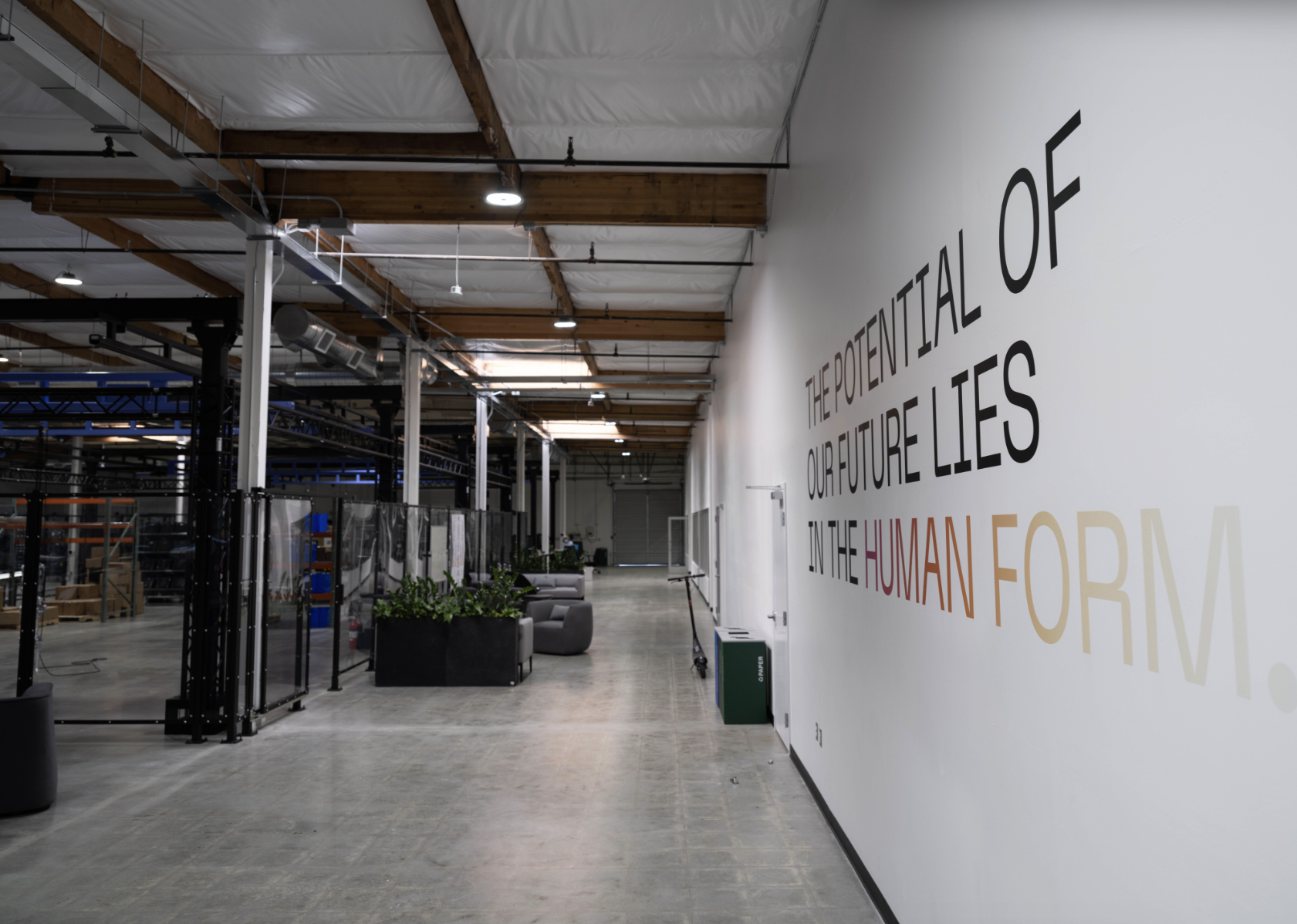
Figure office, interior

Image Credits: Figure

Apptronik will be exploring a Series A this year, once the robot is revealed and — hopefully — drives investor interest. Meanwhile, one of the company’s chief competitors, Figure, just announced its own $70 million Series A, shortly after its own humanoid robot took its first steps days before the company’s first anniversary.

“We’re focused on investing in companies that are pioneers in AI technology, and we believe that autonomous humanoid robots have the potential to revolutionize the labor economy,” investor Parkway Venture Capital’s Jesse Coors-Blankenship said in a prepared statement. “We are impressed by the rapid progress that Brett and the team of industry experts at Figure have made in the last year and are thrilled to be a financial partner to provide resources to accelerate the commercialization of Figure 01.”
Image Credits: Brian Heater

I’m finishing up this week’s Actuator from Gate A17 at the Detroit Metropolitan Wayne County Airport in Romulus, MI (track nine from Sufjan Stevens’ seminal 2003 album, Michigan). I capped off my first Automate with dinner at Huntington Place’s Grand Riverview Ballroom for the bi-annual Joseph F. Engelberger Robotics Award (though it seems the show will soon be going yearly, along with Automate itself).

The award’s namesake, Joseph F. Engelberger, is credited with co-developing Unimate, the first industrial robot, alongside George Devol in the 50s. The arm would eventually be installed in a General Motors assembly line, making it an innovation decades ahead of its time. The award is regarded as one of the industry’s most prestigious (A3 likes to call it the “Nobel Prize of Robotics”).

Jeff Burnstein fittingly received one of the awards, alongside longtime Universal Robotics employee, Roberta Nelson Shea. Burnstein’s story was a nice one — that of a Detroit native who has had a front row for the dizzying highs and lows of his city and industry alike. Shout out to a fellow English major (though they called it “Literature” where I went to school) who somehow ended up involved in the robot space. Perhaps there are more of us. Let’s start a club.

To hear her tell it, Nelson Shea’s journey was also unexpected. UR’s Global Technical Compliance Officer is best known for her tireless efforts to promote robot safety. Between cobots, HRI and countless hardware and software innovations, the subject is now central to the way with think about industrial robots. The standards Shea helped create are a big piece of that. 

“This award is a testament to the great contribution Roberta has made to the robotics industry,” says UR President Kim Povlsen. “Her dedication to safety has helped create the standards for the interaction between people and robots. This has been an important contribution to the collaborative relationship we see today between humans and robots across hundreds of thousands of workplaces.”

And Nelson Shea in her own words, “The Engelberger Robotics Award for Application in Safety is a tremendous honor to me and to all those who have embraced and contributed to robotic safety. I remember meeting Joe Engelberger over 40 years ago and never imagined receiving this award. I view the award to be honoring the industry’s progress in optimizing safety and productivity. The journey has been amazing!” 

Image Credits: Bryce Durbin / TechCrunch

Rev up your engines and subscribe to Actuator.

Motor City mechatronics by Brian Heater originally published on TechCrunch


from TechCrunch