A Texas judge issued an injunction today to stall the enforcement of an online age verification bill. The Free Speech Coalition, along with adult video sites like Pornhub, led the legal challenge against Texas’ HB 1181, arguing that the bill violates the First Amendment and infringes on rights guaranteed by Section 230. “The Court agrees […]
from TechCrunch
Thursday, 31 August 2023
India Continues To Be World`s Fastest-Growing Economy, Thanks To Modinomics: BJP
India recorded a 7.8-per cent GDP growth in the April-June period of 2023-24, the highest in the last four quarters, on the back of double-digit expansion in the services sector.
from Zee News :India National
from Zee News :India National
YouTube Music gets more social, adds comments to the ‘Now Playing’ screen
YouTube Music redesigned its “Now Playing” screen recently, with the most notable update being a new comments section, which allows users to read and write comments directly from the app. The latest upgrade also includes easily accessible buttons, larger cover art and more. The redesign is rolling out to iOS and Android devices today, per […]
from TechCrunch
from TechCrunch
Wednesday, 30 August 2023
Top Universities Offering Free Online Courses
Online courses empower individuals to continuously upgrade their skills, ensuring they remain adaptable and capable of meeting evolving industry demands.
from Zee News :India National
from Zee News :India National
Best 5 Bikes And Cars In Bollywood Movies That You Can`t Ignore
Bollywood films have a talent for converting automobiles into iconic icons that stick in our memories and making them an essential part of the narrative.
from Zee News :India National
from Zee News :India National
Savor the complete SaaS Stage agenda at TechCrunch Disrupt 2023
Software as a service (SaaS) is an ever-evolving industry, especially now with AI changing the software landscape yet again. It’s why we dedicated a day and a stage to the topic at TechCrunch Disrupt 2023. We teased some of the programming a few weeks back, and today we’re excited to announce that the SaaS Stage […]
from TechCrunch
from TechCrunch
Tuesday, 29 August 2023
Meta avatars are finally getting legs (in beta)
It’s time to beta test Meta’s greatest technological innovation since the News Feed: legs. Now on Meta Quest headsets, you can download an update that lets you walk on two feet, just like our ancient ancestor, the Ardipithecus ramidus, an early hominid that achieved bipedality 4.4 million years ago. Now, it comes full circle. When […]
from TechCrunch
from TechCrunch
Announcing the complete AI Stage agenda at TechCrunch Disrupt 2023
AI — the tech that’s everywhere and touching everything — keeps evolving at a pace that’s surprising even in an industry where change is just about the only constant. It’s complicated, unregulated, thrilling and unnerving all at once. At TechCrunch Disrupt 2023, we’re dedicating a day and a stage to this galloping industry — and […]
from TechCrunch
from TechCrunch
Did India`s Global Clout Grow Under PM Modi? Global Survey Springs Surprising Results
The multi-nation poll was conducted by the Pew Research Center to assess India's image in the world in the year of India's presidency of the G-20, whose leaders will congregate in a few days in New Delhi for their annual summit.
from Zee News :India National
from Zee News :India National
Monday, 28 August 2023
Friend.tech gets unfriended: Daily transactions drop 95% as hyped decentralized social app loses steam
It may be time to put to rest yet another effort to build a social network on a blockchain: The number of transactions on decentralized social network friend.tech has cratered after less than 20 days since its launch.
Friend.tech is trying a new spin on a decentralized social network by letting users tokenize themselves and sell “shares,” now dubbed “keys,” to fans and followers. People who buy these shares then become “shareholders” and can engage with the creator directly.
While many rushed to sign up like it was the next gold mine as big name crypto influencers, NBA players and OnlyFans creators jumped onto the platform, others were more cautious and skeptical because the app needed you to deposit funds when signing up, lacked a clear privacy policy, and had a pretty foggy roadmap. Now, it appears the people who hesitated on betting their net worth on others’ may be the ones to come out on top.
Activity on the app, running as an invite-only public beta since August 10, had declined 95% from a peak of almost 39,000 daily transactions on August 21 to about 1,400 at the time of writing, according to Dune Analytics data from user cryptokoryo.
Just seven days ago, I wondered if friend.tech’s early growth would be sustainable, and we can see clearly that the answer is clearly “no.”
Besides declining transactions, the inflow of funds on the protocol has also tumbled from $1.98 million at its peak on August 20 to about $8,300 today. Still, the app has recorded inflow of about $81 million in total, which isn’t insignificant for a platform this new.
To be fair, it isn’t uncommon to see declining user engagement after launch: Social media platforms BlueSky and Threads gained ample early traction only to see the hubbub fade in the following weeks and months.
from TechCrunch
Angry Miao’s AM AFA R2 is part sculpture, part keyboard
Whether you love their keyboards or not, there can be no doubt that Angry Miao doesn’t do things halfway. The AM 65 Less is an exercise in building a high-quality 65% keyboard that replaced the cursor keys with a touch panel. The AM Hatsu looks like it was imported from the future, while the Cyberboard would almost be a conventional keyboard if it wasn’t for its massive LED panel. With the AM AFA, the company introduced its version of an Alice-style ergonomic layout last year and now it’s back with a second run of this anime-inspired mechanical keyboard.
As always, it’s almost impossible to find fault with Angry Miao’s build quality. This is a solid board, weighing in at just under five pounds (or 2.26 kilos) and like the AM Hatsu, it’ll ship in Angry Miao’s signature suitcase-style case. The design, with the wide-open pattern at the front and back, makes it seem almost weightless and like it floats on your desktop, though — especially as you sit in front of it. It’s a smart design trick and exactly what you would expect from Angry Miao.
In addition to the sculpture-like metal frame, the actual keyboard actually consists of three interconnected parts that help to create this illusion. The two halves of the keyboard are actually separate pieces of hardware, with the control module (which now features a cover made from real glass compared to the plastic cover of the first version) in the middle. They are connected through very thin ribbon cables that you never really see in day-to-day use, making the design feel even more open.
The company says it takes roughly 10 hours of CNC processing and manual polishing to create the metal structure.
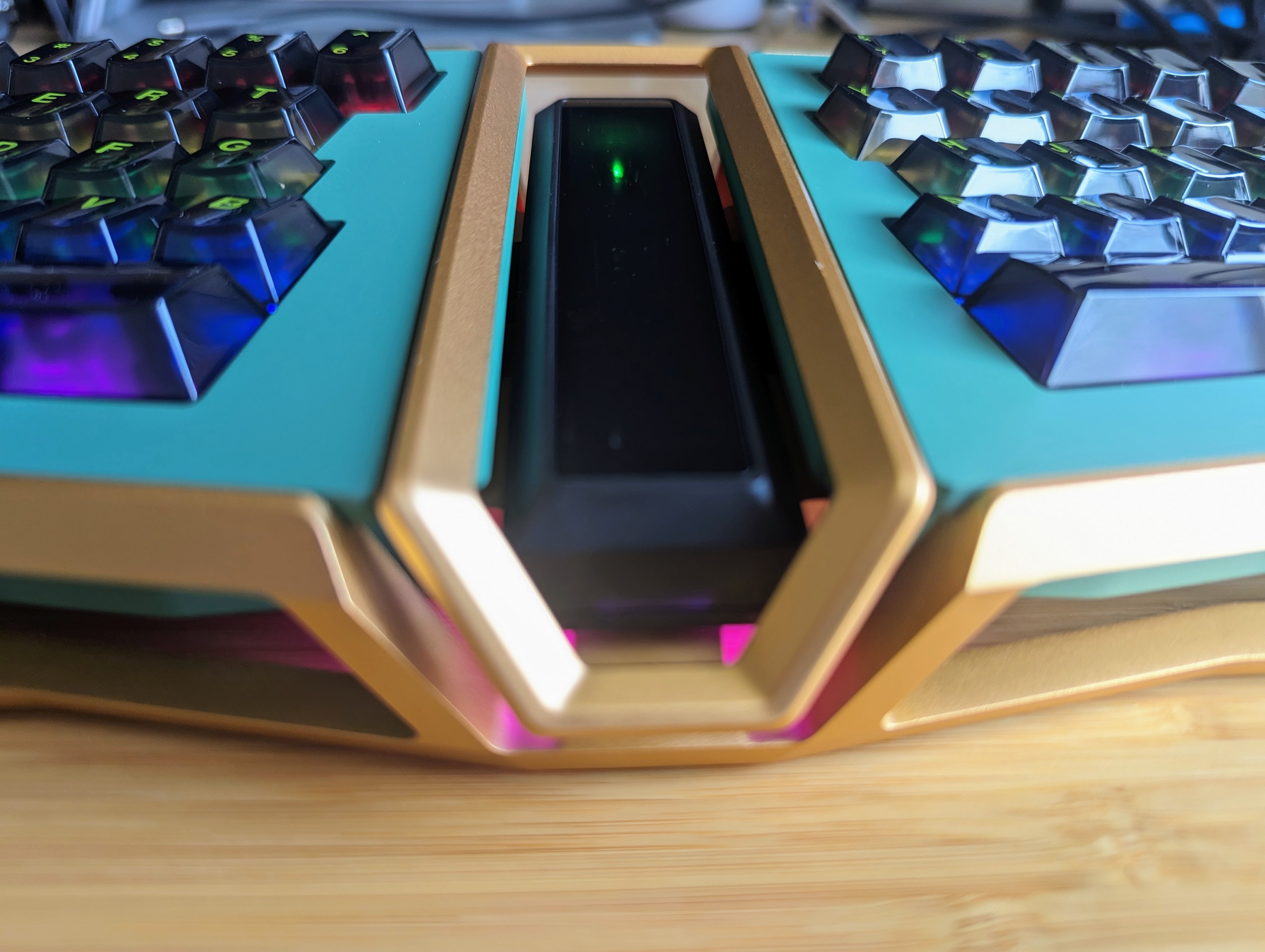
Image Credits: TechCrunch
Let’s just get the prices out of the way, because this is not a budget keyboard: The base kit without switches and keycaps will retail for $680 and the full bundle goes for $795. That’s a lot, but not out of the ordinary for a high-end mechanical keyboard (and the AM Hatsu cost is closer to $1,600). In the U.S., it’ll be available as a group buy through Space Cables, starting at 8 pm PT on August 31.

Image Credits: Angry Miao
For the most part, the AM AFA is a standard hot-swap Alice-style board, with the usual slightly curved and angled split layout and 68 keys. But this is Angry Miao, so you’ll quickly find some quirks as well. The distance between the two halves is significantly larger than that on a standard Alice layout, at 64.5 millimeters. To me, that makes for a more comfortable typing position.
The company also decided to put the right shift button to the right of the up arrow, for example. If you often use right shift, that’s going to take some getting used to. It made me realize I’m 100% a left shift user, so it never bothered me, but your mileage may vary. Another twist here is that the team put the page up, down and delete keys on the left side of the keyboard, inverting what most users would expect. Because that doesn’t affect any of my day-to-day typing, I didn’t mind that change and got used to it fairly quickly.

Image Credits: TechCrunch
With this second run of the keyboard, the company is introducing five new designs. The version the company sent me was the gold and green “Magic Forest” edition, inspired by Nintendo’s The Legend of Zelda: Tears of the Kingdom. There’s also a slightly tuned version of the first version of the AM AFA, the Macross-inspired VF-19, Pink Slayer, Cyber Cop and Unit-01. The Magic Forest colors are definitely striking, even as I admit that I personally wouldn’t necessarily have chosen it.
If you don’t quite like the choice of top plate, there’s another nice feature here: Those top plates are magnetic and very easy to replace. Angry Miao will include four alternative plates with the retail version.
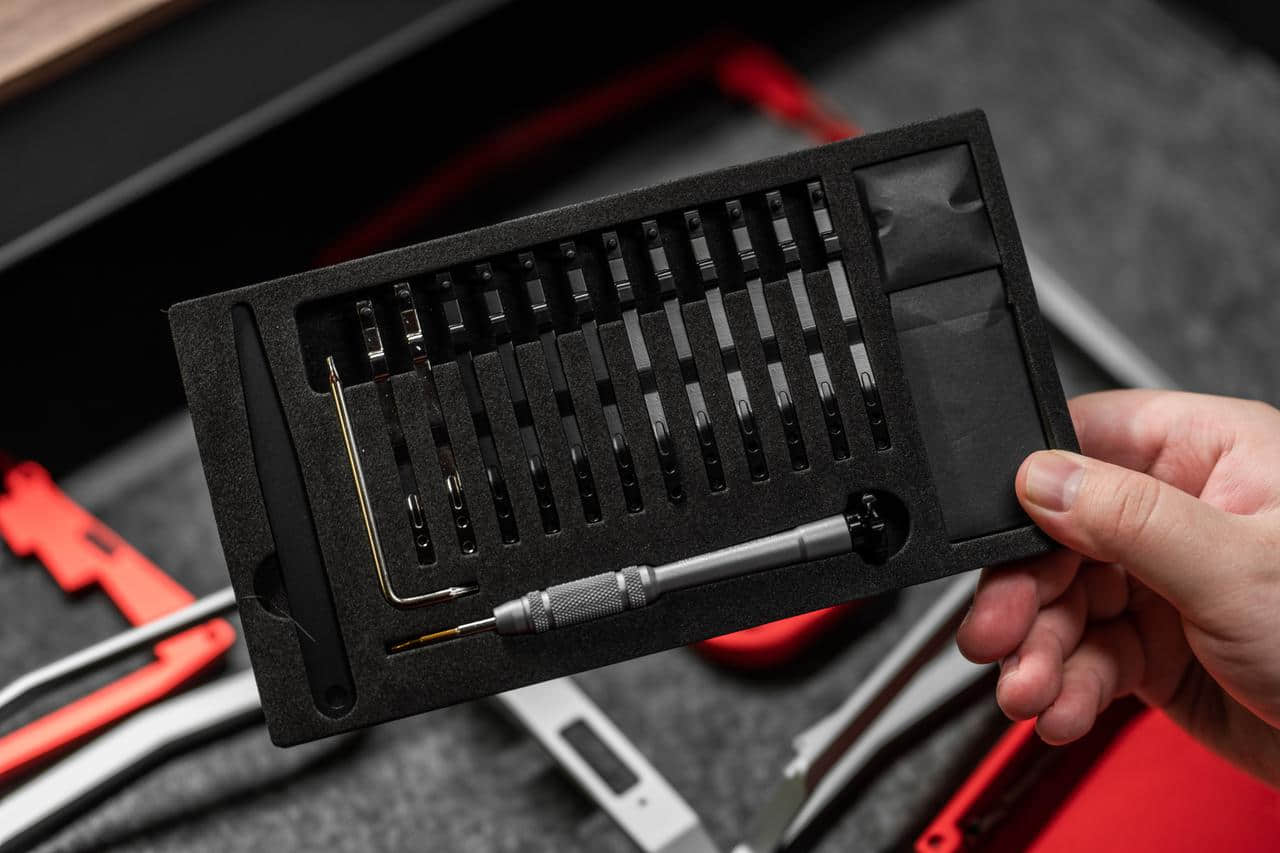
Image Credits: Angry Miao
Like with the first version, Angry Miao uses its three-stage adjustable leaf spring mount to allow users to adjust the bounce of the keyboard. With the first edition, changing those springs was rather arduous. You had to remove a total of 24 screws and pretty much completely disassemble the entire keyboard. That didn’t exactly invite a lot of experimentation. With this new version, you only have to remove the magnetic top plate, remove eight screws and remove the ribbon cables from both sides and you have full access to the springs. That’s because now the PCB assembly sits inside what’s essentially a tray, making it very easy to take apart. Out of the box — or in this case, the suitcase — you get all of the tools you need to make these changes.
I think the spring leaves are one of Angry Miao’s best innovations. I prefer a slightly bouncy keyboard and the default option works quite well for me. Now that it’s easy enough to change them, though, I think most buyers will experiment with different options, and adding and removing springs (there are stainless steel and copper ones) actually makes an appreciable difference to how the board feels. Also included in the box are bottom and adjustment pads that slightly change the sound of the board but don’t make too much of a difference for the actual typing feel.
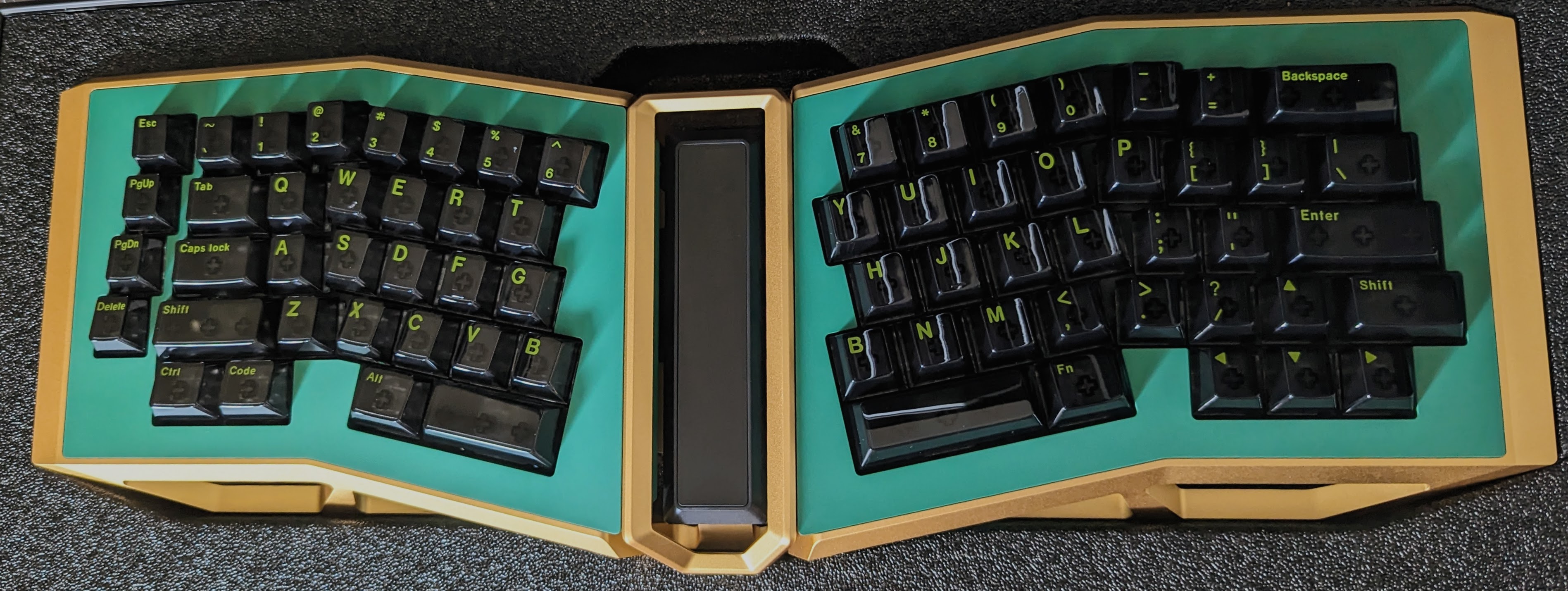
Image Credits: TechCrunch
Talking about typing feel, the AM AFA bundle comes with Angry Miao’s linear Icy Silver switches. I’ve never had any complaints about those in the company’s other keyboards and they remain a solid option. There’s no scratch and very little wobble. With an initial force of 45g, they sit right in my personal sweet spot. Since this is a hot-swap board, though, you can easily change them out for another type of switch — even a clicky one. I won’t judge you.
I don’t love the transparent Glacier Dark keycaps quite as much. They are frosted inside, which makes for a really nice light show from the PCB board’s LEDs, but they are a bit too glossy and smooth for my liking. Unlike many of the cheaper transparent keycaps you can find on Amazon and elsewhere, they do feel rather premium, though — and also enhance the keyboard’s overall sound. I would’ve preferred the excellent triple-shot keycaps Angry Miao used for the AM 65 Less, but that’s purely a personal preference.
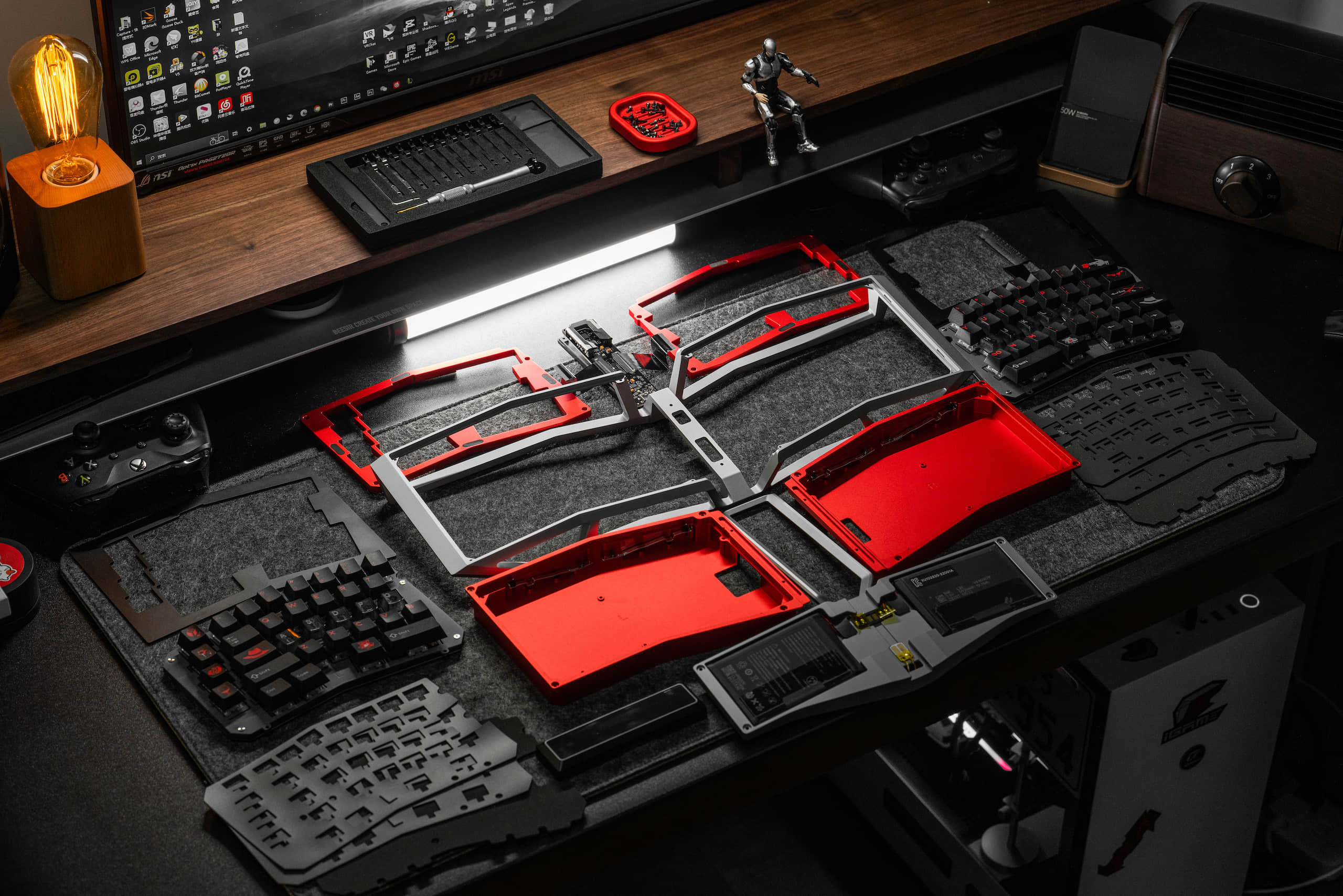
Image Credits: Angry Miao
Personally, I really like the overall sound profile of the AM AFA. It’s not too loud, but you’ll know when you press a key. The sound resembles that of two pool balls colliding, which is close to my personal ideal. Using a different bottom foam and changing out the switches and keycaps allows you to tune this to your heart’s desire. Unlike with most keyboards, I was perfectly happy with the default here, though.
Also included in the bundle, by the way, are Angry Miao’s Hover wrist rests. I found the keyboard low enough to type on it without a wrist wrest, but the twist here is that we’re talking about two individual round wrist rests. In good Angry Miao tradition, they can flexibly take on any angle, with opposing magnets in the middle providing some additional cushioning and support. It’s a nifty trick, though I don’t think it’s a must-have. I found myself using a cheap wooden wrist rest I bought for a Keychron Q8 and while it wasn’t a perfect fit, it was a better solution for my typing style.
I always wish Angry Miao would support QMK/VIA for customizing its keyboards’ layout and lighting setup. The company’s own software is passable, though I always feel like it’s a bit of an afterthought. I don’t spend a lot of time modifying my layout, so it’s not a dealbreaker for me, but you’d be right to expect a bit more.
As with all of these high-end keyboards, whether they are worth their price for you is a personal decision. If I were in the market for a $750 board, though, I think the AM AFA is definitely worth a look. For most people, a Keychron Q8 or Q10 (either in their Pro or standard versions) are perfectly good Alice-style boards for far less (at $210 for a Q8 Pro, for example). The AM AFA is unabashedly a luxury board but it has the build quality and design to back that up.
from TechCrunch
Centre Withdraws Affidavit In SC Opposing Bihar Caste-Based Survey; Here`s Why
A short affidavit had been filed by the Office of the Registrar General in the Union Home Ministry in response to the batch of pleas challenging the caste-based survey in Bihar, placing the constitutional and legal position for consideration of the top court.
from Zee News :India National
from Zee News :India National
Sunday, 27 August 2023
Kapil Sibal Slams Amit Shah For Targeting Ashok Gehlot Over ‘Red Diary’
Earlier this month, the BJP had slammed the Rajasthan Chief Minister Ashok Gehlot after he sacked minister Rajendra Gudha who had released three pages of the 'red diary' and accused the ruling Congress of corruption.
from Zee News :India National
from Zee News :India National
Rozgar Mela: PM Modi To Distribute Over 51,000 Appointment Letters To Newly Inducted CAPF Recruits Today
Rozgar Mela: In a virtual meeting, the PM will launch the 8th edition of Rozgar Mela and deliver his address virtually across 45 locations in the country
from Zee News :India National
from Zee News :India National
The battery business is booming and Zeekr kicks off it IPO roadshow
The Station is a weekly newsletter dedicated to all things transportation. Sign up here — just click The Station — to receive the newsletter every weekend in your inbox. Subscribe for free.
Welcome back to The Station, your central hub for all past, present and future means of moving people and packages from Point A to Point B.
We have a lot to cover so let’s jump in. But wait! One note to share: These days, I’m a semi-regular guest on TechCrunch’s Equity Podcast, including an episode that aired Friday that covers robotaxis, Nvidia’s earning, plus Better.com and startups that are full of shit (you’ll get the joke if you listen).
Vamos.
Want to reach out with a tip, comment or complaint? Email Kirsten at kirsten.korosec@techcrunch.com.
Reminder that you can drop us a note at tips@techcrunch.com. If you prefer to remain anonymous, click here to contact us, which includes SecureDrop (instructions here) and various encrypted messaging apps.
Deal of the week

The battery business keeps attracting capital.
Just take a look at Swedish lithium-ion battery producer Northvolt. The company raised around $1.2 billion in a convertible notes from BlackRock and various Canadian pension plans. Participants in the round included Goldman Sachs, Volkswagen, Baillie Gifford, Swedbank Robur, Singapore’s GIC and Hong Kong-based Chow Tai Fook Enterprises.
That cash will be used to build new factories in North America and Europe.
Northvolt has been on a bit of tear the past few years — even before the big battery boom really took off. The company has raised $9 billion in debt and equity since 2017, including $1.1 billion in convertible notes last year. The company has also secured more than $55 billion in orders from customers like BMW, Fluence, Scania, Volvo and Volkswagen.
The Northvolt deal gives me another chance to plug a collection of articles we put together earlier this month on the one-year anniversary of the Inflation Reduction Act, including a look at how startups have benefited and a map that tracks all the battery factories in North America. Once Northvolt picks a location for this next factory, we’ll update the map.
Other deals that caught my attention …
Accure, a startup that uses AI to predict lithium-ion battery failures, raised $7.8 million in a Series A2 round led by Blue Bear Capital and HSBC Asset Management with participation from Riverstone Holdings and Capnamic Ventures.
Channel19, a startup that developed software for refrigerated trucking companies, raised $2.7 million in pre-seed and seed funding round led by Augment Ventures with participation by Accion Venture Lab, TMV, Overton Venture Capital and Refashiond Ventures. Several Silicon Valley and freight tech industry angels also participated, according to the company.
Electric Era, a startup founded by former SpaceX engineers that developed software and hardware to make EV charging stations faster and more reliable, raised $11.5 million in a Series A round led by HSBC’s asset management arm. Climate-tech fund Blackhorn, lithium-mining giant SQM and mobility-focused investor Proeza also participated.
NaaS Technology Inc., an EV charging service company in China, said it plans to acquire Charge Amps AB in a deal valued at $66.4 million.
Nickelytics, an advertising tech startup focused on rideshare, has been acquired by Texas-based venture capital group T72 Club Inc. Terms were not disclosed.
Zeekr, the Chinese EV maker under Geely Holdings, is kicking off its roadshow with investors ahead of its initial public offering, Reuters reported citing unnamed sources. Zeekr’s aim is a share sale that will push its valuation over $13 billion. Zeekr filed confidentially for an IPO back in December and raised $750 million in February. If Zeekr is successful and actually lists, this could be one of the largest Chinese IPOs in the past two years.
Chinese companies listing on U.S. exchanges haven’t had the smoothest of rides. Didi, which raised $4.4 billion in its June 2021 IPO, ran up against Chinese regulators. The company delisted later that year. A few other Chinese companies, including Hesai are dipping their toes back in the U.S. IPO waters now that there is more regulatory clarity in both countries. Last year, the U.S. and China struck a deal that allows American officials to review audit documents of Chinese businesses that trade in the United States, an agreement expected to lower the likelihood of Chinese companies on U.S. exchanges delisting.
Notable reads and other tidbits

ADAS
Polestar plans to make Mobileye’s hands-off, eyes-off automated driving technology (called Chauffeur) available to owners of the upcoming Polestar 4 electric SUV coupe. The vehicle, which launched in China and will hit global markets in 2024, comes standard with Mobileye’s SuperVision advanced driver assistance system. Polestar plans to add Chauffeur at a later date, but did not specify when.
Tesla shareholders who sued the company for financial losses stemming from Elon Musk’s “funding secured” tweet in 2018 are set to receive compensation now that the case has been settled. The SEC said 3,350 eligible claimants will share in the $42.3 million payout.
Speaking of Tesla, CEO Elon Musk livestreamed a test drive of FSD Beta v12 — a yet-to-be-released version of its automated driving software (the video has since been posted on YouTube by a number of people). To be clear, this is not a self-driving car; it is ADAS that requires a human to be ready to intervene at any time. The 40-minute video showed the vehicle handling roundabouts and intersections and even some construction. At about the 19-minute mark Musk had to intervene and take control of the vehicle when it misread the traffic signal and tried to go through a busy intersection at the wrong time.
Autonomous vehicles
Baidu expanded its Apollo Go driverless ride-hailing service to cover trips to and from Wuhan Tianhe International Airport. The company now operates Apollo Go robotaxis in five cities in China.
Beep has partnered with self-driving software company Oxa (previously known as Oxbotica) to deploy autonomous vehicles in the United States.
Electric vehicles, charging & batteries
Jaguar Land Rover has found a use for its second-life Jaguar I-Pace batteries.
The National Highway Traffic Safety Administration is investigating whether Ford‘s 2022 recall of nearly 49,000 Mustang Mach-E electric vehicles sufficiently addressed issues and whether more vehicles should be included in the recall.
Gig economy
Uber is blaming high insurance rates for its decision to raise the minimum age requirement for new drivers in California to 25 years old. There are some caveats though.
People
General Motors’ Ultium Cells, the joint venture with LG Energy Solutions, reached an agreement with the United Auto Workers to increase pay for workers at its Ohio battery factory by an average of 25%.
Wu Xinzhou, the former vice president of autonomous driving at Chinese electric vehicle maker Xpeng, posted on social media site Weibo that he’s taken a job at Nvidia.
Disrupt!

Vroom vroom! TechCrunch Disrupt 2023, taking place in San Francisco on September 19–21, is where you’ll get the inside scoop on the future of mobility. Come and hear from today’s leading mobility entrepreneurs on what it takes to build and innovate for a more sustainable future. Save up to $400 when you buy your pass now through September 18, and save 15% on top of that with promo code STATION. Learn more.
from TechCrunch
Saturday, 26 August 2023
Rajasthan: Kashmiri Students `Attack` Others Over Chandrayaan-3 Celebrations; `Raise` Allah-Hu-Akbar Chants
Local students allege that after fighting with Hindu students, Kashmiri students waved sharp weapons and sticks at the university campus.
from Zee News :India National
from Zee News :India National
Father-In-Law Wanted To Sleep With Newly-Wed Daughter-In-Law; Mother-In-Law Did This Next
Tejendra Singh, a toy manufacturer, was found dead under suspicious circumstances while asleep in the courtyard of their home in Bilsi town.
from Zee News :India National
from Zee News :India National
Can Wife Ask Husband To Live As `Ghar Jamai`? Delhi High Court Says This
The high court held that the insistence of the wife's family for the husband to abandon his parents and become a "ghar jamai" amounts to cruelty.
from Zee News :India National
from Zee News :India National
Microsoft brings Python to Excel, Cruise reduces fleet following crash, and MrBeast creates controversy
Hello, folks, and welcome to Week in Review (WiR), TechCrunch’s regular newsletter that covers the biggest happenings in tech over the past few days. Haven’t been able to follow the news closely? Don’t sweat it. WiR will get you up to speed.
In this edition of WiR, we cover Microsoft bringing Python to Excel, Cruise being forced to reduce its robotaxi fleet following a crash, and Amazon launching its new Fire TV Channels app. We also recap Twitter competitor Bluesky buckling under load, influencer MrBeast’s poorly timed Olympics video, IBM building a code translator for COBOL, and Snapchat expanding further into generative AI.
If you haven’t already, sign up here to get WiR in your inbox every Saturday. Now, without further ado, here’s the week’s news!
Most read
Microsoft brings Python to Excel: Microsoft this week announced the public preview of Python in Excel, which will allow advanced spreadsheet users to combine scripts in the popular Python language and their usual Excel formulas in the same workbook. The feature will first roll out to Microsoft 365 Insiders as part of the Excel for Windows beta channel, Frederic reports.
Cruise told to reduce fleet following crash: Cruise, the self-driving car subsidiary of GM, has been asked by the California Department of Motor Vehicles to reduce its robotaxi fleet by 50% in San Francisco following a crash Thursday night with a fire truck.
MrBeast’s geopolitical nightmare: Billionaire creator MrBeast inadvertently stoked generations of geopolitical tension in his latest YouTube video, in which participants from “every country on Earth” competed in “Squid Game”-like elimination challenges for a chance to win $250,000. It was the countries that weren’t included in the competition, as well as the map featured in the video, that made the stunt ripe for discourse.
IBM taps AI to translate COBOL code: IBM this week unveiled Code Assistant for IBM Z, which uses a code-generating AI model to translate COBOL (one of the older programming languages in use) into Java syntax. It’s potentially quite handy, considering there’s over 800 billion lines of COBOL in use on production systems and a strong desire among many of the companies using it to migrate to more modern languages.
Amazon launches Fire TV Channels app: Amazon announced Monday the launch of its new Fire TV Channels app, giving Fire TV customers access to over 400 free ad-supported TV channels, including ABC News, CBS Sports, Fox Sports, MLB, Martha Stewart and more.
Bluesky struggles with growing popularity: X (formerly Twitter) competitor Bluesky buckled following Elon Musk’s announcement that X will no longer support blocking users in favor of mutes only. The company has often had to deal with an influx of users when Twitter announces particularly unwelcome changes, Sarah writes.
Snapchat adds new generative AI features: Snapchat is preparing to further expand into generative AI features, after earlier launching its AI-powered chatbot My AI, which can now respond with a Snap back, not just text. With the company’s forthcoming generative AI feature called “Dreams,” Snap will again experiment with AI images — but soon, those images may contain you and your friends in imaginative backgrounds.
Phone hacking company tries to keep tech secret: For years, cops and other government authorities all over the world have been using phone hacking technology provided by Cellebrite to unlock phones and obtain the data within. And the company has been keen on keeping the use of its technology “hush hush,” Lorenzo reports.
Audio
Have a hankering for new podcast content? You’re in luck. TechCrunch has plenty on deck for your listening enjoyment.
On Equity, the crew discussed Nvidia’s earnings report, raises from Ramp and AI-powered writing platform Lex, Northvolt’s move to North America, the story behind Better.com’s IPO and startups that are literally full of crap (it’ll make sense once you listen — trust me).
Meanwhile, Found focused on Feyi Ayodele, the co-founder and CEO of CancerIQ, a precision health company designed for physicians to help their patients with monitoring cancer risk and prevention. Ayodele recounted how she came up with the startup idea while hiking Mount Kilimanjaro with her mother.
And on Chain Reaction, Erik Svenson talked about Blockstream, a bitcoin and blockchain-focused infrastructure firm that he helped co-found in 2014. Blockstream has its own sidechain technology, Liquid Network, as well as bitcoin mining operations and hardware wallets for Bitcoin and other assets.
TechCrunch+
TC+ subscribers get access to in-depth commentary, analysis and surveys — which you know if you’re already a subscriber. If you’re not, consider signing up. Here are a few highlights from this week:
OnlyFans proves the creator economy boom was real: Venture capital investment into the creator economy category slowed down significantly starting in the second half of 2022. But Ron and Anna write about how OnlyFans’ profitability suggests that there’s juice in the sector yet.
Nvidia rides the AI wave — but for how long?: When Nvidia announced eye-popping earnings on Wednesday with three-digit year-over-year growth, it was easy to get caught up in the excitement. But the lingering question is, can it keep it up?
The late-stage venture market is crumbling: New data from CB Insights details that there have been sharp valuation declines across nearly every startup stage around the world. But is that a reason for panic? Alex and Anna don’t think so — at least not now.
Grab your pass to TC Disrupt 2023
Join 10,000 startup leaders in San Francisco at TechCrunch Disrupt on September 19–21. Last-minute passes are still available. Save 15% with code WIR. Register now!
from TechCrunch
A Brazilian phone spyware was hacked and victims’ devices ‘deleted’ from server
A Portuguese-language spyware called WebDetetive has been used to compromise more than 76,000 Android phones in recent years across South America, largely in Brazil. WebDetetive is also the latest phone spyware company in recent months to have been hacked.
In an undated note seen by TechCrunch, the unnamed hackers described how they found and exploited several security vulnerabilities that allowed them to compromise WebDetetive’s servers and access to its user databases. By exploiting other flaws in the spyware maker’s web dashboard — used by abusers to access the stolen phone data of their victims — the hackers said they enumerated and downloaded every dashboard record, including every customer’s email address.
The hackers said that dashboard access also allowed them to delete victim devices from the spyware network altogether, effectively severing the connection at the server level to prevent the device from uploading new data. “Which we definitely did. Because we could. Because #fuckstalkerware,” the hackers wrote in the note.
The note was included in a cache containing more than 1.5 gigabytes of data scraped from the spyware’s web dashboard. That data included information about each customer, such as the IP address they logged in from, and purchase history. The data also listed every device that each customer had compromised, which version of the spyware the phone was running, and the types of data that the spyware was collecting from the victim’s phone.
The cache did not include the stolen contents from victims’ phones.
DDoSecrets, a nonprofit transparency collective that indexes leaked and exposed datasets in the public interest, received the WebDetetive data and shared it with TechCrunch for analysis.
In total, the data showed that WebDetetive had compromised 76,794 devices to date at the time of the breach. The data also contained 74,336 unique customer email addresses, though WebDetetive does not verify a customer’s email addresses when signing up, preventing any meaningful analysis of the spyware’s customers.
It’s not known who is behind the WebDetetive breach and the hackers did not provide contact information. TechCrunch could not independently confirm the hackers’ claim that it deleted victims’ devices from the network, though TechCrunch did verify the authenticity of the stolen data by matching a selection of device identifiers in the cache against a publicly accessible endpoint on WebDetetive’s server.
WebDetetive is a type of phone monitoring app that is planted on a person’s phone without their consent, often by someone with knowledge of the phone’s passcode.
Once planted, the app changes its icon on the phone’s home screen, making the spyware difficult to detect and remove. WebDetetive then immediately begins stealthily uploading the contents of a person’s phone to its servers, including their messages, call logs, phone call recordings, photos, ambient recordings from the phone’s microphone, social media apps, and real-time precise location data.
Despite the broad access that these so-called “stalkerware” (or spouseware) apps have to a victim’s personal and sensitive phone data, spyware is notoriously buggy and known for their shoddy coding, which puts victims’ already-stolen data at risk of further compromise.
WebDetetive, meet OwnSpy
Little is known about WebDetetive beyond its surveillance capabilities. It’s not uncommon for spyware makers to conceal or obfuscate their real-world identities, given the reputational and legal risks that come with producing spyware and facilitating the illegal surveillance of others. WebDetetive is no different. Its website does not list who owns or operates WebDetetive.
But while the breached data itself reveals few clues about WebDetetive’s administrators, much of its roots can be traced back to OwnSpy, another widely used phone spying app.
TechCrunch downloaded the WebDetetive Android app from its website (since both Apple and Google ban stalkerware apps from their app stores), and planted the app onto a virtual device, allowing us to analyze the app in an isolated sandbox without giving it any real data, such as our location. We ran a network traffic analysis to understand what data was flowing in and out of the WebDetetive app, which found it was a largely repackaged copy of OwnSpy’s spyware. WebDetetive’s user agent, which it sends to the server to identify itself, was still referring to itself as OwnSpy, even though it was uploading our virtual device’s dummy data to WebDetetive’s servers.
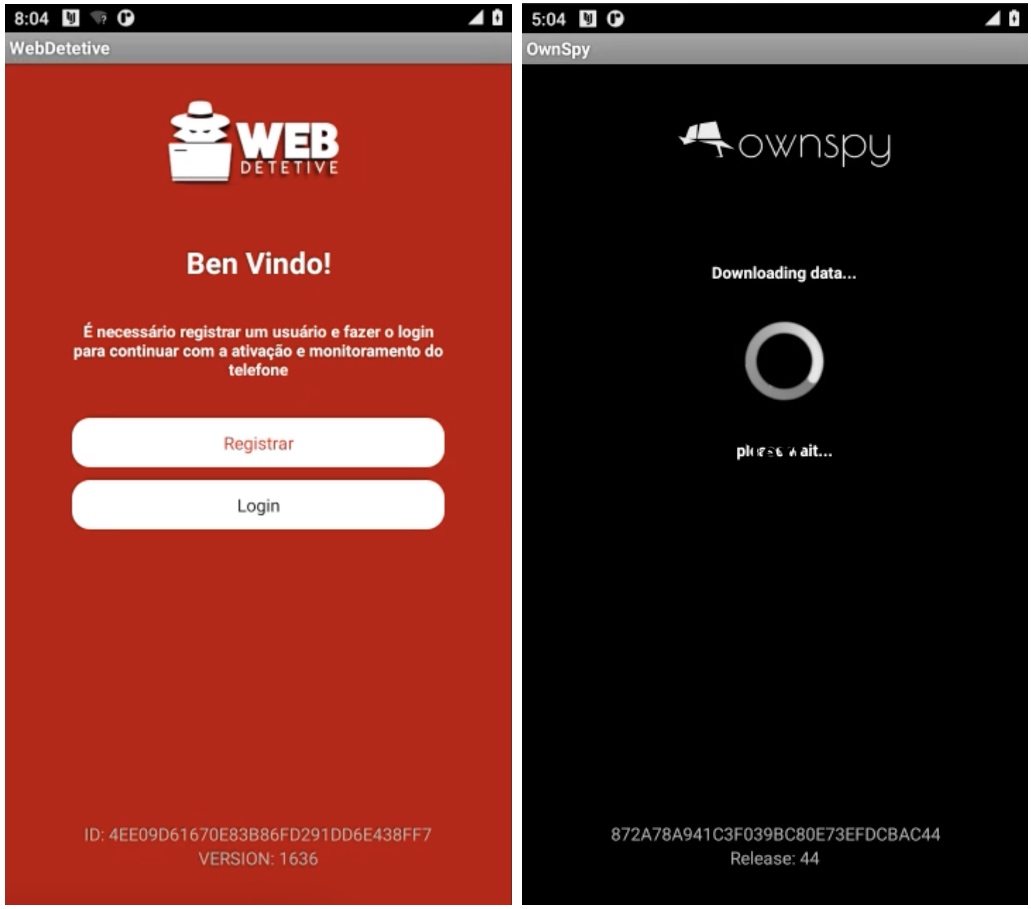
A side-by-side photo comparison of WebDetetive (left) and OwnSpy (right) running on Android. Image Credits: TechCrunch
OwnSpy is developed in Spain by Mobile Innovations, a Madrid-based company run by Antonio Calatrava. OwnSpy has operated since at least 2010, according to its website, and claims to have 50,000 customers, though it’s not known how many devices OwnSpy has compromised to date.
OwnSpy also operates an affiliate model, allowing others to make a commission by promoting the app or offering “a new product to your clients” in return for OwnSpy taking a cut of the profits, according to an archived copy of its affiliates website. It’s not clear what other operational links, if any, exist between OwnSpy and WebDetetive. Calatrava did not return a request for comment or provide contact information for WebDetetive’s administrators.
A short time after we emailed Calatrava, portions of OwnSpy’s known infrastructure dropped offline. A separate network traffic analysis of OwnSpy’s app by TechCrunch found that OwnSpy’s spyware app was no longer functioning. WebDetetive’s app continues to function.
Destructive attack?
WebDetetive is the second spyware maker to be targeted by a data-destructive hack in recent months. LetMeSpy, a spyware app developed by Polish developer Rafal Lidwin, shut down following a hack that exposed and deleted victims’ stolen phone data from LetMeSpy’s servers. Lidwin declined to answer questions about the incident.
By TechCrunch’s count, at least a dozen spyware companies in recent years have exposed, spilled, or otherwise put victims’ stolen phone data at risk of further compromise because of shoddy coding and easily exploitable security vulnerabilities.
TechCrunch was unable to reach the WebDetetive administrators for comment. An email sent to WebDetetive’s support email address about the data breach — including whether the spyware maker has backups — went unreturned. It’s not clear if the spyware maker will notify customers or victims of the data breach, or if it still has the data or records to do so.
Destructive attacks, although infrequent, could have unintended and dangerous consequences for victims of spyware. Spyware typically alerts the abuser if the spyware app stops working or is removed from a victim’s phone, and severing a connection without a safety plan in place could put spyware victims in an unsafe situation. The Coalition Against Stalkerware, which works to support victims and survivors of stalkerware, has resources on its website for those who suspect their phone is compromised.
How to find and remove WebDetetive
Unlike most phone monitoring apps, WebDetetive and OwnSpy do not hide their app on an Android home screen, but instead disguise themselves as an Android system-presenting Wi-Fi app.
WebDetetive is relatively easy to detect. The app appears named as “WiFi” and features a white wireless icon in a blue circle on a white background.

A screenshot showing the “WiFi” app, which presents as a system Wi-Fi app. However, this app is spyware in disguise. Image Credits: TechCrunch
When tapped and held, and the app info is viewed, the app is actually called “Sistema.”

This “WiFi” app icon, when tapped, will actually show as an app called “Sistema,” designed to look like an Android system app, but is actually WebDetetive spyware. Image Credits: TechCrunch
We have a general guide that can help you remove Android spyware from your phone, if it is safe to do so. You should ensure that Google Play Protect is switched on as this on-device security feature can defend against malicious Android apps. You can check its status from the settings menu in Google Play.
If you or someone you know needs help, the National Domestic Violence Hotline (1-800-799-7233) provides 24/7 free, confidential support to victims of domestic abuse and violence. If you are in an emergency situation, call 911. The Coalition Against Stalkerware also has resources if you think your phone has been compromised by spyware.
from TechCrunch
Nuh, Haryana: No Permission For Shobha Yatra On August 28, Sec 144 Imposed
Haryana government have also imposed Section 144, which prohibits the assembly of more than four people, and suspended internet services in the district till August 28
from Zee News :India National
from Zee News :India National
Friday, 25 August 2023
The mugshot that launched a thousand memes
Memes can happen in the blink of an eye, like a Jeopardy! contestant who accidentally makes a sexual innuendo under the pressure of stage lights, or a kid who randomly gets interviewed on a playground and professes his undying love for America’s most plentiful crop, corn.
But as soon as we knew former President Donald Trump would be processed at Fulton County Jail for his fourth indictment, we knew that the resulting mugshot would be all over the place for years to come, from novelty t-shirt stands to our hypothetical future childrens’ history textbooks. We waited for it, knowing that as soon as the image was released to the public, it would become unavoidable.
“This will break Etsy,” Jesse Case wrote in a now-viral tweet (or X post, whatever). And sure enough, less than twenty four hours after Trump’s mugshot was released, Etsy already turns up 5,290 results to the search “trump mugshot.”
Even the former president himself has already set up an extensive merch store with t-shirts, posters, mugs and stickers featuring the photo, which is accompanied by text declaring “NEVER SURRENDER!” It’s unclear if Trump chose this wording since he literally surrendered to Fulton County Jail, or if this somehow went over his team’s head. But nonetheless, Trump supporters can now buy their very own mugshot beer koozie, and yes, this sentence took a year off of my life to type.
Naturally, fake mugshots circulated social media before the real thing was even released – and perhaps due to their less rigorous fact checking standards, pop culture news accounts like Pop Base beat legacy news outlets to the punch, circulating the now ubiquitous mugshot.
It didn’t matter what Trump’s mugshot would look like. No matter what, this image was going to be both a viral meme and an historically monumental artifact. But even without any editing, Trump looks yassified: his bright blonde hair shows no trace of gray, draped in a swoop across his forehead. Prison lighting is unforgiving, but combined with the over exposure of the flash, Trump almost looks younger, as the shadows smooth out the wrinkles on his left cheek. The wave of his hair is perfectly positioned in the center of his forehead, accentuating his angry countenance. At first glance, it looks as though his eyebrows and hair are one, making his scowl even more sinister, more jarring.

As TikToker Kirby Alice pointed out, there’s an irony to these historic mugshots, which aren’t very high-quality images, since, well, they’re mugshots from a county jail.
“I can pretty well guarantee that whatever camera they have to take mugshots was probably purchased at like, a Radio Shack circa 2007,” she said, days before Trump turned himself in. “It might be in the back of a closet suffering heat damage in Georgia right now, and it is about to take one of the most important images in American history.”
I’m reminded of a recent episode of “The Kardashians,” when Kim brought an entire hair and makeup team with her to the DMV to get her license renewed, cheating us out of the idea that awkward driver’s license photos are the one great equalizer of mankind. While Trump’s team surely thought long and hard about everything from his tie color to his facial expression, he wasn’t going to get any special treatment while getting processed in jail, even as some probably-underpaid municipal employee pressed the shutter button to take an undoubtedly iconic photo of our lifetime.
“LizaMinnelliOutlives was how I saw Trump’s mugshot,” a friend wrote to me on Discord. After all, it wasn’t that long ago that we found out that the Queen of England died due to the pronouncement that Liza Minnelli had outlived Queen Elizabeth II.
After Trump’s presidency, the American right and left are so far divided that perhaps only the Donald himself could unite us once more: Everyone, regardless of their political affiliation, is making memes of Trump’s mugshot. It is, quite literally, memetic, as used in the Richard Dawkins sense. It will be circulated, remixed, repurposed and mutated until it perhaps outlives even the LizaMinnelliOutlives meme, surviving the brutal natural selection that is the attention span of digitally-addled brains.
In liberal internet circles, the mugshot is a cause for celebration, an “I told you so” to relatives who were naively lured by Trump’s emboldening rhetoric almost eight years ago. And yet on Truth Social, the somewhat dormant social app that Trump himself founded, the image is a rallying cry – it’s literally being used to solicit campaign donations – yet Trump supporters still find the image funny.
One Truth Social meme account edited Trump’s mugshot to replace the Mona Lisa, as crowds swarm to get a closer look. Another user advertised t-shirts with the mugshot that declare “my pronouns are Trump/won,” which also conveys a serious misunderstanding of how grammar works.
You would think that nothing could be more political than a mugshot of a former president who is indicted for interfering with the democratic process. But some memes just aren’t political at all, reminding us of the absurdity of the moment.
“who cares,” wrote @roastmalone_ on X (Twitter). “trump isn’t even the first actor from home alone 2 to have his mugshot released.”
from TechCrunch
Bitcoin startups remain undercapitalized as funding drought drags on
The crypto industry has not had a great run over the past year. Along with increasing regulatory scrutiny and skeptical investors, capital deployment has pulled back significantly from the highs of 2021, which has left many young startups struggling to raise funds.
This capital crunch is affecting the Bitcoin ecosystem as well. According to Erik Svenson, co-founder and CFO of blockchain infrastructure firm, Blockstream, Bitcoin-focused companies are falling behind as fewer checks are being written.
“I think investment into crypto kind of peaked early last year,” Svenson said on TechCrunch’s Chain Reaction podcast this week. “But Bitcoin itself has always been an area that has been undercapitalized.”
Founded in 2014, Blockstream focuses on its own sidechain technology, dubbed Liquid Network, it has bitcoin mining operations, and provides hardware wallets for bitcoin and other assets. Notably, it doesn’t have a token of its own, unlike many other crypto companies that launched their own during the initial coin offering (ICO) boom in 2017.
“We decided early on not to issue our own token,” Svenson said. “We didn’t raise an ICO like many projects did, so we’ve been relying on more traditional VC investment,” he added.
Blockstream raised $125 million in late January, bringing its total funding to about $400 million. The company had a post-money valuation of $2.49 billion as of August 2022, according to PitchBook data.
However, it’s not been all smooth sailing for the company, especially as the crypto waters have grown choppier amid the broader funding crunch. Svenson pointed out that while Blockstream has some “really bullish Bitcoin investors” on its cap table, it also has LPs, and the turbulence in the crypto market has made things more challenging. “The LPs are trying to parse both the macroeconomic factors and then also the industry-specific direction that everybody’s experienced in the last year.”
from TechCrunch
VFX artists show that Hollywood can use AI to create, not exploit
Hollywood may be embroiled in ongoing labor disputes that involve AI, but the technology infiltrated film and TV long, long ago. At SIGGRAPH in LA, algorithmic and generative tools were on display in countless talks and announcements. We may not know where the likes of GPT-4 and Stable Diffusion fit in yet, but the creative side of production is ready to embrace them — if it can be done in a way that augments rather than replaces artists.
SIGGRAPH isn’t a film and TV production conference, but one about computer graphics and visual effects (for 50 years now!), and the topics naturally have overlapped more and more in recent years.
This year, the elephant in the room was the strike, and few presentations or talks got into it; however, at afterparties and networking events it was more or less the first thing anyone brought up. Even so, SIGGRAPH is very much a conference about bringing together technical and creative minds, and the vibe I got was “it sucks, but in the meantime we can continue to improve our craft.”
The fears around AI in production are, not to say illusory, but certainly a bit misleading. Generative AI like image and text models have improved greatly, leading to worries that they will replace writers and artists. And certainly studio executives have floated harmful — and unrealistic — hopes of partly replacing writers and actors using AI tools. But AI has been present in film and TV for quite a while, performing important and artist-driven tasks.
I saw this on display in numerous panels, technical paper presentations and interviews. Of course a history of AI in VFX would be interesting, but for the present here are some ways AI in its various forms was being shown at the cutting edge of effects and production work.
Pixar’s artists put ML and simulations to work
One early example came in a pair of Pixar presentations about animation techniques used in their latest film, Elemental. The characters in this movie are more abstract than others, and the prospect of making a person who is made of fire, water or air is no easy one. Imagine wrangling the fractal complexity of these substances into a body that can act and express itself clearly while still looking “real.”
As animators and effects coordinators explained one after another, procedural generation was core to the process, simulating and parameterizing the flames or waves or vapors that made up dozens of characters. Hand sculpting and animating every little wisp of flame or cloud that wafts off a character was never an option — this would be extremely tedious, labor-intensive and technical rather than creative work.
But as the presentations made clear, although they relied heavily on sims and sophisticated material shaders to create the desired effects, the artistic team and process were deeply intertwined with the engineering side. (They also collaborated with researchers at ETH Zurich for the purpose.)
One example was the overall look of one of the main characters, Ember, who is made of flame. It wasn’t enough to simulate flames or tweak the colors or adjust the many dials to affect the outcome. Ultimately the flames needed to reflect the look the artist wanted, not just the way flames appear in real life. To that end they employed “volumetric neural style transfer” or NST; style transfer is a machine learning technique most will have experienced by, say, having a selfie changed to the style of Edvard Munch or the like.
In this case the team took the raw voxels of the “pyro simulation,” or generated flames, and passed it through a style transfer network trained on an artist’s expression of what they wanted the character’s flames to look like: more stylized, less simulated. The resulting voxels have the natural, unpredictable look of a simulation but also the unmistakable cast of the artist’s choice.
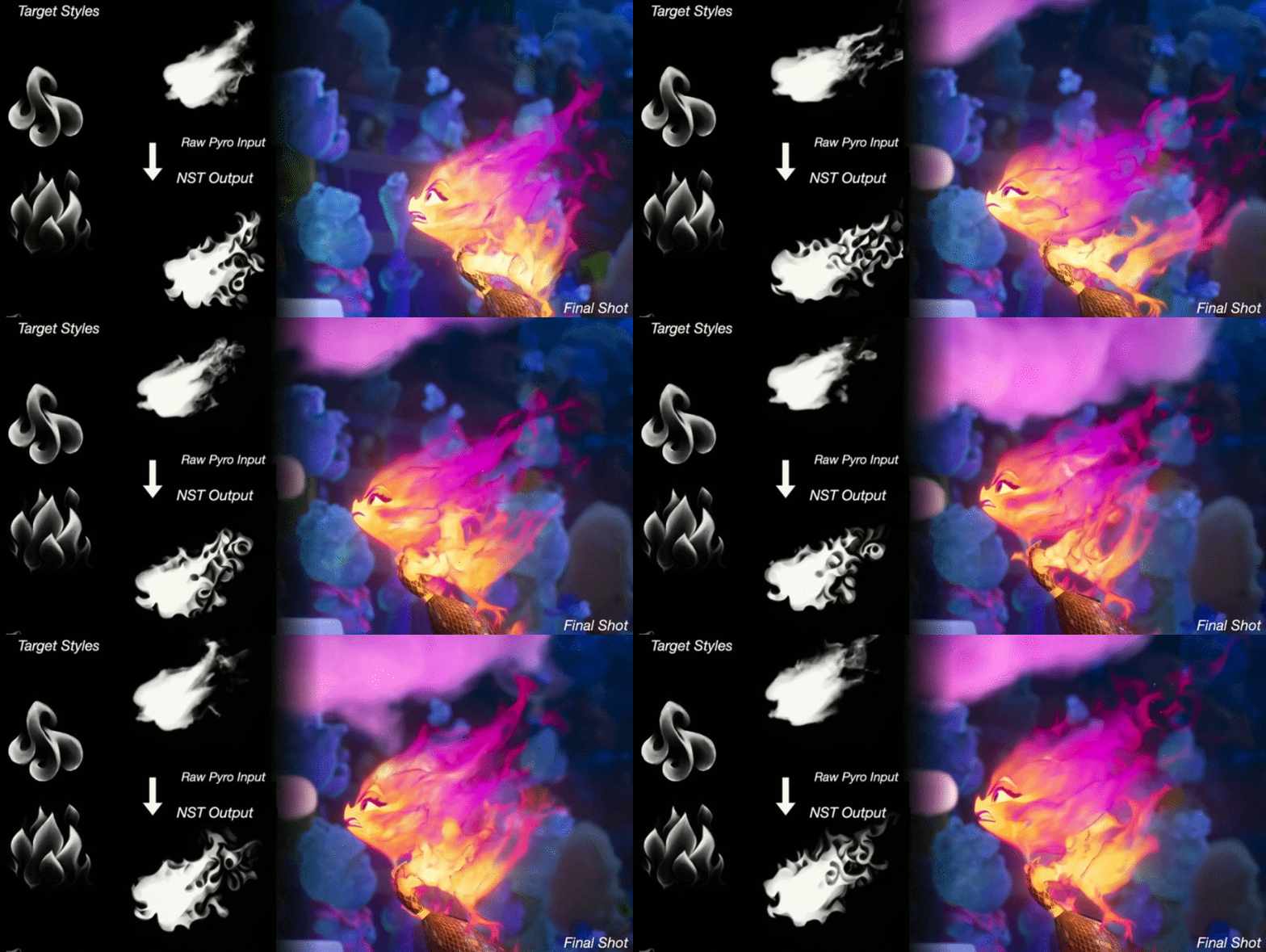
Simplified example of NST in action adding style to Ember’s flames. Image Credits: Pixar
Of course the animators are sensitive to the idea that they just generated the film using AI, which is not the case.
“If anyone ever tells you that Pixar used AI to make Elemental, that’s wrong,” said Pixar’s Paul Kanyuk pointedly during the presentation. “We used volumetric NST to shape her silhouette edges.”
(To be clear, NST is a machine learning technique we would identify as falling under the AI umbrella, but the point Kanyuk was making is that it was used as a tool to achieve an artistic outcome — nothing was simply “made with AI.”)
Later, other members of the animation and design teams explained how they used procedural, generative or style transfer tools to do things like recolor a landscape to fit an artist’s palette or mood board, or fill in city blocks with unique buildings mutated from “hero” hand-drawn ones. The clear theme was that AI and AI-adjacent tools were there to serve the purposes of the artists, speeding up tedious manual processes and providing a better match with the desired look.
AI accelerating dialogue

Images from Nimona, which DNEG animated. Image Credits: DNEG
I heard a similar note from Martine Bertrand, senior AI researcher at DNEG, the VFX and post-production outfit that most recently animated the excellent and visually stunning Nimona. He explained that many existing effects and production pipelines are incredibly labor-intensive, in particular look development and environment design. (DNEG also did a presentation, “Where Proceduralism Meets Performance” that touches on these topics.)
“People don’t realize that there’s an enormous amount of time wasted in the creation process,” Bertrand told me. Working with a director to find the right look for a shot can take weeks per attempt, during which infrequent or bad communication often leads to those weeks of work being scrapped. It’s incredibly frustrating, he continued, and AI is a great way to accelerate this and other processes that are nowhere near final products, but simply exploratory and general.
Artists using AI to multiply their efforts “enables dialogue between creators and directors,” he said. Alien jungle, sure — but like this? Or like this? A mysterious cave, like this? Or like this? For a creator-led, visually complex story like Nimona, getting fast feedback is especially important. Wasting a week rendering a look that the director rejects a week later is a serious production delay.
In fact new levels of collaboration and interactivity are being achieved in early creative work like pre-visualization, as one talk by Sokrispy CEO Sam Wickert explained. His company was tasked with doing pre-vis for the outbreak scene at the very start of HBO’s “The Last of Us” — a complex “oner” in a car with countless extras, camera movements and effects.
While the use of AI was limited in that more grounded scene, it’s easy to see how improved voice synthesis, procedural environment generation and other tools could and did contribute to this increasingly tech-forward process.
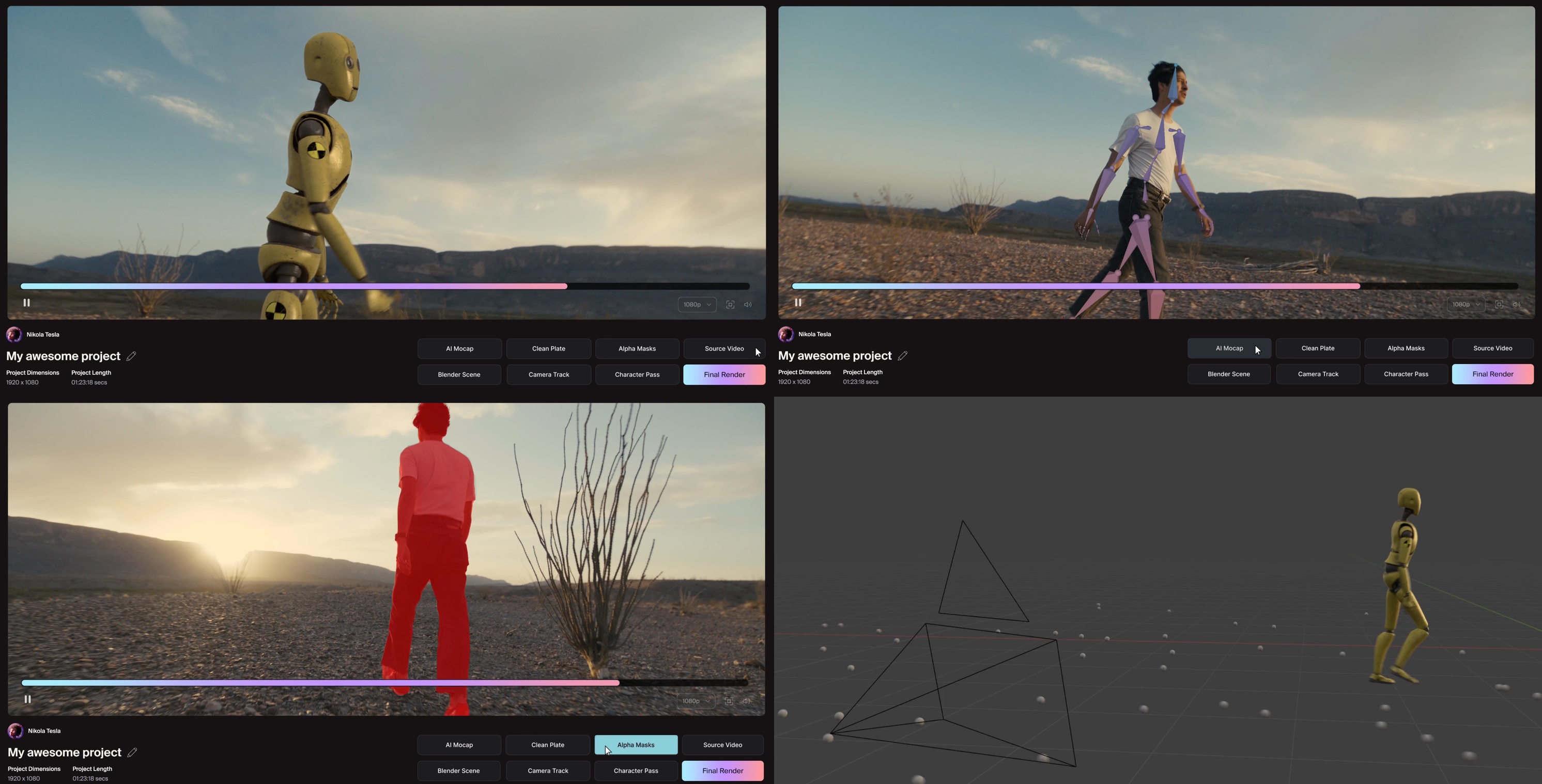
Final shot, mocap data, mask and 3D environment generated by Wonder Studio. Image Credits: Wonder Studio
Wonder Dynamics, which was cited in several keynotes and presentations, offers another example of use of machine learning processes in production — entirely under the artists’ control. Advanced scene and object recognition models parse normal footage and instantly replace human actors with 3D models, a process that once took weeks or months.
But as they told me a few months ago, the tasks they automate are not the creative ones — it’s grueling rote (sometimes roto) labor that involves almost no creative decisions. “This doesn’t disrupt what they’re doing; it automates 80-90% of the objective VFX work and leaves them with the subjective work,” co-founder Nikola Todorovic said then. I caught up with him and his co-founder, actor Tye Sheridan at SIGGRAPH, and they were enjoying being the toast of the town: it was clear that the industry was moving in the direction they had started off in years ago. (Incidentally, come see Sheridan on the AI stage at TechCrunch Disrupt in September.)
That said, the warnings of writers and actors striking are in no way being dismissed by the VFX community. They echo them, in fact, and their concerns are similar — if not quite as existential. For an actor, one’s likeness or performance (or for a writer, one’s imagination and voice) is one’s livelihood, and the threat of it being appropriated and automated entirely is a terrifying one.
For artists elsewhere in the production process, the threat of automation is also real, and also more of a people problem than a technology one. Many people I spoke to agreed that bad decisions by uninformed leaders are the real problem.
“AI looks so smart that you may defer your decision-making process to the machine,” said Bertrand. “And when humans defer their responsibilities to machines, that’s where it gets scary.”
If AI can be harnessed to enhance or streamline the creative process, such as by reducing time spent on repetitive tasks or enabling creators with smaller teams or budgets to match their better-resourced peers, it could be transformative. But if the creative process is seconded to AI, a path some executives seem keen to explore, then despite the technology already pervading Hollywood, the strikes will just be getting started.
from TechCrunch
Madhumita Shukla Murder Case Convict And Ex-UP Minister Amarmani Tripathi, Wife Released After 16 Years In Jail
Mudhumita Shukla Murder Case: Poet Madhumita, who was pregnant, was shot dead on May 9, 2003, in the Paper Mill Colony, Lucknow. Amarmani Tripathi was arrested in September 2003 in connection with the murder of the poet with whom he was allegedly in a relationship.
from Zee News :India National
from Zee News :India National
Thursday, 24 August 2023
You can finally buy Lego’s Braille Bricks
Building with Lego bricks has stayed a formative and important practice for kids around the world, partly because it’s so easily enjoyed by anyone, regardless of location, language, or ability. Now the company has made its Braille Blocks, a learning toy for children with visual impairments (or who just want to learn the script) available for purchase by anyone who wants them.
The set was introduced back in 2019, but only as a kit that was distributed for free to limited recipients, like people and organizations specializing in teaching kids with vision impairments. After a couple years of feedback, Lego has decided to make the set widely available.
It’s a 287-piece box of special bricks, most of which are of the standard 2×4 variety, which allows room for each letter of the 2×3-dot Braille alphabet and a visible label. This allows them to be teaching tools for sighted and vision-impaired; there’s also a reference sheet with the letters and blocks in order, and a set of starter projects to get things moving.
“For the blind community, braille is not just literacy, it’s our entry to independence and inclusion into this world, and to have LEGO Braille Bricks made available for the wider public is a massive step forward to ensuring more children will want to learn braille in the first place,” said Martine Abel-Williamson, president of the World Blind Union, in Lego’s announcement of the set’s availability.

Image Credits: Lego
The set is part of a gradual progression of expanding specialized Braille learning tools from schools to homes. There is also, for instance, a new push to make refreshable Braille displays available and affordable, which would enable e-reader-like functionality as well as composition capabilities.
Accessibility is being baked into more digital products as well, though there are still countless challenges in making sure people with disabilities can interact intuitively with some of the more complex web apps and services.
The Play with Braille Lego set will be shipped in early September, but is available for pre-order in English and French now for $90.
from TechCrunch
Advanced Ionics nets $12.5M Series A to inject green hydrogen into heavy industry
When people talk about hydrogen these days, they almost always mention transportation. I get it: people are used to filling up tanks, not charging cars. But from a practical perspective, transportation is not a great use for hydrogen.
“Hydrogen is really terrible to store and to transport,” said Chad Mason, founder and CEO of Advanced Ionics.
Which is why Advanced Ionics is a hydrogen company that has nothing to do with transportation. Instead, the startup is focused on heavy industry, which represents about a third of global emissions.
“Hydrogen is one of the main feedstocks for a vast majority of industrial processes,” Mason told TechCrunch+. It’s essential for the ammonia used to make fertilizers and for many petrochemical processes used to make everything from plastics to synthetic rubber and lubricants. Even steel and glass production could benefit from a decarbonized source of hydrogen.
Amid the crowd of hydrogen companies hoping to elbow their way into these markets, Advanced Ionics hopes its more efficient approach to using electrolysis will give it an unfair advantage in producing hydrogen.
Today, much of the world’s hydrogen supply comes from what’s called steam-reformed methane. Basically, steam is mixed with methane gas, producing hydrogen and carbon dioxide. Electrolyzers, on the other hand, use electricity to split water into hydrogen and oxygen. If they’re powered by renewable energy, then the process can be carbon-free.
But they’re not perfect.
Most efforts to produce hydrogen work at either relatively low temperatures or high temperatures. Advanced Ionics’ electrolyzers, though, work at temperatures that are not too high or low, basically the same range at which many industrial processes already take place. That means the heat requirements for the startup’s equipment are the same as what’s already available at those sites.
from TechCrunch
Friend.tech hype grows, Tornado Cash founders go for a spin and FBI’s monitoring North Korean hackers
Welcome back to Chain Reaction.
To get a roundup of TechCrunch’s biggest and most important crypto stories delivered to your inbox every Thursday at 12 p.m. PT, subscribe here. Follow me on Twitter @Jacqmelinek for breaking crypto news, memes and more.
If you haven’t heard about friend.tech this week, you’re probably living under a rock. But that’s ok, we dove deep into the hype and looked at what skeptics are worried about for the new application.
There was also a lot of talk around Tornado Cash as the two founders behind the crypto mixer were charged on Wednesday by U.S. federal agencies. Details on that and more below.
This week in web3
- Two founders behind crypto mixer Tornado Cash charged by U.S. federal courts
- FBI says North Korean hackers preparing to cash out after high-profile crypto hacks
- Friend.tech hype is skyrocketing, but will it actually reach the stars?
- Solana Pay integrates plug-in with Shopify for USDC payments
- Checkout.com cuts ties with Binance, which is mulling legal action in response
The latest pod
For this week’s episode, Jacquelyn interviewed Erik Svenson, co-founder, president and chief financial officer at Blockstream, a bitcoin and blockchain-focused infrastructure firm.
The company was founded in 2014 and has its own sidechain technology, Liquid Network, as well as bitcoin mining operations and hardware wallets for Bitcoin and other assets. It most recently raised $125 million in January and has raised more than $400 million to date.
Erik previously worked on Wall Street as a VP for AIG investments and was a co-founder and consultant of other startups. The last startup he co-founded before Blockstream was Dan’s Plan, a health tech company.
We discussed how the current macroenvironment is impacting Bitcoin-focused businesses and where Erik sees the most opportunities for startups today.
We also talked about:
- Blockstream’s mining operations
- Surviving a bear market
- Transitioning from TradFi to crypto
- Advice for startups
Subscribe to Chain Reaction on Apple Podcasts, Spotify or your favorite pod platform to keep up with the latest episodes, and please leave us a review if you like what you hear!
Follow the money
- Crypto lender Maple Finance raises $5 million to enter Asia amid regulatory clarity
- Vessel Capital emerges from stealth with $55 million fund focused on web3 infrastructure and apps
- Berlin-based Anytype raises $13.4 million for its open sourced tool
- Nodal Power raises $13 million to use landfill to power bitcoin mining centers
- Decentralized credit protocol PADO Labs raises $3 million in a seed round
This list was compiled with information from Messari as well as TechCrunch’s own reporting.
What else we’re writing
Want to branch out from the world of web3? Here are some articles on TechCrunch that caught our attention this week.
- Nvidia’s Q2 earnings prove it’s the big winner in the generative AI boom
- 5 trends in VC funding for pre-seed startups (TC+)
- Chronic technical debt could be holding your company back (TC+)
- The late-stage venture market is crumbling (TC+)
- Introducing the Startup Battlefield 200 companies at TechCrunch Disrupt 2023
from TechCrunch
Wednesday, 23 August 2023
SpaceX alums say they’ll bring rocket reliability to EV charging
Electric Era says it cracked the code for fast and reliable electric-vehicle charging stations that can go wherever they’re needed.
Founded by former SpaceX engineers, the startup just announced a $11.5 million series A round led by HSBC’s asset management arm. Climate-tech fund Blackhorn, lithium-mining giant SQM and mobility-focused investor Proeza also chipped in.
Electric Era intends to use that cash to prove that its soon-to-launch PowerNode stations can help turn around public chargers’ wack reputation in the U.S. It’s a worthwhile goal, since subpar and scarce public chargers, as well as grid infrastructure challenges, are altogether slowing down EV adoption in the U.S. — hampering the nation’s decarbonization plans. But is four-year-old Electric Era up for the challenge?
Founder and CEO Quincy Lee tells TechCrunch that the team’s experience developing Starlink satellites in particular will help make it happen. Lee worked at SpaceX for seven years, while CTO Sam Reineman spent nine years and software VP Sith Dharmasiri spent seven at the Elon Musk-cofounded private space company. Lee argues that their prior experience there grants Electric Era both an outsider’s perspective and deep technical engineering competencies. “We’ve really gone from space down to earth and are working on building the infrastructural backbone that EV drivers need,” added Lee.
Electric Era is developing its own software — PowerNode OS — and some hardware, while outsourcing other key components. “We don’t build the chargers or the batteries,” said Lee. “We focus instead on the entire EV fast charging station.” The CEO says the startup’s “battery-backed and software optimized” PowerNode stations bring a “rocketry level of reliability” to public EV charging, without requiring serious grid upgrades.
These stations can apparently scale up gradually, wherever they’re needed, such as gas stations, convenience stores, grocers and restaurants. “We can, as part of our software stack, incorporate real-time management of battery systems and solar systems to bring energy and generation to the sites, so that we can add more capacity to the grid locally, as opposed to kind of redoing all the wires,” said Lee.
As for where you can find a PowerNode station, the company plans to launch in nine states before the end of the year. That’ll be about 27 chargers in total, or about three per station, Lee tells TechCrunch.
Lee says the startup’s thesis is that “legacy car refill is dying. They’re facing extinction from this shift to electric forms of transportation, and we are keeping them in business.” Electric Era handles everything from real-time monitoring to on-site energy management. That’s one factor in the company’s plan to keep reliability high. Another is extensive testing, which includes running these power-management systems through “a ton of different crazy edge cases” and charging 20-30 different types of vehicles — Teslas, Rivians, Bolts, Leafs and so on.
The company is on a “warpath to have about three gigawatt hours of installed battery capacity and utilities all across the country by 2030,” according to Lee. That’d equate to operating about 10,000 stations across the U.S. — a serious undertaking, but not all that huge a figure if you consider that S&P analysts expect to see 28 million EVs on U.S. roads by the end of the decade.
Electric Era has raised $19 million to date, and its series A values the firm at $48 million (post money).
from TechCrunch
Subscribe to:
Posts (Atom)