Monday, 31 July 2023

GM begins shipping a pricier-than-expected Chevy Blazer EV

The Chevrolet Blazer EV, a battery electric SUV that is part of GM’s bid to surpass Tesla in U.S. EV sales by 2025, is headed to dealerships.

The automaker said Monday that the first 2024 Chevrolet Blazer EVs have started shipping from GM’s factory in Ramos Arizpe, Mexico. GM also released details on pricing and range estimates for a few of the SUV’s trim models.

The upshot? Prices are higher than expected.

The Blazer EV follows the behemoth GMC Hummer pickup and Cadillac Lyriq in the new Ultium architecture — the modular electric platform that includes a new battery design and software and is at the heart of the automaker’s EV strategy.

The vehicle will initially be available in three trims: luxury (LT), rally sport (RS) and super sport (SS). The 2LT front-wheel drive version will be the entry-level option. The company said it’s also making a “police pursuit” vehicle available to law enforcement early next year.

GM, like most other automakers, has launched with its more pricey trim. Still, it seems even some of the lower priced trims are still higher than GM’s original estimate. Last year, the company revealed Blazer EV and said the base version would start at about $44,995. At the time, the company said it would price the 2LT at about $47,595 and the RS at $51,995.

In reality, the trims are as much as $10,000 higher than originally estimated.

The first Blazer EV to hit dealer lots this summer will be the RS all-wheel drive, a model that starts at $60,215 and has an estimated range of 279 miles. This vehicle is loaded with a number of features, including gloss black trim, a heads-up display, heated front and rear seats, ventilated front seats and animated exterior lighting. Prices don’t include tax, title, license, dealer fees and optional equipment.

The RS rear-wheel drive, which is expected to have a 320-mile range and has a few extras including a Bose audio system, will start at $61,790. The 2LT AWD, which starts at $56,7151 and has a range of 279 miles, will come equipped with a 17.7-inch-diagonal infotainment touchscreen and 11-inch-instrument cluster, heated steering wheel, heated front seats, heated side mirrors and wireless phone charging, among other features.

GM said the RS rear-wheel drive and 2LT AWD trims will begin production this fall. The company has pushed the production start date of the SS version to spring 2024.


from TechCrunch

Sunday, 30 July 2023

Fidelity deepens valuation cut for SaaS startup Gupshup

Fidelity has slashed the estimated worth of its holding in SaaS startup Gupshup by over 20% in a month and by more than 50% since the original investment in the latest brutal markdown across private markets.

The U.S. asset manager valued its holding in Gupshup at $8.08 million at the end of June, down from $10.15 million a month prior, according to a monthly disclosure. Fidelity originally invested $16.2 million from its Blue Chip Growth Fund in Gupshup in mid-2021 in a funding round that valued the business messaging services provider at $1.4 billion.

The business messaging platform, which started its journey in India 17 years ago, raised $340 million in 2021 from a clutch of investors including Tiger Global, Think Investments and Malabar Investments.

Fidelity slightly improved the value of its holdings in Reddit, Discord, Twitter-parent X Holdings and Indian e-commerce Meesho in the month of June, it disclosed in the filing.


from TechCrunch

Tesla’s range-flation problem, Waymo reverses on self-driving trucks and Ford tweaks its EV playbook

The Station is a weekly newsletter dedicated to all things transportation. Sign up here — just click The Station — to receive the newsletter every weekend in your inbox. Subscribe for free. 

Welcome back to The Station, your central hub for all past, present and future means of moving people and packages from Point A to Point B.

Hey frens! I’m back from vacation and who-wee — a lot happened this week from automaker earnings and the Tesla range inflation drama to Waymo tapping the brakes on self-driving and Cruise expanding to yet another city.

One other note, you can find me on TechCrunch’s Equity podcast, a place where I will show up on a semi-regular basis, including this episode that came out Friday!

Onward!


Want to reach out with a tip, comment or complaint? Email Kirsten at kirsten.korosec@techcrunch.com.

Reminder that you can drop us a note at tips@techcrunch.comIf you prefer to remain anonymousclick here to contact us, which includes SecureDrop (instructions here) and various encrypted messaging apps.

Micromobbin’

the station scooter1a

Is there anything else to talk about besides Lyft mulling the sale of its ebike division?

Lyft posted on its blog that it had received “strong inbound interest” in its bikes and scooters business.

The company stated:

As a leading bikeshare provider, supplying solutions to over 53 markets across 15 countries, it’s only logical for Lyft to listen to credible proposals and explore strategic partners and options in several forms to serve more riders in more cities. We expect this part of the business to continue to be a meaningful part of Lyft’s offering now and into the future.

The announcement runs contrary to what newly appointed CEO David Risher has told reporter Rebecca Bellan in past interviews. Risher, who is known as a big supporter of ebikes, did say the company planned to focus on its core ride-hailing business and become profitable, but it didn’t seem like the two-wheeled share service was on the chopping block.

The news prompted some here at TechCrunch to declare that shared micromobility was officially dead. I’m not so sure.

What do you think?

Deal of the week

money the station

Instead of a deal of the week, I’d like to call y’all’s attention to the list of deals below. See a pattern emerging?

Yup, me too. Software and EV charging sure seems like a thing, eh?

Other deals that got my attention this week …

Ampcontrol, an EV fleet management software startup, raised $10 million in Series A funding round led by the Westly Group. Other investors included AngelPad and Lorimer Ventures.

Aurora raised $820 million in a public and concurrent private offering (a deal we covered last week.) As I mentioned in the Equity podcast, tucked inside the SEC filing detailing the deal we learn that Uber invested $1 million in the private placement and $74 million in the public follow-on. When taking into account the Class B shares, Uber has a 22% stake in Aurora.

EV.energy, the UK-based EV charging software startup, raised $33 million in a Series B round led by National Grid Partners with participation from new investors Aviva Ventures, WEX Venture Capital and InMotion Ventures, as well as existing investors Energy Impact Partners, Future Energy Ventures and ArcTern Ventures.

Flipturn, a startup that developed a software management system for EV truck fleets, raised $4.5 million in a seed round led by Accel.

Field, the battery energy storage systems developer launched by former Bulb Energy co-founder Amit Gudka, raised £200 million from DIF Capital Partners.

Voltpost, a New York City–based startup that developed hardware that converts lampposts into EV charging spots, raised $3.6 million in a seed round led by RWE Energy Transition Investments with participation from Twynam Funds Management, Exelon Foundation, Good News Ventures and Climate Capital.

VW Group made a pair of deals with Chinese automakers aimed at shoring up sales in China, including taking a 5% stake valued at about $700 million XPeng as part of a deal to jointly develop and produce two mid-sized EVs for China. In a separate agreement, Audi expanded a partnership with SAIC. Reporter Rita Liao provides insight on what this deal could mean for future alliances between China and the West.

Notable reads and other tidbits

Autonomous vehicles

Cruise self-driving vehicles arrived in Nashville this week for testing; a robotaxi service is expected to follow. Cruise will also begin testing in multiple, new cities as part of its aggressive commercial ramp, according to the company. If the company’s careers page provides any hints, it seems Atlanta is one of them.

Want evidence that Cruise is accelerating? One year ago, Cruise only operated in San Francisco. Cruise has since expanded to Austin, Dallas, Houston, Phoenix and most recently Miami.

Rafaela Vasquez, the safety driver who was behind the wheel of an Uber ATG self-driving vehicle when it struck and killed a pedestrian in Tempe in 2018, pleaded guilty to endangerment. Vasquez was sentenced to three years of supervised probation.

Waymo is tapping the brakes on self-driving trucks and shifting most of its capital, resources and talent to one commercial bet: ride-hailing. I won’t call it a complete shutdown as limited testing will continue. But the program as it once stood is over. It seems most people on the team have kept their jobs at Waymo, per sources. (However, it’s still early; we’ll see how it all shakes out once the program is wound down.)

Earnings

Ford and GM both posted earnings this week and there were some general themes; namely that business is good if you’re selling gas and hybrid trucks and SUVs. The EV business? Well that’s a bit of a money loser. Both companies raised profit guidance for the year and GM said it would cut costs another $1 billion as it focuses on earning more money.

Ford, which now breaks out earnings for three business units, is tweaking its EV plans. The big line item is that Ford expects its EV business to lose $4.5 billion in 2023 — double what it previously forecast. And the company seems to be more bullish than ever on hybrids, which reminds me of Bill Ford’s comments way back in 2016 about viewing hybrids as a transitional, or bridge technology. At the time, the sentiment was about consumer adoption. These days Ford is learning that hybrid technology applied to trucks is particularly attractive to buyers.

Electric vehicles, batteries & charging

Ample, a San Francisco-based startup, is bringing its modular EV battery swapping technology to Mitsubishi Fuso’s electric trucks this winter.

GM isn’t going to kill off the Chevy Bolt EV after all. This is going to be a next-gen Bolt EV based on the new Ultium platform and battery design. I’m fascinated by this reversal because it happened so quickly (3 months!).  Will it still be assembled at the Orion plant? Reminder: Orion was supposed to be retooled for electric truck production once the Bolt went out of production at the end of 2023.

Tesla exaggerated the range estimates for its EVs for years, prompting owners to flood its service center over concerns that their vehicles needed service, according to a new detailed Reuters report. As I note in my own story, one of the nagging problems with range estimates is their variability, which allows some automakers to push the boundaries of the system. While the EPA does review and approve those estimates, it allows automakers to use one of two methods to reach those figures: use a standard formula that converts fuel economy results, or conduct additional tests to come up with their own range estimate. Tesla has always done the latter, which gives far better numbers.

Miscellaneous

Lacuna Technologies, a startup that sold software services to cities to help create and enforce transportation policies, has shut down, per a LinkedIn post from product lead Samuel Jackson. (h/t to the source who pointed me to the post).

Disrupt!

Beep beep! TechCrunch Disrupt 2023, taking place in San Francisco on September 19–21, is where you’ll get the inside scoop on the future of mobility. Come and hear from today’s leading mobility entrepreneurs on what it takes to build and innovate for a more sustainable future. Save up to $600 when you buy your pass now through August 11, and save 15% on top of that with promo code STATION. Learn more.


from TechCrunch

`Will RWAs Speak Now?`: With Legs Tied, Dog Beaten To Death By 12 SHAMELESS Youth In Ghaziabad, Police Files FIR

The video gradually went viral on social media and various animal rights WhatsApp groups, drawing widespread attention to the appalling act of cruelty.

from Zee News :India National

Saturday, 29 July 2023

Weather Update: IMD Predicts Heavy Rainfall In Karnataka, Telangana; Godavari Crosses Danger Mark

The IMD has predicted very heavy rainfall activity over Madhya Pradesh and Chhattisgarh during the next 2 days.

from Zee News :India National

Amid Manipur Ethnic Clashes, Home Minister Amit Shah`s Big Move On `Illegal` Myanmar Immigrants

The violence in Manipur erupted after a rally by the All Tribal Students' Union of Manipur (ATSUM) on May 3 to protest against the high court order, asking the state government to consider adding the Meitei community to the list of Scheduled Tribes (STs). 

from Zee News :India National

Monsoon Claimed 187 Lives In Himachal Pradesh Till Now: Official Data

Over 650 roads including three national highways are closed. Earlier, Chief Minister of Himachal Pradesh, Sukhvinder Singh Sukhu, said that the state has faced the harshest rain and flood disasters in the past 75 years. 

from Zee News :India National

Twitter rebrands to ‘X,’ hackers infect Call of Duty, and foreign visitors to China go cashless

Hey, friends, welcome to Week in Review (WiR), TechCrunch’s roundup of the week in tech news. Life getting in the way of your daily TechCrunch habit? Not to worry. WiR will get you caught up in no time.

This week, WiR covers the improving quality of AI porn generators and the ethical dilemmas they raise; Twitter rebranding to “X”; and hackers infecting Call of Duty with self-spreading malware. Elsewhere, we dive into a North Korean hacking group, foreign Chinese visitors’ newfound ability to go cashless, and the rollout of Sam Altman’s Worldcoin eyeball-scanning crypto project.

As always, it’s a lot to get to, so let’s not delay. But first, a reminder that if you haven’t already, sign up here to get WiR in your inbox every Saturday.

Most read

Twitter rebrands to “X”: This week, Twitter removed its iconic bird logo and adopted “X” as its new official branding. The move, which Elon Musk announced over the weekend, is a harbinger of the platform’s shift — perhaps more aspirational than concrete — to deemphasize text tweets in favor of audio, video, messaging and payment and banking.

Now it’s my X: Twitter’s rebranding to X hasn’t been faring exceptionally well. In addition to a haphazard rollout that saw parts of the site referencing “X” while others still implored you to “search Twitter” or push a blue button to “Tweet,” the company didn’t even make an attempt to secure the @x Twitter handle, owned by Gene X Hwang of the corporate photography and videography studio Orange Photography. Twitter later wrested control of the handle without notifying or compensating Hwang.

Hackers infect Call of Duty: Hackers are infecting players of an old Call of Duty game, Modern Warfare 2, with a worm that spreads automatically in online lobbies. As Lorenzo writes, Modern Warfare 2 was released quite a bit ago — 2009 — but still has a small community of players. Call of Duty publisher Activision said in a tweet that it would bring the Steam version of the game offline as it “investigates report of [the] issue.”

Foreign visitors to China go cashless: This week, China’s two dominant mobile payment solutions, WeChat Pay and Alipay, announced that foreign users can now pay at Chinese retailers by linking their foreign credit cards, including Visa, Mastercard and Discover. Previously, using WeChat Pay and Alipay in China required a local bank account, making it challenging for short-term visitors to use these payment methods.

Worldcoin launches its eyeball-scanning project: Worldcoin, Sam Altman’s audacious eyeball-scanning crypto startup, has begun the global rollout of its services to help build a reliable solution for distinguishing humans from AI online. People can download World App, the startup’s protocol-compatible wallet software, and visit an Orb, Worldcoin’s helmet-shaped eyeball-scanning verification device, to receive a unique “World ID.”

North Korean hackers expose themselves: Security researchers say they have high confidence that North Korean hackers were behind a recent intrusion at enterprise software company JumpCloud because of a mistake the hackers made. Mandiant, which is assisting one of JumpCloud’s affected customers, attributed the breach to hackers working for North Korea’s Reconnaissance General Bureau, or RGB, a hacking unit that targets cryptocurrency companies and steals passwords from executives and security teams.

Waymo puts the brakes on trucks: Waymo is tapping the brakes on self-driving trucks and shifting most of its capital, resources and talent to one commercial bet: ride-hailing. Kirsten writes that the move, which was announced Wednesday in a company blog post, comes six years after Waymo first tested its autonomous vehicle system in Class 8 trucks. The company emphasized the decision was driven by the commercial opportunities in applying its autonomous vehicle technology to ride-hailing.

SEC probes Bolt ex-CEO: Ryan Breslow, co-founder of the e-commerce software outfit Bolt, was subpoenaed along with the company last year by the U.S. Securities and Exchange Commission, Christine reported this week. A letter authored in April by a lawyer representing Bolt investors said the SEC was investigating whether federal securities laws were violated in connection with statements made when Bolt was raising money in 2021.

Audio

In need of a podcast to fill the hours? You’re in luck. TechCrunch has a roster of new episodes to keep you both entertained and informed.

On Equity this week, the crew dug through the headlines of the past few days, starting with AngelList’s acquisition of Nova, Waymo steering toward robotaxis and the latest on interest rates from the Fed. They also touched on earnings for Big Tech and how more limited partner capital can funnel into diverse venture funds.

Found featured a conversation with Mandy Price, the co-founder and CEO at Kanarys, a software-as-a-service startup that helps companies tackle their diversity and inclusion problems with data. Mandy talked about why she started the company after a decade-long career as a lawyer and why she didn’t want Kanarys to just be focused on hiring metrics, as many other diversity, equity and inclusion platforms are.

And on Chain Reaction, Deana Burke and Natasha Hoskins, the co-founders of Boys Club, spoke about their social decentralized autonomous organization for the “crypto curious.” Originally designed to get women and nonbinary people into the web3 world, Boys Club now aims to be an open space for anyone looking to get into the space.

TechCrunch+

TC+ subscribers get access to in-depth commentary, analysis and surveys — which you know if you’re already a subscriber. If you’re not, consider signing up. Here are a few highlights from this week:

Why SAFE rounds are safe: SAFEs, simple agreements for future equity, have long been touted as a founder-friendly structure for signing venture deals. But is it really fair to call them that? Rebecca investigates.

Positivity in the face of toxicity: Dominic writes about how prioritizing positive company culture is just as important — or at least, should be as important — as investor returns.

Playing the long AI game: Microsoft’s and Alphabet’s results indicate the AI game is more of a long-term strategy, Alex writes.


Get your TechCrunch fix IRL. Join us at Disrupt 2023 in San Francisco this September to immerse yourself in all things startup. From headline interviews to intimate roundtables to a jam-packed startup expo floor, there’s something for everyone at Disrupt. Save up to $600 when you buy your pass now through August 11, and save 15% on top of that with promo code WIR. Learn more.


from TechCrunch

Chaos Erupts During Moharram Procession in Delhi`s Nangloi: Stones Thrown at Police, Several Injured

According to DCP Harinder Singh, the Moharram procession in Nangloi commenced peacefully, with organizers and attendees marching peacefully to observe the occasion.

from Zee News :India National

Friday, 28 July 2023

Samajwadi Party Leader Swami Prasad Maurya Claims ‘Badrinath Was A Buddhist Monastery,’ Sparks Row Yet Again

Swami Prasad Maurya Sparks Row: The Samajwadi Party leader has claimed that ‘Badrinath was a Buddhist Monastery.’ 

from Zee News :India National

Twitter, now X, opens up its ad revenue sharing program with global creators

Earlier this month, Twitter — which has since rebranded as X — began sharing ad revenue with verified creators in an attempt to retain top talent on its platform. Today, the company announced its “Ads Revenue Sharing” program is now available for eligible creators globally. The program, according to posts by X owner Elon Musk, aims to dole out $5 million in the first round of creator payments. This would be cumulative from the month of February onward, he noted.

Several creators posted they had received substantial payouts as a result, with some ranging in the five to six figures.

To be eligible, X users will need to subscribe to Blue (formerly Twitter Blue) or Verified Organizations and must have “at least 15M impressions on your cumulative posts within the last 3 months,” the website on the creator program explains. In addition, users must have at least 500 followers.

X is monetizing the ads served in the replies to creators’ posts to determine payouts, not the ads served in the main X timeline. This incentivizes creators to post things that encourage a lot of conversation. While that could lead to controversial hot takes or opinions and other extreme content, X has put some guardrails on what’s permitted. Sexual content, violence, criminal behaviors, gambling, drugs, alcohol, and “get-rich schemes” are not allowed, for example. Creators also can’t attempt to monetize copyrighted content they don’t own.

With today’s announcement, the program is now globally available to creators who meet the eligibility requirements.

“We want X to be the best place on the internet to earn a living as a creator and this is our first step in rewarding you for your efforts,” reads a post by the official X account.

Adds X CEO, Linda Yaccarino, “absolute game changer for our creators.”

In addition to the global launch, Elon Musk also tweeted a chart indicating X’s monthly users reached a new high in 2023, even after the removal of bots, he claims. (Bot removal is an ongoing activity, of course, not a one-and-done scenario). The chart indicates Twitter, now X, at one point, reached 541.5 million monthly users, but it’s not labeled to show the months. It’s also not clear how Musk determines what qualifies as “monthly usage,” as compared with the industry standard MAU (monthly active user).

The chart differs from what others have shared using third-party measurement tools, including Cloudflare CEO Matthew Prince, who recently pointed to tanking traffic to the Twitter domain. Simialarweb also reported declines in Twitter traffic alongside the launch of Threads.


from TechCrunch

UP: A Man Was Seen Walking With Something Unusual In His Hand - It Was His Sister`s Head. READ SHOCKING STORY

This chilling event took place in Barabanki, Uttar Pradesh, and has sparked outrage across the nation.

from Zee News :India National

Thursday, 27 July 2023

Mobile website builder Universe launches AI-powered designer

Universe, the no-code mobile website builder, announced today that it’s launching an AI-powered website designer in beta. The designer, called GUS (Generative Universe Sites), can help anyone build and launch a custom website from their iOS device.

Once you get started with GUS, you will enter the familiar Universe grid editor. Instead of starting with a template, you start a text conversation with GUS to begin creating your website. GUS will start by asking: “What kind of website would you like to build today?” Once you give GUS some initial details about the type of website you would like to build, GUS will ask you for a bit of information about what exactly you’re looking. For instance, GUS may ask if you have a specific design or color scheme in mind, or if you have an idea of how many pages you would like on the website.

After you give GUS details about your vision for the website, GUS will create a layout for you. The layout is completely editable, as you can manually change things without having to touch any bits of code. For instance, if you want to change an image that GUS selected, you can go in and swap it with a different one. Once you’re happy with what you see, you can go ahead and publish your website.

“When we set out to develop what would ultimately become Universe, our mission was clear – to empower anyone to build the internet,” said Universe founder and CEO Joseph Cohen in a statement. “Generative AI lets us do this at an entirely new level: just tell GUS what’s in your mind and it’ll build it for you. Now, everyone on our iOS app can try the GUS beta. We hope we can give everyone the confidence and design support—from tattoo artists to general contractors to students to pragmatists to visionaries—to claim their corner of the internet with the computer they already carry around in their pocket every day.”

The GUS Beta is currently available to all users who update their Universe app on iOS. Universe plans to bring the experience to the web in the near future to give users without an iPhone or those who prefer desktop the ability to access GUS.

Universe’s new tool is similar to one launched by Wix earlier this month, which is called the AI Site Generator. The tool allows users to describe their intent and generate a website complete with a homepage, inner pages and text and images — as well as business-specific sections for events, bookings and more.

One of the main ideas behind both companies’ products is to help small and medium-sized businesses launch and maintain websites to drive sales, which can be a challenging process. For context, a 2022 survey by Top Design Firms, a directory for finding creative agencies, found that nearly 27% of small businesses still don’t have a website and that low traffic, followed by adding “advanced” functionalities and cost, are the top challenges they face with their website.

Of course, the products aren’t only geared and marketed towards business-owners, as they can be used by anyone to create a website easily.

“Universe continues to champion inclusivity and accessibility in web design, and GUS marks a significant milestone in this journey,” Universe wrote in a press release. “With its AI-powered capabilities, GUS opens doors for individuals from all walks of life to bring their creative visions to life on the digital canvas.”

Founded in 2014, Universe has raised $47.3 million in funding to date, according to Crunchbase. The company raised $30 million in December 2021 as part of its Series B round from Google Ventures, Javelin Venture Partners, Box Group and more. Universe closed a $10 million Series A from Google Ventures back in April 2020.


from TechCrunch

‘Finish Me If You Can’: Uddhav Thackeray Dares BJP In Latest `Saamana` Interview

In an interview with Saamana, Uddhav Thackeray asserted that his country is his family, underlining that "this is his Hindutva". 

from Zee News :India National

Are you going to let Sam Altman’s crypto project scan your eyeballs or not?

Welcome back to Chain Reaction.

To get a roundup of TechCrunch’s biggest and most important crypto stories delivered to your inbox every Thursday at 12 p.m. PT, subscribe here.

Earlier this week, OpenAI CEO Sam Altman’s audacious eyeball-scanning crypto startup Tools for Humanity started the global rollout of its Worldcoin product. The company wants to help build a reliable solution for “distinguishing humans from AI online,” enable “global democratic processes” and “drastically increase economic opportunity” the company said in a release.

The startup, which raised about $250 million altogether from backers like Andreessen Horowitz, Khosla Ventures and Reid Hoffman, said it’s rolling out its identity technology as well as its token internationally.

The project gives eligible participants 25 Worldcoin (WLD) tokens, currently worth about $55, for onboarding. During its trial phase, more than 2 million people signed up and scanned their eyes for the startup’s biometric database.

With that said, not everyone is excited about this endeavor and find the 25 tokens a nominal tradeoff for some of their biological data. Some people are also arguing that Worldcoin is exploitative for initially recruiting participants through poorer countries.

In an interview with MIT Technology Review, Worldcoin CEO Alex Blania acknowledged there was some “friction,” with the startup, but attributed it to the fact that the company was still in its early phases.

The “Orb tour” began in Tokyo in April 2023 and has spread to other locations across North America, Europe, the Middle East and Asia.

Although the Worldcoin token is not available to U.S. citizens due to regulatory restrictions, that hasn’t stopped the startup from advertising appointments to get your eyeballs scanned in major American cities like Miami, New York City and San Francisco. I even spotted a few advertisements this week as I walked through mid and lower Manhattan, but did not make an appointment.

Individuals who participate must consent to the startup’s biometric data collection. The consent form has three options: don’t agree to anything (no data collected and no scan happens), agree to Orb scan but opt out of data custody (data collected, but temporarily stored) or agree to Orb scan and full data custody.

Worldcoin’s services are also not eligible to people in 11 other countries, including Ukraine, Russia, Iran and Cuba, as well as the European Union, according to its user terms and conditions.

If Worldcoin succeeds, there’s potential for the startup to have one of the largest databases of human biometrics, which could come with security risks if the information is not protected properly. In turn, that data could help prove who is real online — and on the blockchain — a non-trivial problem to solve.

On the other hand, if the startup doesn’t gain mass adoption, it could leave investors with a big hole in their pockets, and could make those who signed up susceptible to their personal information being sold to others (which is apparently already happening).

With all that said, would you sign up?

This week in web3

  1. Wormhole digs out of its hole with new security measures to move on from $320M hack
  2. Avalanche Foundation to invest $50M in asset tokenization on its blockchain
  3. After federal court win, Ripple’s legal head still expects the battle for regulatory clarity to drag on
  4. a16z-backed Eco unveils Beam, a P2P crypto transfer service aiming to be a ‘global Venmo’
  5. Crypto wallet Zengo launches pro subscription with additional security features

The latest pod

For this week’s episode, Jacquelyn interviewed Deana Burke and Natasha Hoskins, the co-founders of Boys Club.

Boys Club is a social decentralized autonomous organization (DAO) for the “crypto curious.” Originally designed to get women and non-binary people into the web3 world, it now aims to be an open space for anyone looking to get into the space.

Although it’s a social DAO, Boys Club has a handful of other ventures, like their newsletter and podcast, which I was a guest on, as well as events like crypto conference parties and trivia nights.

Before Boys Club, Deana and Natasha were co-founders of a recently acquired travel platform Allcall. Deana was also a communications partner for the blockchain-based Celo Foundation and Natasha previously worked at Fora Travel as a general manager.

We discussed the origin story for Boys Club, what trends Deana and Natasha are following and how they’ve seen the industry evolve since launching their group.

We also talked about:

  • EthCC 2023 vibe check
  • Inclusivity in web3
  • Diversifying the industry
  • Advice for the crypto newbies

The bonus pod

This week we also have a bonus episode. Jacquelyn interviewed Stu Alderoty, chief legal officer of Ripple Labs.

Stu spent most of his career working for traditional financial institutions in legal roles at firms like CIT Group, American Express and HSBC and left that world in 2019 to join Ripple.

Ripple has been around since 2012, but has been making headlines lately for the recent federal court ruling that stated the XRP token, which is linked to Ripple, is not a security when sold to the general public but can be treated as a security for past XRP sales to institutional clients.

We broke down the nitty gritty details of the U.S. District Court of the Southern District of New York federal court ruling for Ripple and what it means for the company, XRP token and crypto ecosystem.

We also talked about:

  • Securities versus commodities
  • Ripple’s SEC lawsuit
  • Future regulation and clarity
  • Advice for other startups

Need to catch up before you listen? Read these for a quick overview:

Subscribe to Chain Reaction on Apple Podcasts, Spotify or your favorite pod platform to keep up with the latest episodes, and please leave us a review if you like what you hear!

Follow the money

  1. Flashbots raised $60 million in a Series B to help improve Ethereum-based infrastructure
  2. Web3 gaming developer Delabs Games raised $4.7 million in a seed round
  3. Decentralized cloud infrastructure provider Aethir raised about $9 million at $150 million valuation
  4. EthStorage raised $7 million in a seed round at a $100 million valuation to scale Ethereum through its layer-2 solution
  5. Side Protocol raised $1.5 million through a SAFT to grow its cross-chain liquidity network

This list was compiled with information from Messari as well as TechCrunch’s own reporting.

What else we’re reading

Want to branch out from the world of web3? Here are some articles on TechCrunch that caught our attention this week.

  1. Microsoft’s and Alphabet’s results indicate the AI game is more of a long-term strategy
  2. 5 founders discuss why SAFEs are better for early-stage and bridge rounds
  3. Finding CEO: It’s the new ‘Finding Nemo’
  4. Hackers are infecting Call of Duty players with a self-spreading malware
  5. Don’t fall into the toxic workplace trap

Follow me on Twitter @Jacqmelinek for breaking crypto news, memes and more.


from TechCrunch

Startups aren’t (just) a young person’s game

There’s a pervasive myth in Silicon Valley: Startups are only founded by a bunch of 20-year-olds who recently dropped out of college. “The Social Network,” “Pirates of Silicon Valley,” the various Steve Jobs biopics, and even the “Silicon Valley” TV show — wherever you look, the popular narrative is all about youngsters making it big.

It is true that entrepreneurial folks are more likely to start companies before the real world has beaten the optimism out of them and dulled their eyes with cynicism. But while youthful vigor can fuel and motivate fresh-faced founders, startup veterans know there are other aspects of building companies that are equally important.

After you’ve seen enough startup pitches (God knows, I have), you start to spot a pattern: The best founders often have a few miles under their belt. The advantage is in having a curated, personal database of solvable problems, of the people who might be able to help, and a good idea of who you can sell your product to once you’ve built it.

Life skills often come with age. For example, having kids makes you a better manager, because it forces you to learn priorities and the value of time. Parents tend to be more resilient and patient, which are both crucial startup skills. But the real reason why experience is important is related to building one’s personal network.

When I got my journalism degree, I found myself wondering, “Great! Now I have the academic and theoretical context for the field of journalism, and I know all the techniques journalists use to string an article together.” What I didn’t have, though, was anything to write about.


from TechCrunch

Cruise is bringing its self-driving cars to Nashville

Cruise CEO Kyle Vogt said Thursday it will expand its robotaxi service to Nashville as the GM subsidiary ramps up its commercial operations

The company’s self-driving vehicles will arrive on Nashville streets this week with a robotaxi service to follow.

The announcement is the latest example of Cruise’s aggressive push into commercial operations. Cruise will also begin testing in multiple, new cities, according to the company. If the company’s careers page provides any hints, it seems Atlanta is one of them.

A year ago, the company only operated in San Francisco. Cruise has since expanded to Austin, Dallas, Houston, Phoenix and most recently Miami.

Cruise isn’t commercially operating in all of these cities just yet. Cruise has a established a formula for its rollouts. The company typically enters a new market with test vehicles. Eventually, those vehicles will lose the human safety operator — making it driverless. A ride-hailing service will become available first to employees and then customers who have signed up for the service. The service area and hours often start on a limited basis and slowly expand.

Today, the company has commercial operations in San Francisco, Austin and Phoenix with one important caveat. Cruise still isn’t charging for rides in San Francisco because it’s awaiting a final permit from the California Public Utilities Commission.

Vogt said the company has been able to scale so quickly via its so-called city-first strategy, which starts with generalized tech and then tweaks the software to fit specific environments.

“What we had to do was find the areas where our AV system didn’t generalize well and fix it,” he wrote. “In some cases it was as simple as retraining our ML models using data from the new city. In some cases we found we had to redesign parts of a system.”

This approach means each new city requires less work than the last, according to Cruise.


from TechCrunch

BJP’s Nishikant Dubey MOCKS Rahul Gandhi, Says `House Feels Empty Without Him`

In a video message shared by Congress, Rahul Gandhi has blamed PM Modi for the chaos and violence in Manipur. 

from Zee News :India National

Manipur Violence: BJP Leader Vinod Sharma Quits Party, Says `PM Modi Is Sleeping`

The nearly three-month-long ethnic violence in Manipur has claimed over 160 lives.

from Zee News :India National

Wednesday, 26 July 2023

Ask Sophie: Which US visas are best for international founders?

Here’s another edition of “Ask Sophie,” the advice column that answers immigration-related questions about working at technology companies.

“Your questions are vital to the spread of knowledge that allows people all over the world to rise above borders and pursue their dreams,” says Sophie Alcorn, a Silicon Valley immigration attorney. “Whether you’re in people ops, a founder or seeking a job in Silicon Valley, I would love to answer your questions in my next column.”

TechCrunch+ members receive access to weekly “Ask Sophie” columns; use promo code ALCORN to purchase a one- or two-year subscription for 50% off.


Dear Sophie, 

I am from Georgia but I live in Poland. I created my startup in Delaware a few years ago. To realize it and grow it, I need to move to the U.S.

I have a business plan and a market plan, but no immigration plan. What’s your advice? Which visa should I apply for?

— Global Georgian

Dear Global,

Congratulations on creating a plan and following through to expand your startup in the United States! I am committed to helping founders like you make the world a better place by coming to the U.S. to achieve your dreams. Thanks for reaching out!

Before I dive into your visa options, let me pass along some advice that Daniel Zawarczynski, the Austrian Trade Commissioner to the U.S. and co-director of Open Austria, offered to startup founders during our recent podcast. “Use all the resources you have on the ground and build your local network,” he advised. “Knowledge can be acquired so easily through Google and YouTube videos, but knowing the right people to trust and who trusts you is really the path to success.”

To start building that network of trusted individuals, I suggest consulting with an immigration attorney to help guide you on your immigration journey to the United States based on your business plan, timing, your long-term goals, your education, your qualifications and your unique situation.

Now, let’s lay out your immigration options!

“Transferring” to the U.S.

The L-1A visa for intracompany transferee executives and managers offers a great option for international founders who have been working for their startup abroad for at least one of the past three years and want to open an office in the U.S. If you have been working for a legal entity in Poland that’s related to your startup, your Delaware entity could sponsor you for an L-1A visa to come to the U.S. to open an office here. You will have to provide evidence that you have been on the payroll of your startup for at least a year through pay slips or tax documents.

The L-1A visa application will require you to submit documents such as business plans, growth models and organization charts. You will need to show that you have secured an office in the U.S. and that the U.S. office will support your position within one year of the L-1A visa being approved. Even though more people are working remotely in the U.S., the L-1A requires your company to have a physical office, which is also considered a sign that your company is serious, viable, growing and even hiring. We’ve been successful in getting L-1 visas approved for companies situated in a co-working space, but I would still recommend a stand-alone office within it.


from TechCrunch

`This Is Modi`s Guarantee`: PM Assures India To Be Among World`s Top 3 Economies In His Third Term

PM Narendra Modi's assurance came on a day when the Opposition moved a motion of no-confidence against his government in the Lok Sabha.

from Zee News :India National

Tuesday, 25 July 2023

Spotify CEO teases potential AI-powered capabilities surrounding personalization, ads

During the company’s second-quarter earnings call this morning, Spotify CEO Daniel Ek teased a few ways the streaming service could introduce additional AI-powered functionality. Ek touched on how AI could be used to create more personalized experiences, summarize podcasts and generate ads.

Earlier this year, the company launched a DJ feature that delivers a curated selection of music alongside AI-powered spoken commentary about the tracks and artists you like. Ek says consumers can expect to see similar AI-powered features that aim to contextualize and personalize content across the streaming service in the future.

“DJ is a phenomenal product,” Ek said during the call. “It’s probably one of my personal favorites over the last few years that we have developed, and we’ve seen really strong consumer interactions with that. And that just talks about the ability for us to contextualize and personalize all the amazing content that we are have on the Spotify platform. So I think you’re going to see a lot more of that where we can contextualize and personalize content across the entire platform to make it more accessible.”

One of the ways Spotify may use generative AI is by leveraging it to summarize what podcasts are about, as it can be somewhat difficult to get into new podcasts. Ek said doing so could make it easier to merchandise new podcasts for consumers, which would in turn lead to higher engagement and more growth for creators.

Ek says another way AI could be used to make Spotify more efficient is through AI-generated audio ads.

“By using generative AI and our tools here, I think you’re going to be able to see that we can significantly reduce the cost that it takes for advertisers to develop new ad formats,” Ek said. “And that obviously means that you as an advertiser instead of having one ad, you can imagine having thousands and tested across the Spotify networks, things that you could easily do today using text but you haven’t been able to do over video or in audio.”

Ek’s comments come as Spotify is seeking a patent for an AI-powered “text-to-speech synthesis” system. The patent was published on July 20 and filed back in February. The technology can take text and convert it into human-like speech audio that incorporates emotion and intention. The system can create realistic speech that is capable of conveying emotions such as anger, happiness or sadness, along with intentions such as sarcasm. It’s also capable of doing so in a whispering or shouting manner, and in accents.

The patent indicates that Spotify is looking to go beyond its DJ feature, which simply says a few AI-powered sentences between songs. The text-to-speech synthesis system has the potential to be used for things like narrating audiobooks using AI in a way that sounds natural. It’s worth noting that Apple launched AI-powered audio narration for select titles on Apple Books early this year.

The patent filing and Ek’s comments come as Spotify has been investing in AI voice technology. Last year, the streaming service acquired Sonantic, a London-based startup that has built an AI engine to create realistic-sounding human voices from text, for an undisclosed sum. Spotify leveraged the acquisition to power its AI DJ feature.

Spotify’s second-quarter earnings revealed that there are currently 220 million people who pay for a Spotify subscription around the world — that number is up 17% year over year. Overall, Spotify now has 551 million monthly active users. The company reported nearly €3.2 billion in revenue for the most recent quarter ($3.5 billion at today’s exchange rate). Revenue is up 11% year over year. However, Spotify also reported €247 million in operating loss ($274 million).

Spotify also announced a price hike for its premium plans yesterday. In the U.S., an individual premium plan will now cost $10.99 per month instead of $9.99. The duo plan will cost $14.99 instead of $12.99 and the family plan will be priced at $16.99 instead of $15.99.


from TechCrunch

Zombie game maker Techland joins Tencent’s global empire in latest acquisition

Tencent, one of the world’s largest gaming companies, is set to gobble up Techland, the Polish game developer known for open-world zombie games like Dying Light, adding yet another member to its sprawling investment portfolio.

In a letter to players, Techland’s founder and CEO Paweł Marchewka announced that Tencent is in the process of becoming the gaming firm’s majority shareholder. Terms of the deal were not disclosed.

“Teaming up with Tencent will allow us to move full speed ahead with the execution of the vision for our games. We have chosen an ally who has already partnered with some of the world’s finest video game companies and helped them reach new heights while respecting their ways of doing things,” he wrote.

In the span of two decades, Tencent has turned itself into a gaming IP and publishing behemoth by investing in and buying studios around the world. Some of the bigger deals it has struck include its full acquisition of Riot Games, the creator of League of Legends; its majority stake in Clash of Clans developer Supercell; becoming the single largest shareholder in Ubisoft, the creator behind Assassin’s Creed; and having a stake in Fortnite developer Epic Games as well as PUBG creator Krafton.

The Chinese firm’s investment pace has slowed significantly in recent times, recording just 11 deals in Q1 this year, down from 35 and 34 in the same period during the two preceding years, according to public data gathered by Crunchbase.

Tencent is known for taking a hands-off approach with its gaming portfolio companies, even those that it wholly owns. It probably acknowledges that the creative teams at these Western gaming companies may have very different cultural norms than a Chinese internet giant like itself. By partnering with Tencent, these companies gain an entry point to the world’s second-largest gaming market, while Tencent benefits from the valuable IPs generated by these studios.

Indeed, Paweł reassured the players that Techland “will retain full ownership of our IPs, maintain creative freedom, and continue to operate the way we believe is right.” He will continue serving as the studio’s CEO.


from TechCrunch

WATCH: London Girl Claims `Everything Is Fixed In Divya Darbar`, Baba Bageshwar Dham Sarkar Takes Out Her Scroll And...`

Baba Bageshwar In Leicester, UK: An Indian girl, who is settled in the United Kingdom, claimed that Baba Bageshwar plays some kind of tricks and knows things beforehand

from Zee News :India National

Monday, 24 July 2023

Max Q: Umbra is a Silicon Valley outsider — they prefer it that way

Hello and welcome back to Max Q!

In this issue:

  • A closer look at Umbra
  • News from Rocket Lab, Astranis and more

Umbra is a Silicon Valley outsider — they prefer it that way

Umbra co-founder Gabe Dominocielo’s last name is roughly translated from the Latin as “lord of the skies.” It’s a fitting title for the head of a satellite imagery company — but in a recent interview with TechCrunch, he joked that his last name should be “unit economics.”

“Space isn’t my background,” he said. “My passion is unit economics.”

Umbra’s story can be summed up as a marriage of technological innovation and — you guessed it — sound unit economics.

More news across TC

  • Amazon will spend $120 million on a new satellite processing facility at NASA’s Kennedy Space Center for its Project Kuiper satellite internet constellation.
  • Astranis said its first commercial internet satellite will be unable to provide full coverage to Alaska due to a technical issue with the spacecraft’s solar arrays.
  • Pew Research Center found that few Americans think that going to the moon or Mars should be among NASA’s top priorities.
  • Rocket Lab advanced its Electron reusability program with its most recent launch, which includes a number of upgrades to the booster to make it more water-resilient.
  • SpaceX’s Swarm Technologies is halting new sales of its modem, in a move that seems to be connected to SpaceX’s plans to move into the sat-to-cell market.
  • Virgin Galactic is gearing up for its second commercial launch in August, which will send three private citizens to suborbital space and back.

Max Q is brought to you by me, Aria Alamalhodaei. If you enjoy reading Max Q, consider forwarding it to a friend. 


from TechCrunch

Blow for Flutterwave as Kenyan court declines request to withdraw case

Plans by Kenya’s Assets Recovery Agency (ARA) to withdraw its second case against African fintech giant Flutterwave have been shot down by the country’s third highest court, the High Court.

The agency had in August last year frozen $3 million belonging to Flutterwave, Hupesi Solutions, and Adguru Technology Limited on suspicion of money laundering and fraud. The funds seizure happened two months after the ARA froze another $52.5 million belonging to Flutterwave and six other companies. The ARA filed a suit after each seizure, the first of which was withdrawn formally in March this year.

Request for the withdrawal of the second suit, was rejected by High Court Judge Nixon Sifuna who, in a ruling seen by TechCrunch, noted that the ARA, being a public-funded body, had failed to give reasons for the withdrawal, including “negotiations or settlement, or the terms of such negotiations or settlement.”

This was despite the agency including an affidavit by its investigator, and a trove of documents including bank statements as evidence that the millions in the fintech’s bank and mobile money accounts were proceeds of crime and money laundering. The judge sought to know why the agency claimed to no longer have any evidence of the alleged crime.

“The bodies entrusted with the duty to fight corruption, economic crime, organized crime and similar vices (including money laundering) should not abdicate their divine duty or become complicit in such vices,” said Judge Sifuna declining the withdrawal, adding that the proceedings will be determined upon receipt of an affidavit sworn by the agency’s CEO or a high-ranking officer.

He said the agency must be guided by public interest, and that its decisions or actions have to “be open and beyond reproach in the public eye.”

The ruling is set to further delay its prospects of getting a license to operate in Kenya. TechCrunch has reached out to Flutterwave for a comment.

In the two cases, the agency said Flutterwave’s bank accounts were used as conduits for money laundering under the guise of merchant services. It said Flutterwave had failed to provide evidence to validate retail transactions from customers. It added that there was no evidence of settlements to the alleged merchants.

Flutterwave was founded in 2016 by Iyinoluwa Aboyeji, Olugbenga “GB” Agboola (CEO), and Adeleke Adekoya, to facilitate cross-border payments in Africa. It has since grown to include a remittance service that allows users to send money to recipients to and from the continent; a shopify-like e-commerce platform for small businesses called Flutterwave Store, and Tuition, an education payments platform.

It raised $350 million last year at a $3 billion valuation, making it one of the most valuable startups in Africa. It has, however, not been without controversy, as it has had to deal with a string of controversies including claims of harassment, funds misappropriation, and mismanagement.


from TechCrunch

A beginner’s guide to Mastodon, the open source Twitter alternative

As Twitter users fret over the direction that new owner Elon Musk is taking the company, masses of users have hopped over to Mastodon, an open-source Twitter alternative. The news that Twitter is rebranding to ‘X’, a change already live on the website, spurred a surge in usage numbers for the open-source rival.

Since October 27, when the SpaceX and Tesla CEO formalized his Twitter takeover, Mastodon has gained 2.1M monthly active users. But what is Mastodon, and should we all be getting our accounts set up?

If you’re a Twitter purist who likes to use basic functionality like private DMing, quote-tweeting and user-friendly onboarding, Mastodon might not be for you. But if you’re looking to try something new on the social internet, then why not give Mastodon a whirl? Elon Musk isn’t there!

What is Mastodon?

Mastodon was founded in 2016 by German software developer Eugen Rochko. Unlike Twitter, Facebook, Reddit or any other popular social media site, Mastodon is a nonprofit, meaning that, ideally, its goal is to benefit the public, rather than shareholders.

“Unlike the past 5 years that I’ve been running Mastodon operations as a sole proprietor, where Mastodon’s income was my personal income (minus all the expenses), I am now an employee with a fixed wage,” Rochko wrote in a blog post last year. “My personal income will thus be lower but I was willing to go this route because I want Mastodon to have more resources for things like hiring extra developers, UX designers, developing official apps and so on, and I want there to be a clear boundary between fundraising for that cause and my personal income.”

Mastodon might look like a Twitter clone at first glance, but the underlying system behind the microblogging platform is far more complex. The service is decentralized (no, not in a blockchain way), describing itself as a “federated network which operates in a similar way to email.”

When you first create your account, you choose a server — similar to how you choose to open an email account on Gmail, Hotmail, Yahoo or wherever — which generates your profile’s address. So, for example, if you sign up for Mastodon via the climate justice server, then your address will be @[your username]@climatejustice.social. But no matter which server you sign up with, you will be able to communicate with users from any other server, just like how Gmail users email Hotmail users and vice versa. However, some servers might have blocked other servers (perhaps if it’s an unsavory group), which would mean you can’t communicate with anyone from the blocked server.

The Mastodon lingo

Mastodon users generally refer to individual communities as “instances” or servers. These Mastodon servers can be run by individuals, groups or organizations that each have their own set of rules regarding how users can sign up, as well as their own moderation policies. Some servers let anyone join, while others are invite-only or require approval by an admin. For example, a server for professional scientists asks applicants to include a link to their research to demonstrate that they are, indeed, professionals.

Choosing which server to register your account with might seem stressful, but it’s possible to move your account later, so don’t worry. Plus, you can follow people regardless of which server they’re on.

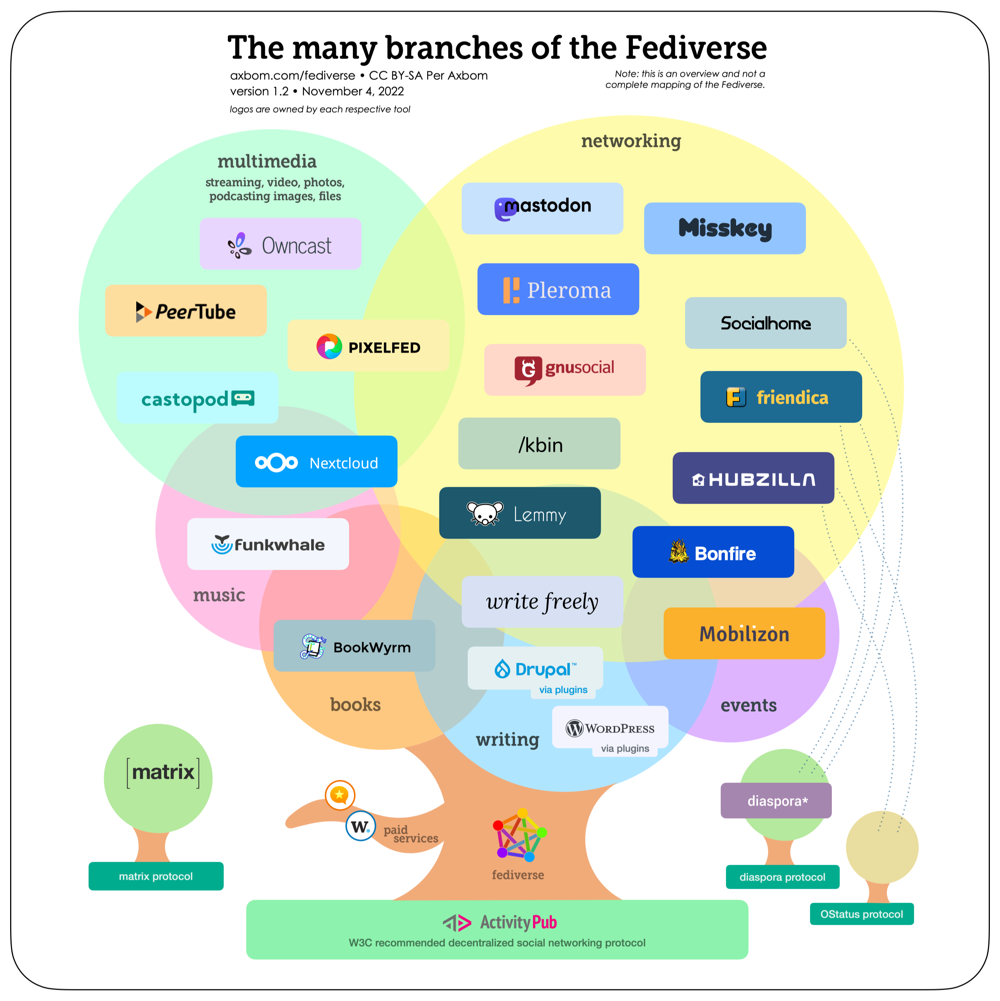
You may also hear Mastodon described as part of the “Fediverse,” or an interconnected web of various social media services. You know how having a Twitter account doesn’t mean you can use that account on Instagram? Through the Fediverse, your single Mastodon account also grants you access to other decentralized social networks, if that interests you.

You may also see Mastodon’s equivalent of tweets being referred to as “toots,” but this is fading out of favor (since it’s kind of silly!). Many people are just calling them “posts” these days, but “toot” is often found referenced in older third-party clients.

Mastodon supports a number of Twitter conventions like replies, retweets, favorites, bookmarks and hashtags. But its retweets are called “boosts” and it doesn’t support the concept of quote tweets. This was an intentional choice on the part of the founder who said it encourages speaking “at your audience” instead of “with the person you’re talking to.”

In addition, Mastodon lists work slightly differently from Twitter as you can only add people to a list if you’re already following them. And Direct messages on Mastodon are just @username posts, not private messages coming to a DM inbox. 

What does it mean that Mastodon is open source?

Anyone can download, modify and install Mastodon on their own server — plus, the developers of the platform don’t own the copyright.

That doesn’t mean that you can grab Mastodon’s code without acknowledging the source, though. Former President Donald Trump’s social media platform, Truth Social, initially launched with Mastodon code and passed it off as if it were original software. Mastodon did not take kindly to that.

How do you create a Mastodon account?

When you arrive on the Mastodon website, you can click a button called “create account,” which directs you to a page listing servers to choose from. You can filter these by various factors, like region, language, topic, sign-up speed and more. There, find a server that piques your interest and join — if it’s a server that requires you to be approved, you might need to wait a bit. From there, you can start finding people to follow, regardless of whether they’re registered via your same server.

In effort to minimize confusion on new users picking a server, Mastodon announced it is making it easier to create an account. Now, when you go to sign up, it will give an easy option to create an account on mastodon.social instead of choosing a server.

How do you decide which Mastodon server to join?

Mastodon’s website has helpful resources — but it’s still a bit overwhelming and challenging to find a home base that aligns with your interests. Ask friends who are already on Mastodon if they have suggestions! Or just join somewhere random, because you can always change your server affiliation later once you get into the swing of things.

Can you talk to people on other Mastodon servers besides your own?

Yes, you can follow people outside of your local server and reply to their posts. However, when you want to follow someone on a different server, you have to enter their username in the search box on your server to find them first, then follow them. You can’t just go to their profile and click the follow button as you would on Twitter.

What’s the difference between the Home, Local and Federated timelines?

Your Home timeline shows you posts from people that you follow, similar to Twitter. The Local timeline shows posts from all users in your server, while the Federated timeline shows you all public posts from users that people in your server follow. (Hint: You can turn on “Slow Mode” in Preferences –> Appearance to hide timeline updates behind a click if things are coming at you too fast!)

What is Mastodon’s moderation policy?

Individual server admins set their own moderation policies, so you should read the policy on the server you choose to ensure it matches up with your values.

What are the drawbacks of Mastodon when compared with Twitter?

Mastodon’s user base is a fraction of a percentage of the size of Twitter’s user base. It’s also far less intuitive to navigate, since it hasn’t been designed for a massive global audience like Twitter. That could change in time as more developers join the project in the wake of the Twitter takeover.

What are the benefits of Mastodon compared with Twitter?

Well, for one thing, Mastodon is not owned by Elon Musk. But in all seriousness, it’s going to be difficult in the near-term for Mastodon to replicate the same “watercooler of the world” vibe that Twitter is defined by. Some users might prefer Mastodon to Twitter, though, as it’s more customizable by nature. Unlike Twitter, individual communities have different content guidelines, which provide a variety of different user experiences. And while the user base on Mastodon is smaller, this can lead to more personal and direct conversations, at times, compared with tweeting into the void, so to speak.

Is Mastodon safer than Twitter?

Mastodon is what you make of it. Due to its decentralized nature, if you are looking for a more controlled online experience, you can join a server with stricter guardrails against harassment. Some Mastodon features are also built with mitigating harassment in mind. For example, you can only search by hashtag, not by words that appear in a toot. So if you want your post to be discoverable, you can tag it — if you’d rather limit the audience, no one can find your tweet about the Red Sox by simply searching “red sox” if you haven’t tagged it.

However, a text-based search can surface the posts you’ve written, favorited, boosted or have been mentioned in, which can be useful.

The service has another handy feature that allows users to easily add a content warning to a post directly in the compose box. Some Mastodon users have been having fun with this lately by “warning” others their post would be about Twitter drama.

Can I post images and video?

As noted above, Mastodon supports many Twitter conventions, but its support for media is more limited. Where Twitter supports a variety of media and other data appended to tweets, including its audio-only social “Spaces,” plus photos, video, GIFs, polls, precise location and experimental “Status” tags, Mastodon simply supports images, videos, audio and polls.

You can add up to four images to a post, up to eight megabytes in size. Video and audio can be any length, but with a file size limit of 40 megabytes.

Can I post privately to friends?

Similar to how Twitter now allows users to limit their tweets’ visibility through its Circle feature, Mastodon offers the ability to set your post’s privacy at the time of writing. Posts can be set to be public to be visible by all; unlisted to make them public but opted out of discovery features; only visible to your followers; or only visible to those users you’ve mentioned.

Can I post threads?

Yep! But this functionality isn’t built into Mastodon officially, as it now is on Twitter. Instead, you have to build threads the old-fashioned way — by replying to your own posts.

Can I get verified on Mastodon?

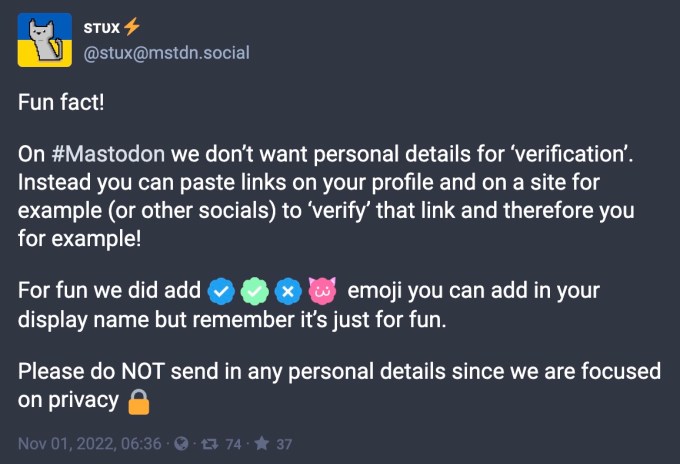
No. There’s no universal verification system like on Twitter. Some servers may vet their user sign-ups and you can self-verify, in a way, by adding links to your Mastodon profile that have a specific attribute (rel=”me”) in order to prove you are who you say you are.

Some servers are having fun with the idea of verification in a less-than-official fashion. For example, the mstdn.social server lets you add blue-and-white checkmarks and other emoji to your display name if you’d like, which make you look verified, even though these don’t mean anything. (Sort of like Twitter’s new verification system! But for free!)

Is Mastodon here to stay?

Mastodon is experiencing a massive influx of new users from Twitter, but it’s not clear the platform will continue growing at such a rapid rate in the weeks ahead. With now just one million users, Mastodon is far smaller than Twitter, which today counts over 237 million monetizable daily active users. Still, not all social networks are created equal, and you might find that you prefer tooting about TTRPGs in a dedicated server, as opposed to tweeting into a realm of madness. Or, you might find that this decentralized system is confusing, and you’ll just ride out the Muskening on Twitter. Choose your own adventure!

I’m not sure I want to leave Twitter. Can I cross-post from Twitter to Mastodon?

Yes, this is possible by way of third-party tools. These require you to authorize your account with Twitter and Mastodon and set up parameters. We’ve had success with Moa Party, which allows you to get specific as to which tweets or retweets are cross-posted. But other tools are available, including Mastodon Twitter Crossposter, which is also available here on GitHub.

Can I find my Twitter friends on Mastodon?

Yes, this is also possible with third-party tools. We’ve seen many Mastodon users trying out tools like Fedifinder, Twitodon and Debirdify, for example.

Will Mastodon work with Bluesky, the decentralized social network that Twitter co-founder Jack Dorsey is building?

Nope — not unless Bluesky chooses to adopt the ActivityPub protocol Mastodon uses. Currently, Bluesky is not planning to integrate with ActivityPub, having decided to build its own networking protocol, Bluesky, which will also be the name of the social networking app. There is some skepticism among the developer and open source community about whether or not Bluesky’s decision to go its own way is really about its own protocol’s advantages or if it’s more about producing a spec it could eventually control.


from TechCrunch